
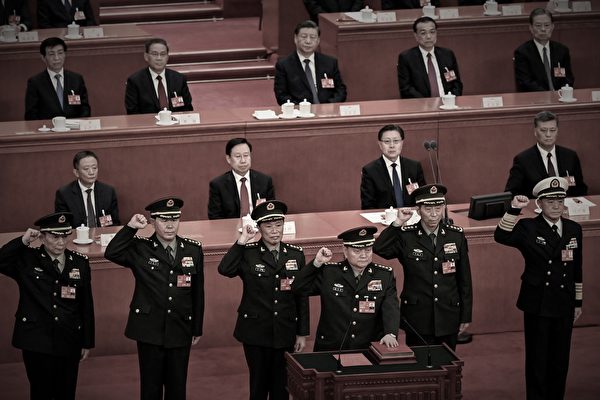
Chinese Communist Party (CCP) Vice Chairman of the Military Commission Zhang Youxia and Chief of the Joint Staff Department Liu Zhenli were officially announced to be under investigation, causing shockwaves within the military. Informed sources within the military disclosed to Epoch Times that Xi Jinping and senior military leaders had sharp disagreements on issues such as military affairs in the Taiwan Strait and pandemic response. Zhang and many active and retired military personnel privately criticized Xi Jinping for being “afraid of death” during the pandemic but still seeking re-election.
On January 24, the CCP’s Ministry of National Defense announced the investigation of Zhang and Liu, followed by an editorial in the “Military News,” which characterized Zhang and Liu’s actions as “seriously trampling and destroying the responsibility system of the Chairman of the Military Commission.”
This severe characterization is seen as a landmark event in recent years of high-level military purge. After the official announcement, discontent within the military resurfaced.
On January 29, military insider Shen Jianhui (pseudonym) told Epoch Times that the conflict between Zhang Youxia and Xi Jinping was not sudden but a result of long-term accumulation. During the COVID-19 pandemic in mainland China, dissatisfaction among the top military leadership towards Xi Jinping reached its peak.
According to the insider, Zhang and many military leaders, both active and retired, strongly criticized Xi for avoiding risks and not being on the front lines, believing that he was “afraid of death” but still seeking re-election.
Shen Jianhui pointed out that during the pandemic, Xi Jinping never truly visited the front lines. The only time he supposedly inspected a military hospital was through a video link in a large hall, while the real medical staff were working in other areas. This practice caused widespread resentment within the military.
“Not only active-duty military personnel, but also retired personnel and military families would criticize him during gatherings: What kind of state has he turned the country into?” he said.
Zhang Youxia adopted an extremely passive response during the pandemic. Shen Jianhui cited information from military insiders saying that Zhang intentionally acted unwell and lackluster when receiving visitors, but immediately returned to normal after the visitors left, clearly showing non-compliance with top-level directives. After the pandemic ended, Zhang resumed his duties normally, indicating no substantial health issues.
Shen Jianhui pointed out that the core conflict between Zhang and Xi Jinping focused on the Taiwan issue. Zhang and most senior officers within the system opposed using force against Taiwan.
High-ranking military officials generally believe that actual combat would result in serious casualties and equipment losses: “You could lose an entire branch that you’ve worked so hard to build in one fell swoop.” They argue that during peacetime, military exercises can demonstrate strength, but the risks and costs of actual combat are entirely different.
Shen Jianhui analyzed that Xi Jinping’s motivation to push for the reunification with Taiwan through force was to solidify his personal power: “He simply can’t afford to step down now, because once he does, all the corruption issues within his family will come to light.”
Insiders believe that Xi Jinping is worried about facing political purges if he loses power, thus he needs to enhance his ruling legitimacy by achieving significant political achievements such as unifying Taiwan.
Regarding the issue of military corruption, Shen Jianhui revealed a more complex background. He stated that the buying and selling of ranks within the military used to be widespread, making it difficult for senior officers like Zhang Youxia to rise in ranks without participating in such activities.
“Some lieutenant generals failed to be promoted to general because they refused to pay bribes, and even the son of a major general like Su Yu couldn’t advance to lieutenant general by avoiding bribery,” he noted.
However, insiders believe that the current anti-corruption campaign has evolved into a political tool for struggles. Xi Jinping selectively labels officers who he finds unfavorable as corrupt, while the systemic responsibility for military corruption should be shouldered by the highest levels.
Shen Jianhui particularly refuted foreign media reports about Zhang Youxia leaking military intelligence to the United States as “completely groundless,” aiming to create public opinion pressure on the military and create an illusion that the military is under control.
This insider stated that the final outcome of the current situation remains unclear. He believes that as long as the investigated military personnel have not been executed, there is still a possibility of a turnaround: “As long as they are alive, there is always hope for a reversal.” This stance suggests a wait-and-see attitude within the military towards the outcome of the current political struggle, indicating that variables still exist within the power structure.
With the news of Zhang Youxia and Liu Zhenli being under investigation made public, the reaction of the military and local forces has become a focus of attention.
Former Beijing lawyer and independent scholar Lai Jianping, in an interview with Epoch Times on January 29, pointed out that there has been an unusual collective “silence” from the CCP military and local forces following Zhang Youxia’s investigation, contrasting sharply with the public responses in the past after high-ranking officials were investigated.
Lai Jianping believes that the political and disruptive nature of the Zhang Youxia case is approaching the historical level of “dealing with Lin Biao during Mao Zedong’s era.” Zhang Youxia had long been at the core of military power with a position of “above one person, below ten thousand,” and had a close relationship and long-term political trust with Xi Jinping. His investigation could not be simply attributed to corruption but is more in line with high-level political struggles or power reshuffling.
In this context, the military and various institutions are not demonstrating the usual political mobilization of “rushing to demonstrate loyalty and draw clear boundaries.” Instead, an overall attitude of observation or even silence is prevailing. This abnormal silence reflects widespread doubts within the system about the nature of the investigations and highlights the high instability of the current power structure.
Lai Jianping analyzed that this unprecedented phenomenon sends multiple signals:
Firstly, some individuals within the system are dissatisfied with the political legitimacy of the investigations, realizing that it is not purely a legal issue.
Secondly, some are concerned that the situation has not yet stabilized, and the possibility of a reversal remains uncertain, so they choose not to take sides temporarily.
Thirdly, many people have a “fearful” mindset, believing that if someone like Zhang Youxia can be targeted, they themselves could easily become victims of the power struggle, lacking the motivation to openly express their stance.
Lai Jianping pointed out that this widespread caution and silence indicate that Xi Jinping’s actions have not received an “overwhelming, unqualified loyal response” within the system, but have instead triggered widespread suspicion and watchful sentiment. This is a “very clear and very dangerous political signal,” showing a decrease in the cohesion of power centers and the emergence of cracks in political trust.
The deep-rooted reasons behind the extensive purging of the CCP military this time are becoming clearer with external analysis and evaluations.
A recent report from the American defense policy think tank, the Jamestown Foundation, pointed out that the purge in the Chinese military is not just an anti-corruption campaign but stems from disagreements between figures like Zhang Youxia and Xi Jinping in military policy. Zhang’s push for joint combat training schedules did not align with Xi’s requirement to have the capability to attack Taiwan by 2027, which was seen as resistance and non-compliance with directives.
The report suggests that with the commencement of the last annual training cycle before 2027 in January of this year, disagreements have escalated from planning debates to direct non-compliance in execution, posing a significant threat to Xi Jinping’s authority. The investigations of Zhang Youxia and Liu Zhenli reflect Xi Jinping’s strengthening of personal absolute control over the military through purges, prioritizing political loyalty over professional competence. Although this may exacerbate internal instability, it does not change the timetable for Taiwan in 2027.
Previously, multiple sources disclosed to Epoch Times that in several internal meetings, Zhang Youxia explicitly opposed immediate military action, pointing out that Taiwan’s defense system ranks just below Israel and above Ukraine, and suggesting a high possibility of intervention by the US, Japan, Australia, and the “Five Eyes Alliance.” Should they fail to quickly defeat Taiwan, it would lead to domestic turmoil, and the current manpower and logistics of the CCP military would struggle to sustain a prolonged conflict. Zhang advocated for stabilizing the situation, avoiding initiating a conflict amid economic downturn and diplomatic isolation, a stance viewed by Xi Jinping as “shaking military morale.”
Lai Jianping believes that the “silence” following the investigation of Zhang Youxia does not mean that the situation has stabilized; on the contrary, it reflects a high degree of uncertainty and deep anxiety within the system. The future evolution of the situation will depend on the further direction of power struggles and the actual control ability of the top leadership, making it difficult to draw conclusions at present.