
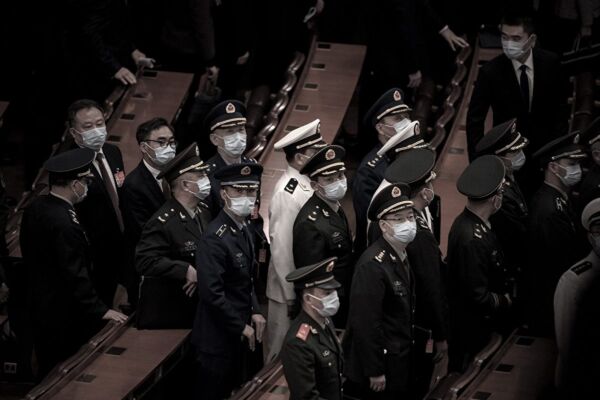
On January 24, Vice Chairman of the Central Military Commission of the Chinese Communist Party Zhang Youxia and Chief of Staff of the Joint Staff Department Liu Zhenli were announced to be under investigation by the authorities, leading to increased turmoil within the military. A retired officer from the 31st Group Army of the Chinese Communist Party disclosed to the public that after Zhang Youxia’s arrest, the military was thrown into chaos with senior officers at the regimental level and above submitting resignation reports. There were whispers within the military suggesting a power struggle between the political work system and the military command system.
The current situation within the military is described as a “pre-war silence,” presenting Xi Jinping with the most significant crisis within the military since he came into power. The disclosure was made by a military commentator and host of “True Perspective,” Zhen Fei, on January 29. The whistleblower was a former cadre of the 31st Group Army, where Miao Hua and He Weidong were also stationed. The whistleblower had frequent contact with Miao Hua and He Weidong before their relocation to Beijing, thus possessing valuable insights into the internal dynamics of the military.
Zhen Fei emphasized the credibility of the information as it directly originated from the individuals involved, making it a valuable reference for understanding the opaque political dynamics within the Chinese Communist Party and predicting the trajectory of current events. The officer continues to provide Zhen Fei with the latest developments within the Chinese Communist Party’s military, as the repercussions of the Zhang Youxia case unfold, revealing the true colors of the military’s internal conditions and power struggles.
The officer revealed that a common phrase circulating inside the Chinese Communist Party’s military is, “Are you the propaganda officer of the regiment?” This phrase is derived from the TV series “The Wreath Under the High Mountain,” where the character Zhao Mengsheng, a propaganda officer, is portrayed as a privileged individual who advances through connections rather than competence, creating a stark contrast with true military commanders.
This coded phrase holds three layers of meaning: firstly, it critiques the status of political officers, suggesting that they rely on connections and are looked down upon; secondly, it implies a temporary role with no real commitment to fighting; and thirdly, it alludes to betrayal as depicted in the series – where genuine military commanders sacrifice themselves while the political officers take credit for their achievements.
The officer explained that this phrase effectively serves to discern one’s allegiances: are you siding with Xi Jinping and Zhang Shengmin, or with the veteran military leader Zhang Youxia? Simultaneously, it questions one’s loyalty: are you a traitor?
According to the officer, Zhang Shengmin started his career as a propaganda officer at the grassroots level due to his writing skills and ability to compose lyrics, which were valued traits. However, after entering the Rocket Force, his relationships within the military were weak, and he was not well-received among his peers.
Xi Jinping is currently facing the most significant military crisis since taking office, as orders cannot be effectively conveyed to various military regions, and even if they are, there is a lack of compliance. The complete silence from all military regions for several days indicates a severe problem. In the past, once an order was issued, the entire military would immediately rally to “firmly support Chairman Xi’s decisions,” but there has been no movement so far.
Xi Jinping is now forced to rely on Zhang Shengmin. As military personnel, Zhang Youxia and Liu Zhenli’s “mistakes” should have been handled by the Military Discipline Commission. As the head of the Military Discipline Commission, Zhang Shengmin is obliged to oversee this task. Even if there were other options, Xi Jinping currently has no one else to turn to. If local discipline commissions were to intervene, they would not be well-received by the military, which has its own ways of dealing with them.
However, Zhang Shengmin may not have the courage to visit various military regions. The officer analyzed that anyone with a bit of sense would understand that this situation would only lead to trouble and would not end well. Essentially, by attempting to resolve the issue this way, Xi Jinping has set Zhang Shengmin up for failure. It is entirely possible that if Zhang Shengmin were to visit certain military regions, a disgruntled commander could retaliate, maybe even resorting to violence, and it would be decisive and clean, using means outside official military channels.
The officer further disclosed that Zhang Shengmin has now resigned from his position as the Secretary of the Discipline Inspection Commission.
The Chinese Ministry of National Defense officially announced the downfall of Zhang Youxia and Liu Zhenli on January 24, followed by an editorial in the “People’s Liberation Army Daily” which harshly characterized the two as committing “serious” violations, including “seriously trampling on and damaging the Chairman of the Military Commission’s authority.” Xinhua quickly echoed the editorial from the military newspaper.
After the official announcement of Zhang Youxia’s case by the Ministry of National Defense, Xinhua’s quick dissemination of the “People’s Liberation Army Daily” editorial caused significant backlash within the military.
The officer explained that the process of writing, reviewing, and approving the editorial was complex and required successive approvals from editors, chief editors, and the political work department. The swift response from Xinhua that evening after Zhang Youxia’s arrest indicated a high level of obedience to Xi Jinping’s directives, prompting immediate action.
In a twist of fate, the military blames the “People’s Liberation Army Daily” as the supreme commander, Zhang Youxia, was the one arrested. Coincidentally, the president of the “People’s Liberation Army Daily” also started his career as a propaganda officer, becoming the subject of ridicule with the phrase “Are you the propaganda officer of the regiment?” accusing him of being a traitor.
The officer believes that this situation reflects a consensus within the military that political officers are ineffective in warfare, only eager to take credit for themselves, which is mocked by insiders.
The overall state of the military is characterized by a “silence before action,” akin to the radio silence before a battle, bringing a sense of foreboding. This situation hints at preparations for imminent action — outwardly appearing calm, but once the time comes, all operations will commence.
The entire Chinese Communist Party’s military has now entered a state of heightened readiness. Within the military units, once in the highest state of readiness, there are response mechanisms in place for 24, 48, and 72-hour intervals, dictating what stage to advance to at specific time points. The officer speculates that January 30 will be a crucial juncture, possibly revealing new signs.
Regarding the circulating information online about the Eastern Theater Command and Western Theater Command forwarding notices from the Ministry of National Defense, the officer suggested that this could be a tactic to deceive – by posting such messages on entertainment platforms like Douyin, it can satisfy superiors’ inquiries while actually evading substantive responses, displaying a deceptive form of action. There are no indications from the respective military regions through their official newspapers or channels, as none of them dares to take the lead.
The officer emphasized the military’s strict adherence to hierarchy, with the army always holding the top position. Traditionally, the Chairman and Commanders of the Military Commission must come from army backgrounds, as the army plays a primary role in combat and defense, often bearing the heaviest casualties and holding the highest status and prestige. The navy and air force mainly serve in supportive roles. Toasting at gatherings of officers always begins with the army, a widely accepted norm.
Zhang Youxia’s army background has caused significant backlash within the military. Xi Jinping, by making such decisive moves despite his lack of military knowledge, has severely criticized Zhang Youxia without a chance for reconciliation. Moreover, Xi Jinping’s promotion of younger officers like He Weidong after taking office has fueled discontent within the military. Many senior generals have been patiently waiting for promotion, and if they are not promoted now, they may miss their chance. Zhang Youxia had planned to promote this group, which aimed to stabilize military morale; however, Xi Jinping completely overturned this practice.
The officer speculated that Zhang Youxia likely had plans in place well in advance. Since 2023, tensions between Zhang Youxia and Xi Jinping had been escalating, and it is improbable that Zhang Youxia did not prepare contingencies.