
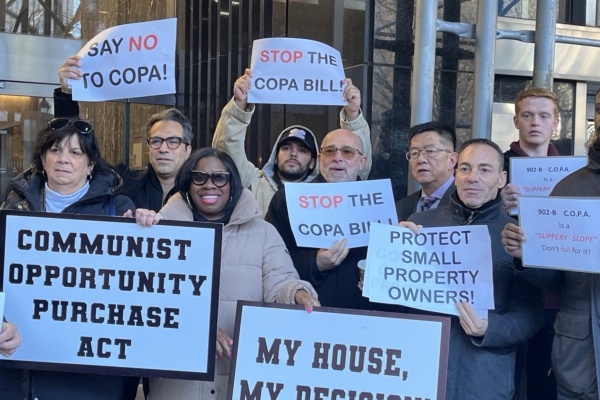
On December 18th, during the final full council meeting, the New York City Council passed the “Community Opportunity to Purchase Act” (COPA). On that day, several small property owners from immigrant communities, community representatives, and elected officials gathered outside City Hall holding signs with slogans like “My house, my rules”, “Stop the bill from passing”, and “Say no to socialism”, expressing strong discontent. They accused the bill of weakening private property rights, restricting intra-family property transactions, and potentially transferring control of some residential properties to government-approved non-profit organizations.
State Senator Chen Xueli emphasized at the scene that if COPA is passed, it will grant specific “community organizations” the right of first purchase for residential properties. In practice, this may prevent property owners from completing transactions directly based on the free market and family preferences when selling their properties. He questioned, “Is this still my house? Or does it already belong to the government?” and further inquired about how these empowered “community organizations” are defined, regulated, whether they are non-profit organizations supported by municipal or government funds, and who ultimately decides on resident eligibility and property use. Chen Xueli believes that the core controversy of COPA lies in limiting free trade and describes it as a “leftist, socialist agenda”.
State Assemblyman Zheng Yongjia criticized COPA for requiring property owners to give non-profit organizations time for evaluation and exercise of priority before engaging in open market transactions, fearing that it may cause delays and distort market mechanisms. He pointed out, “This bill almost replicates the model in San Francisco, which resulted in falling housing prices and a malfunctioning market.” Zheng Yongjia cautioned that if the government intervenes in residential transactions administratively, it may force some property owners to deliberately reduce the number of units to avoid negative impacts, further hindering housing supply.
Irving Lee, a Chinese small property owner from Queens, expressed in an interview that he believes COPA is essentially a system designed by housing laws to “transfer” property out of the hands of small and medium-income families, with an underlying “invisible controlling force” that steers policies unfavorable to private property rights.
Another Chinese property owner, Mr. Zheng, from 8th Avenue in Brooklyn, described the changes in the New York housing policy environment over the past decade based on his own experiences and family experiences. He pointed out that some policies objectively encourage tenants to refuse paying rent, delay taking responsibility, while pushing rising costs (such as taxes, water fees, insurance, etc.) back onto landlords, leading to decreased willingness of small landlords to invest. Mr. Zheng mentioned that his daughter encountered so-called “malicious tenants” just over two months after purchasing a property, with long-standing disputes significantly affecting his daughter’s mental and daily life.
Interviewed under the pseudonym Ziolet (also known as Zarku), a small property owner with multiple family units in Queens, expressed her concerns about not being able to pass on properties according to family plans. “What I fear is that one day I want to leave the house to my children, but cannot sell it to them and must sell it to certain non-profit organizations,” she said. “It’s our home, an asset we as a family have worked hard to build, yet it may no longer be decided by us.” In her view, COPA may centralize power between well-funded large institutions and opaque non-profit organizations supported by the government, while excluding small and medium-sized landlords and families from real decision-making.
At the gathering, some landlords expressed hope that Mayor Adams would veto this bill.