
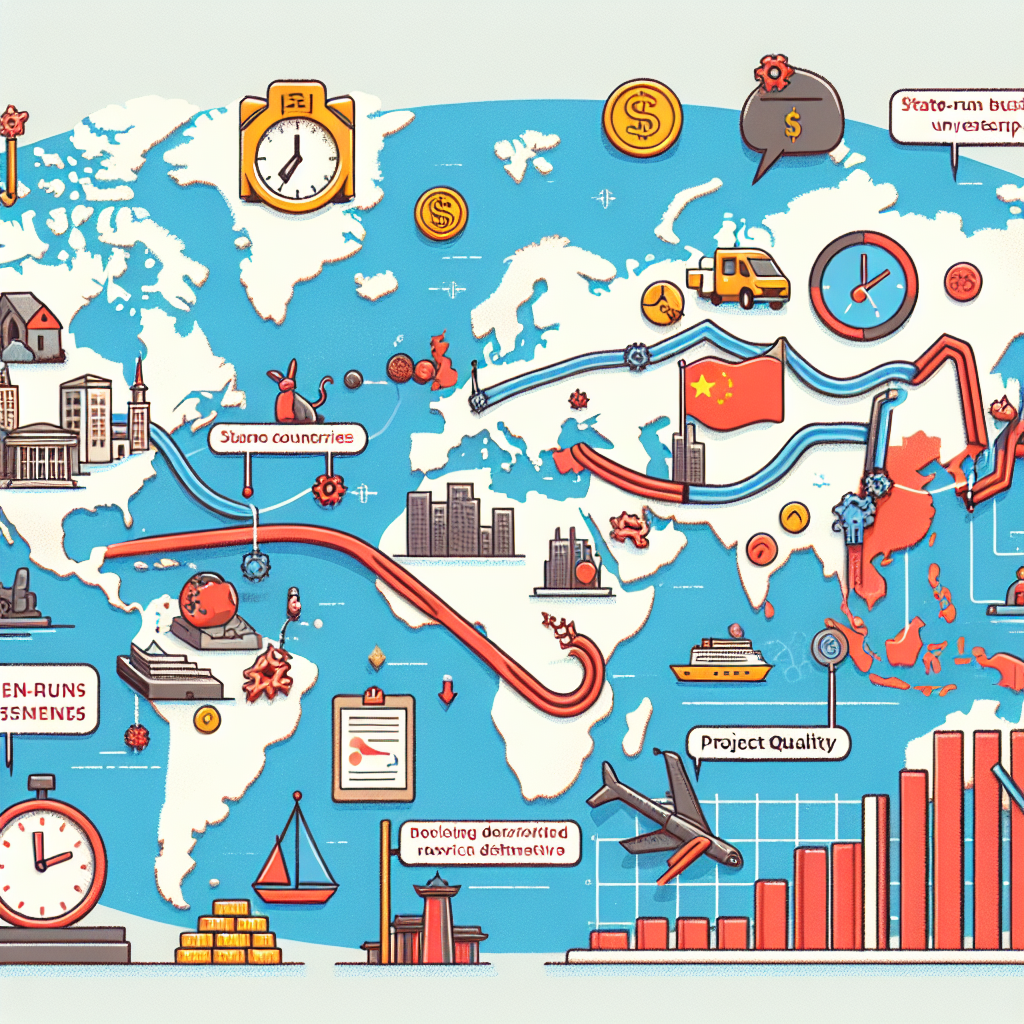
Despite the Chinese Communist Party’s claims of increasing investments in Belt and Road Initiative (BRI) countries, multiple countries have reported issues such as Chinese state-owned enterprises delaying salary payments and a decline in project quality. Experts point out that China’s economic downturn, debt pressure, credibility crisis, and changes in the international environment are weakening the sustainability of the Belt and Road Initiative.
“The China Fund News” recently quoted data from the Chinese Ministry of Commerce stating that from January to October 2025, Chinese enterprises’ non-financial direct investment in BRI countries reached 234.15 billion RMB, equivalent to 32.71 billion US dollars, up by 21.4% compared to the previous period.
Since Xi Jinping proposed the Belt and Road Initiative in 2013, according to data released by the China News Office, 47 central state-owned enterprises have participated, invested, or held shares in 1676 BRI projects, covering infrastructure, energy projects, and industrial infrastructure. These projects include the China-Russia, China-Kazakhstan, and China-Myanmar oil pipelines, as well as numerous thermal power plants, hydropower plants, and nuclear power station projects. Among them, energy state-owned enterprises have invested in over sixty energy projects in more than twenty countries along the Belt and Road.
However, with China’s domestic economy stagnating for a long time and state-owned enterprises burdened with high debt, reports of wage arrears in overseas BRI projects have continuously surfaced.
According to “Liberty Times,” statistics show that among the thousands of projects contracted by Chinese state-owned enterprises along the Belt and Road, at least 14 countries worldwide have reported instances of workers being owed wages, including Guinea, Cambodia, Tanzania, Belarus, Saudi Arabia, among others, with arrears ranging from several months to half a year.
The named companies include China Railway, China Construction, China National Petroleum, Sinopec, China Three Gorges Corporation, China Power Construction, China Metallurgical Group, China Communications Construction, and Shanxi Construction Investment.
At the same time, a report released by the non-profit organization China Labor Watch revealed instances of wage exploitation in BRI projects. A worker returning from Jordan stated that from December 2019 to April 2020, they only received six days’ worth of wages and lived in a high-temperature dormitory made of thin iron sheets in the desert.
In Algeria, a worker’s passport was confiscated, and they were paid only every six months over two years. After the contract expired, the employer refused to provide a ticket back home, demanding the worker to pay 28,000 yuan for the flight.
Taiwan’s National Defense and Security Research Institute researcher Shen Ming-shi expressed that the Belt and Road Initiative was initially based on a model of “China providing funding, state-owned enterprises undertaking construction,” rather than the “recipient country paying.”
“When China’s domestic debt is high and finances are tight, overseas projects are the first to be affected. Projects cannot be halted or workers laid off, leading to wage arrears. This situation has once again put the controversial Belt and Road Initiative under a credibility crisis,” Shen said.
Economic expert Huang Shi-cong from Taiwan added that while state-owned enterprises used to be profitable domestically and could “reciprocate overseas,” they are now facing salary cuts and layoffs at home. “If they cannot pay their employees domestically, it is even less likely for them to operate normally overseas. This continued hemorrhaging will eventually harm the state-owned enterprises themselves, leading to a vicious cycle.”
In addition to the recent wage arrears issues, the Belt and Road projects have long been criticized for poor construction quality and rampant corruption.
Looking at it from an investment return perspective, Huang Shi-cong pointed out that many Belt and Road projects, which are large in scale and have high technological requirements, may not necessarily meet the actual needs of the local areas. For instance, large-scale power plants and airports costing billions of dollars leave room for grey profits, making it easy for local governments and some state-owned enterprise executives to collude for profit, resulting in poor project quality, wage arrears, and other irregularities.
A recent example is the collapse of the National Audit Office building in Bangkok, Thailand, due to an earthquake in Myanmar on March 28, 2025. This was the only building that collapsed in Bangkok due to the earthquake, with China Railway Tenth Bureau being one of the contractors for the building.
Shen Ming-shi stated, “The Belt and Road Initiative has been forced to scale back due to ‘debt traps,’ but major ongoing projects face difficulties in being halted or modified, leading to cut corners, the use of substandard materials, and a decline in construction quality, which could result in significant casualties in the event of disasters like earthquakes.”
Regarding the corruption issues in Belt and Road projects, Shen Ming-shi believes that most projects are located in third-world countries, where corrupt practices between engineering companies and local officials go unnoticed by the general public.
He noted that Chinese companies often bring their usual tactics of coercion or improper means from the domestic market to overseas, severely eroding the integrity and administrative efficiency of the recipient country’s government, ultimately breeding distrust and resentment towards China in these countries.
Referring to the Hambantota Port in Sri Lanka as an example, Huang Shi-cong pointed out that it was initially expected to be a crucial stopping point for Chinese vessels but had to lease the port to China for 99 years due to debt issues, sparking strong domestic backlash. He said, “This model ultimately leads to a ‘double loss’: the recipient country may default, settle past debts, or stir up anti-China sentiments; meanwhile, China carries massive bad debts and international criticisms, with China often ending up as the one in trouble.”
In terms of the international political environment, Shen Ming-shi analyzed that China’s economic decline has led to a significant reduction in foreign aid, evident from the aid scale proposed at recent meetings like the Central Asian Summit.
He emphasized that while future aid plans can be adjusted, ongoing projects are difficult to terminate. As international organizations and countries’ trust in China declines, the Chinese Communist Party’s efforts to expand its influence in global southern countries are facing more significant resistance.
Huang Shi-cong further added that countries like the United States, United Kingdom, and Japan have begun introducing competitive cooperation plans against the Belt and Road. In the past, many countries almost exclusively cooperated with China, but alternatives like Japan have emerged.
He commented, “As the international situation becomes increasingly unfavorable towards the Chinese Communist Party, advancing the Belt and Road Initiative becomes even more challenging. This year’s significant reduction in funding for the project clearly indicates the significant impact of external environmental changes and China’s economic problems on the sustainability of the Belt and Road Initiative.”