
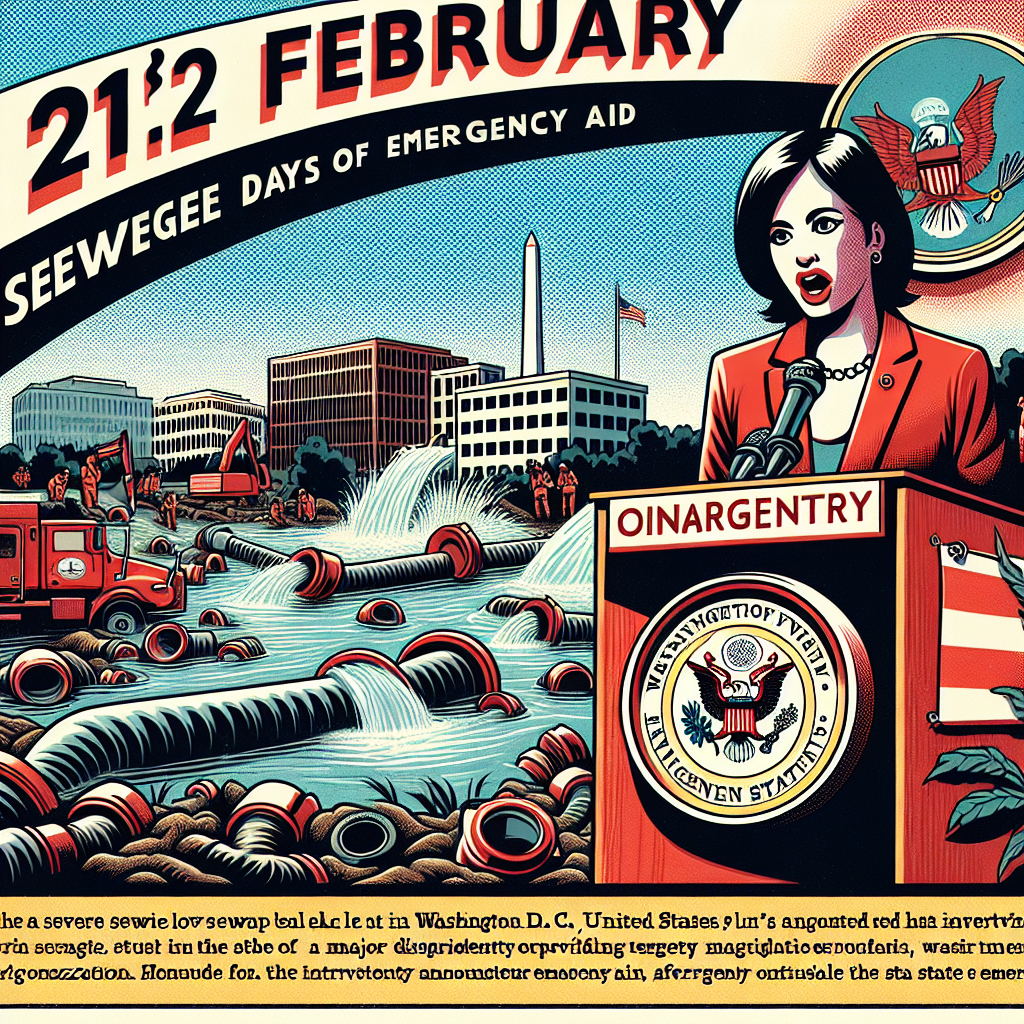
On Saturday, February 21st, the Federal Emergency Management Agency (FEMA) of the United States announced that President Trump had approved emergency aid for Washington, D.C. to address a severe sewage leak in the area.
Washington, D.C. Mayor Muriel Bowser declared a state of emergency on February 18th and requested disaster assistance from President Trump, along with asking the federal government to cover the costs incurred by the city due to the pipeline collapse.
Prior to approving this disaster request, Trump had strongly criticized the handling of the situation by the relevant authorities. He specifically called out Maryland’s Democratic Governor Wes Moore, accusing him of mismanagement and delayed seeking assistance.
During a dinner at the White House for governors of various states, Trump mentioned the sewage leak incident. He stated, “We have to clean up the mess left to us by Maryland and Virginia, and we are working on it.”
Maryland Governor Wes Moore fired back at Trump’s comments. He stated that the pipeline in question is on federal land and has been under federal government jurisdiction for over a century, therefore the federal government should bear full responsibility.
FEMA has stated that it will coordinate all disaster relief efforts and provide necessary equipment and resources, covering up to 75% of emergency protective costs to protect public health and safety.
However, it is worth noting that FEMA is part of the Department of Homeland Security (DHS), and Congress failed to pass a budget by the deadline on February 13th. Currently, the Department of Homeland Security is in a state of “department shutdown.”
The Potomac River pollution incident unfolded on January 19th when a 72-inch diameter Potomac Interceptor pipe ruptured. Within the first five days, at least 250 million gallons of untreated sewage flowed directly into the Potomac River in the northern part of the capital.
DC Water and the Environmental Protection Agency (EPA) immediately collaborated on emergency repairs, and by January 24th, a temporary bypass pipe was installed to redirect most of the sewage back into the system.
The leak situation is now largely under control, with authorities continuously monitoring the impact of the leak on the river’s ecosystem. However, complete pipeline repairs may still take several months. Officials also advise the public to avoid direct contact with the water when engaging in recreational activities in the Potomac River in the near future.