
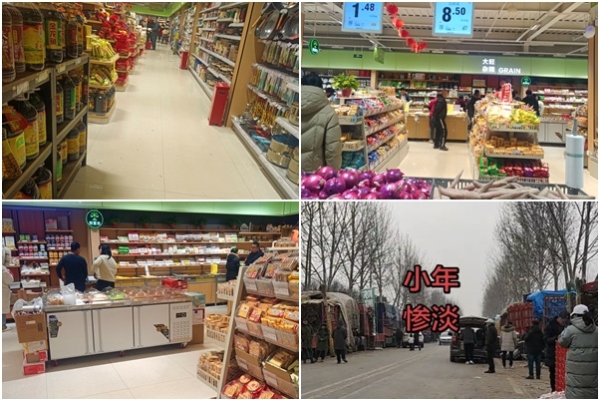
During this year’s Chinese New Year, interviewed people and businesses from various regions in China described this year’s festivities as unusually quiet. Streets were sparsely crowded, the purchasing of new year goods decreased, and even traditional customs like visiting relatives and friends and decorating with festive decorations seemed to have significantly faded. Some interviewees attributed this shift to economic pressures, declining population, and stricter controls on fireworks and firecrackers in various regions.
From rural villages in Hebei feeling like “ghost towns” to the bustling Wangfujing in Beijing being “sparse,” and the streets in Xi’an being “bare,” the collective image painted by interviewees from multiple places depicted a subdued atmosphere during this year’s Chinese New Year celebrations. The festive spirit was fading, foot traffic noticeably decreased, and a combination of “not consuming” and stricter bans on fireworks made the holiday feel “quiet and subdued.”
A business owner from Hebei, Qi Jian, expressed, “This year, the festive atmosphere is particularly, particularly light, especially light!”
In previous years, highways during the Spring Festival were often congested, but this year there were “few vehicles,” and even those traveling from other places to return home had reported seeing “hardly any cars” on the road.
“There used to be a lot of people shopping in malls before the New Year. But now, the crowd is nowhere to be seen,” one video circulating online showed that the community markets, especially during the Lunar New Year days, lacked the usual hustle and bustle.
“The crowded scenes from my childhood, where people would be shoulder to shoulder, are no longer there. Now, it’s so quiet that a car can pass through the whole street without any issue, as there are hardly any people around. The stall owners are saying that the business is becoming unsustainable.”
He mentioned that in the past, families would prepare large feasts for the Lunar New Year, with most households in Hebei preparing eight or ten dishes for the dinner, but now they’re making do with much fewer dishes.
The tradition of visiting friends and relatives has significantly reduced this year, with fewer people driving around to pay their respects. Qi Jian lamented, “The thousands of years of tradition surrounding Chinese New Year suddenly seems to have become insignificant.”
He reminisced about his childhood when the New Year was a time of joy for children playing and older folks being happy. “Now we can’t see anyone. It’s strange where everyone has gone. It’s really odd.”
He described standing on the main street of his village, feeling like he had stepped into a ghost town, with “an unusually quiet” atmosphere. There was hardly any laughter among neighbors, and the absence of the festive spirit gave a feeling of “everything disappearing.”
He specifically mentioned that the ban on fireworks further drained the festive atmosphere, making the whole village even quieter as if “everything disappeared.”
Behind the decrease in foot traffic during the New Year, Qi Jian attributed it to China’s annual birth rate being less than 8 million, resulting in a negative population growth.
The Chinese National Bureau of Statistics released data in January: in 2025, China’s birth rate was only 7.92 million, and by the end of the year, the national population stood at 1.405 billion, marking four consecutive years of negative growth.
Qi Jian doubted that the “7.92 million figure might be a virtual number.” With China facing a population crisis, authorities have been advocating for better childbirth policies. “If the relevant departments do not adjust the data upwards, you could say they are not doing enough, right?”
In Beijing, a resident named Xiao Lin told reporters that Beijing and surrounding areas were not allowing fireworks. “My friend came from Hebei and said that even in the rural areas there, fireworks are not allowed, very strict. It should be related to the current military instability.”
Xiao Lin observed that during New Year’s, the supermarkets and streets were basically devoid of people, with even fewer crowds at Wangfujing compared to previous years – it was particularly sparse.
He described the increased security measures this year, “Security during the New Year is definitely strict; this year, it’s even stricter than before. There are security guards and plainclothes police all over the streets, more than the usual pedestrians, which makes them stand out.”
Xiao Lin also mentioned, “Beijing is not very welcoming to people from other places. Many people have left,” and there have been several deaths of younger individuals in the villages, with some related to vaccines, further contributing to the quiet New Year streets.
“A few years ago, the streets used to be bustling as if trading in a market, but now you can hardly see a few people around. The pandemic has definitely claimed many lives, and there are a lot of unreported cases, especially in rural areas, where people die and no one knows how or why,” Xiao Lin added.
In Xi’an, a resident named Song Wen noticed the disappearance of visible festive decorations. “In the past few years, the streets were filled with lanterns… but this year, everything is bare, with nothing at all.”
Residents around him questioned, “Where’s the money?” to which Song Wen responded, “These lanterns are not meant for one-time use, right? They could be reused.”
With the absence of festival lanterns, the atmosphere for shopping also noticeably cooled off. Song Wen mentioned, “This year, fewer people are buying things anyway. There’s no New Year spirit around here; it’s as if everyone has just vanished. It’s eerily silent this year, as quiet as a cemetery with no lanterns, nothing at all.”
Many neighbors commented that even before the New Year, it felt like they had already celebrated, with the streets eerily empty.
Song Wen noted, “There’s a polarization; 80% of people are out of money.” People working cannot earn enough, and with car loans, house loans, and school fees piling up, they all just have to cut back on expenses wherever they can.
“Some privately owned businesses and shops have delayed paychecks for four to five months, some even longer without paychecks for half a year,” and employees dare not quit but endure it, hoping to at least receive their statutory benefits, which they rely on.
He described a cooling off in community consumption, with households in the past “bringing back a whole lamb” or buying pork starting from ten kilograms, but this year, “I haven’t seen anything of the sort,” even the vegetable vendors noticed an unusual trend, “Are people not eating vegetables anymore this year?”
In his community, he observed, “I don’t know why people aren’t spending money this year, rich or poor, no one is spending. A couple in my neighborhood receives over ten thousand in retirement pension every month. What can’t they afford to buy? They simply aren’t spending. It’s truly peculiar; this New Year is exceptionally eerie.”
A business owner from Shandong, Lin Jian, also mentioned a change in the way people are visiting to pay their respects during the New Year. He said, “There’s no festive atmosphere; it’s just a phone call to wish someone well… In the past, every household used to visit each other, adults would go around the streets greeting each other, but now it’s all quiet outside. Just making a phone call is considered a big deal.”
He described the desolate streets, which struck a chord with small business owners, “Those of us who had morning business before had a lot of people coming in and out. But now, by 9 o’clock, you hardly see anyone around.”
Lin Jian also touched on the exodus of people and the decline of villages, “Those with capabilities have all left… the entire village is disappearing, there’s no one left… those houses are collapsing. The population is dwindling.”
He summarized his own experience as a sharp decline, “It used to be thriving, but now it’s declining rapidly, making people cry over the New Year.”
Discussing another key factor contributing to the fading New Year joy, Qi Jian from Hebei again pointed to the strict control over fireworks.
He told reporters, “This year in Hebei, the ban on fireworks is enforced strictly, so the festive atmosphere has become even more subdued. Nobody is allowed… It’s even more rigid than the ban in previous years, and I don’t know why.”
In the past, even when bans were in place, they were more of a formality, but this year it was especially strict, with New Year’s Eve being “quiet and subdued,” and there were indeed people “detained or taken away. It’s real, all because of setting off firecrackers.”
Qi Jian described how officials at various levels from the county to the village were conducting patrols and checks, with “all village cadres… on duty,” and volunteers conducting frequent inspections.
He speculated that the controls in Hebei, close to Beijing, were stricter than elsewhere. Authorities feared that by allowing firecrackers, the noise could disguise gunshots, which led to more stringent measures.
Additionally, he mentioned a growing “collective anxiety” and discontent among the public, prompting authorities to enhance controls over “knives, firearms, firecrackers, explosives,” and other items.
Being within the country, but having access to reports from overseas media, Qi Jian had a more comprehensive understanding of the overall situation, which further strengthened his belief in the need to cut down on spending and engage in less active consumption. The once common New Year customs of wearing new clothes, enjoying a sumptuous dinner, and setting off firecrackers, which had been part of the tradition for thousands of years, now seemed like “luxury.” He felt a heavy burden with these customs turning into “unattainable” desires.
During the interview, he mentioned the incident of the “yellow lanterns,” possibly motivated by superstition, which sparked public controversy in several Chinese cities. Netizens criticized them, saying they looked like “mourning halls” or scenes from a horror movie, leading officials to swiftly remove them after facing ridicule.
Qi Jian drew connections to the abnormal phenomenon of abnormal groundwater surging in cities like Jinan, Zhengzhou, and Hebei, which he found inexplicable through science, attributing it to “a celestial warning.”
“Heaven may not speak, but it will issue warnings in this way to mankind, indicating possible disasters. People are speaking the harsh truth, suffering is unbearable, truly unbearable, it’s so distressing!”
(For safety reasons, all interviewees use pseudonyms).