
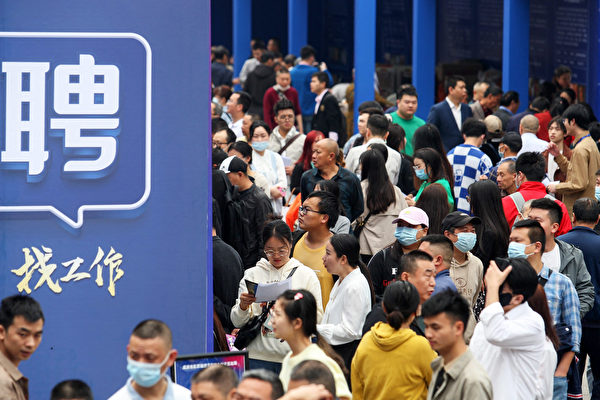
In the midst of economic recession and an increasingly challenging job market, young people in China are no longer seeking prestigious, stable, and upwardly mobile careers. Instead, they yearn for a job that can guarantee basic security and survival – a “normal job.” However, even this basic requirement has become an unattainable luxury.
According to a report by “Sanlian Life Weekly,” in 2025, the employment environment in China further deteriorated. Many young people, despite working diligently and dedicating all their time to work, some even going without a day off for a month, others frequently working “996” (starting work at 9 a.m. and finishing at 9 p.m., six days a week), and even civil servants often having to work until 11 p.m. regularly. The situation is exemplified by an employee at a leading internet company who returned from maternity leave only to embark on consecutive business trips, leaving no time to care for their newborn. Disappointingly, their year-end bonus did not meet expectations, leaving them feeling disillusioned.
In this scenario, senior career planner Lu Yang (alias) observed that the expectations of young people from the “Z generation” have significantly shifted compared to the “post-80s” and “post-90s” generations. They no longer focus on organizational development visions but prioritize personal growth in skills. They are less interested in the prestige of large companies and platforms but highly value fair compensation. Rather than bold leadership and innovation, they crave respect and a healthy, positive work environment.
The “2025 China Annual Best Employer Selection Report” released by Zhilian Recruitment at the end of December 2025 showed that for university students, the highest-ranked factors defining a good job were salary and benefits security, career growth and development, and employment relationship stability.
The report pointed out that young people’s workplace needs have reverted to the most basic “security and survival” requirements. When these fundamental needs are not met, resignation or complete withdrawal from the work environment becomes one of the choices for many young people. On mainland Chinese social media, “work” is often labeled as “meaningless,” with “lying flat” and “waiting for retirement” becoming the ultimate career expectations for many young people.
The report mentioned that over the past 20 years, foreign companies, emerging internet firms, and small and medium-sized startups have been seen as representatives of “good jobs” because they fueled the young generation’s need for self-realization at work. However, as economic conditions fluctuate and industries undergo upheavals, young people’s pursuit of self-meaning is severely thwarted. They no longer aspire to a “good job” but simply desire a well-rounded “normal job” that does not require continuous overtime, ensures regular payment of salaries, provides reasonable annual and sick leave, fosters healthy colleague relationships, and offers opportunities for newcomers to learn.
Nevertheless, the report also cited experts’ views that even such a “normal job” is exceedingly rare in today’s China.