
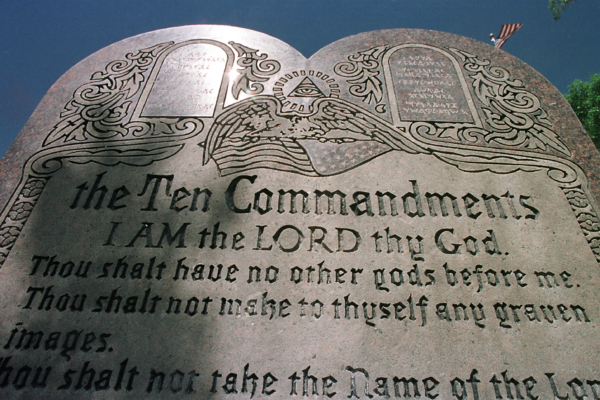
On Friday, February 20th, the United States Appeals Court overturned a decision by the Federal District Court and reinstated Louisiana’s law requiring public school classrooms to display the Ten Commandments.
Louisiana mandates that public school classrooms must display the Ten Commandments. The law was officially enacted in 2024, sparking lawsuits from some parents who argued it violated the First Amendment of the US Constitution regarding the “free exercise clause” and the “establishment clause” (principle of separation of church and state). The plaintiffs strongly opposed the law, accusing it of “unconstitutionally compelling students to participate in religious activities.”
Previously, the Federal District Court had blocked the law, and a three-judge panel of the Fifth Circuit Appeals Court upheld the original decision in June of last year. Subsequently, the Fifth Circuit Appeals Court agreed to rehear the case with all 18 judges sitting en banc.
During the en banc rehearing, the majority of judges did not directly address the constitutional dispute regarding the First Amendment but ruled the lawsuit as “not ripe,” meaning it had not reached a stage suitable for litigation. In an unsigned court opinion, the judges noted there were still too many unknowns about how the law mandating the display of the Ten Commandments would be implemented.
The court opinion stated, “For example, we do not know how prominently the display of the Ten Commandments will be, whether it will be accompanied by other teaching materials, or how teachers will reference these contents during instruction.” The court further added that merely posting displays did not cause any specific harm to the plaintiffs, and any potential future harm was speculative.
The judges also emphasized that such decisions went beyond judicial functions. It was not a judgment but rather speculation. Once the law officially goes into effect, the plaintiffs can again challenge its legality.
Circuit Judge James Ho concurred with the majority opinion. He added that based on the substantive content of the law, he would also support it. In the educational environment at the country’s founding, the application of religion was much freer than it is now.
He wrote, “To the founding fathers of the United States, religious belief was a core element in cultivating ‘good citizens.’ Therefore, the use of religion in early American education was more prevalent than it is now. One of the most popular educational textbooks at the time, ‘New England Primer,’ contained a significant amount of religious material, including poems, prayers, and a curriculum on the Ten Commandments.”
Four judges in the panel held a different opinion, arguing that the law violated a Supreme Court ruling in 1980 in the case of Stone v. Graham, where the Supreme Court invalidated a similar Ten Commandments law in Kentucky.
Circuit Judge James Dennis wrote in a dissenting opinion, “The state government permanently displaying this text in public school classrooms, not for curricular or instructional purposes, amounts to elevating texts originally intended for faith into objects of veneration, exposing children in a compulsory education environment to government-approved religion. This is precisely what the framers of the Constitution foresaw and sought to prevent (establishment of religion).”
However, the majority opinion rebutted this precedent, stating that the principles of that ruling had been overturned in the 2022 decision of Kennedy v. Bremerton School District. The Supreme Court ruled that the dismissal of a high school American football coach for silently praying at the center of the field after a game, without compelling students to join him in prayer, was incorrect.
The Appeals Court ruling on Louisiana’s Ten Commandments law has stirred debate and highlighted the complexities of balancing religious freedom and the separation of church and state in public institutions. The decision underscores the ongoing legal battles over the display of religious symbols in government settings and the interpretation of the constitutional rights pertaining to religious expression in the public sphere.