
【Epoch Times – February 22, 2026】 Approximately 2 million Chinese Communist troops had successively entered North Korea for battle. After suffering heavy losses, they dared only to claim a draw with the 300,000 American troops and United Nations forces, while internally, they falsely claimed victory. From the arrogant surprise attack at the beginning to being pinned down at the 38th parallel, being left stunned time and time again, simplifying the battles of the Korean War still holds real significance.
Chinese Communist troops made a final frenzy on the Korean battlefield – how they were left stunned in the Korean battlefield (Part 22)
On June 15, 1953, all agenda items of the Korean armistice negotiations were agreed upon, and the military demarcation line based on actual control by both sides was mostly finalized. However, the Chinese Communist Party deliberately delayed signing the armistice agreement and launched a final massive battle, attacking the Jinju salient held by South Korean forces, resulting in heavy casualties.
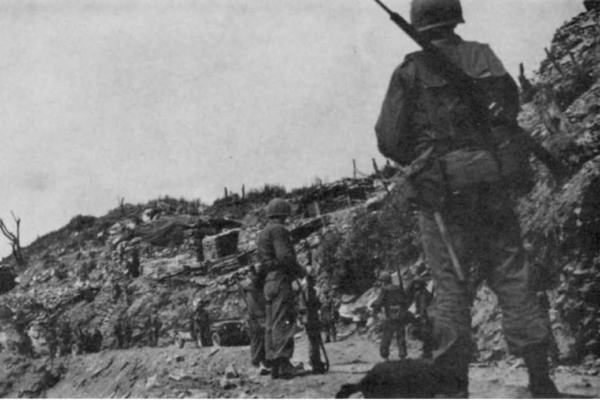
Chinese Communist troops once again attacked Pork Chop Hill and several UN frontline positions and outposts, sacrificing more Chinese soldiers for the lives of some UN soldiers.
This is the basic truth of the Korean War – the limited combat effectiveness of the Chinese Communist troops. Although their manpower in Korea in 1953 reached at least 1.35 million, far exceeding the UN forces, they were unable to break the stalemate on the battlefield.
Mao Zedong’s order to drive the UN forces out of the Korean Peninsula was never fulfilled, and Chinese Communist military leaders found it difficult to comply. They had no choice but to sacrifice the lives of more soldiers to compete with the UN forces, and their final frenzy seemed more like a helpless venting of anger.
The Chinese Communist Party’s madness did not yield any negotiating chips at the table. In the end, they had to accept the UN forces’ insistence on the principle of voluntary repatriation of prisoners of war.
Between May and July 1953, Chinese Communist troops launched a series of final offensives in the Korean War, resulting in 124,912 casualties on their side in exchange for 60,360 casualties in the UN forces.
On July 27, 1953, the Korean Armistice Agreement was signed at Panmunjom and went into effect at 22:00 the same day. Both sides withdrew 2 kilometers from the actual control line, established a non-military buffer zone, and ceased all hostile actions.
The Chinese Communists either claimed victory in the Korean War or boasted of a “draw” with the American forces. More laughable was North Korea, which initiated the war, also claimed victory in the conflict.
According to Chinese Communist archives, approximately 73% of infantry, 67% of artillery, 100% of armored units, and 52% of the air force of the Chinese Communist troops had participated in the Korean War. Additionally, there were over 600,000 civilian laborers, totaling over 3 million people. Despite mobilizing the nation’s resources and manpower, for most of the war, the Chinese Communist troops could only stand in a stalemate against the UN forces. Behind the so-called “draw” lay the spirits of innocent soldiers who perished and were disabled several times over.
In 2014, the Chinese Communist Party once again revised the number of casualties during the Korean War to 197,653; public records showed treatment for 838,417 individuals, with 383,218 of them being severely injured. The Chinese Communist troops employed human wave tactics against the UN forces’ airstrikes and intense artillery fire, resulting in much higher casualties. In addition to lacking an effective system for evacuating wounded soldiers as the American forces did, the Chinese troops often could not receive timely medical treatment. Even if able to survive, the likelihood of disability in the end was significantly higher.
The US estimates indicated that Chinese Communist military casualties exceeded 400,000, with 486,000 wounded and 21,839 taken as prisoners. Encyclopedia Britannica published figures indicating 600,000 casualties or missing in action, 716,000 wounded from the Chinese Communist troops.
Former Chinese Communist Navy Lieutenant Colonel Yao Cheng revealed that official records he had seen noted 390,000 Chinese Communist military casualties, with over a million injured or missing.
US statistics show that 33,686 perished in combat, 7,586 went missing or were captured, and an additional 2,830 died non-combat deaths. Combat injuries were recorded at 103,284.
Between 1950 and 1953, 34% to 43% of the annual government budget was used by the Chinese Communist Party for the Korean War, further depleting the nation’s resources and accruing massive additional debts to the Soviet Union. The Korean War was the largest foreign invasion war conducted by the Chinese Communist troops. Although they briefly infiltrated South Korea, they ultimately failed to move past the 38th parallel.
The various propaganda efforts by the Chinese Communist Party predominantly portrayed an anti-American sentiment, fabricating a series of battle scenarios to cover up their lack of combat capabilities, incompetence of their commanders, and faulty decisions at the top echelons. They deliberately avoided disclosing the actual losses incurred in the war.
One of the major reasons why the Chinese Communist Party prolonged the Korean War for at least two more years was their refusal to accept the voluntary repatriation principle for prisoners of war, insisting on the forced repatriation of all Chinese Communist troops captured by the UN forces. However, after Stalin’s death, the Soviet Union demanded concessions from the Chinese Communists. Reluctant to comply, the top Chinese Communist officials extended the war in an attempt to push the UN forces to yield, but ultimately failed to achieve their goal.
During the final Chinese Communist military actions between May and July 1953, a toll of 124,912 casualties was paid, vastly surpassing the number of prisoners of war at 21,839.
On August 5, 1953, the exchange of prisoners of war between the two sides commenced. Of the Chinese Communist troops held by the UN forces, only 7,110 agreed to return to mainland China, while 14,190 chose not to. Two-thirds of them refused to be subject to the Chinese Communist Party’s rule, severely humiliating the Party.
What added to the humiliation was that the Korean authorities did not truly thank the Chinese Communists; instead, they urged the swift departure of the Chinese military forces. On October 26, 1958, the last Chinese Communist unit left Korea.
The over 7,000 Chinese Communist prisoners of war who chose to return to mainland China could not lead peaceful lives. Of them, 6,064 were immediately sent to a so-called “Returning Home Management Office” in Jinjia Town, Changtu County, Liaoning Province, where they were under strict control.
Within a year, over 91.8% of the returned prisoners of war in mainland China were expelled from the Party, 700 were discharged from active service, more than 4,600 only acknowledged their previous military status before captivity, and only around 30 senior officers and a few others were reassigned due to disabilities; the rest were all discharged. Most of them returned to their hometowns, with the label “controlled use” attached to their files, and some were sentenced on espionage charges.
Some Chinese Communist soldiers who were originally planning to surrender during the war were deprived of the opportunity to become prisoners of war. Reportedly, during the Chinese Communist Army’s retreat in the 5th battle, some former Nationalist soldiers refused to stay up overnight due to hunger and were consequently ordered to be shot by Chinese Communist officers to prevent them from becoming prisoners of war. The Chinese Communist troops also executed Korean civilians who acted as their guides, fearing they would disclose their movements.
Before the Battle of Chosin Reservoir in November 1950, an elderly Korean woman in Pung-san County contacted Korean liaison officers, requesting the American troops to bomb the village where she resided. She claimed that the Chinese Communist troops had shot all adult males and children in the village the night before Thanksgiving and taken away the young women.
From winter 1950 to 1951, the Chinese Communist troops claimed that up to 43% of the American soldiers they held captive died from famine and diseases. However, the UN prisoners argued that the prisoner camps were located near the Yalu River and were easily supplied; the management intentionally provided minimal provisions, causing famine as preparation for communist propaganda.
US prisoner of war Colonel McLaughlin lost 66 pounds during his first winter in the prison camp, estimating 1,700 deaths among the prisoners that year. An English captive claimed he had to cook wild grass for food.
According to American investigations, at least 5,639 US prisoners of war died in Chinese Communist captivity. By 1953, 70% of the American captives were coerced into denouncing US involvement, and non-compliance would result in beatings, forced running, kneeling in the snow, or other punishments.
Following the outbreak of the Korean War, then-Chairman of the US Joint Chiefs of Staff Bradley initially supported Truman’s plan to “repel” communist aggression and later favored the plan to unify the Korean Peninsula. However, after the Chinese Communist forces extensively intervened, Bradley agreed to abandon the plan for Korean unification.
In April 1951, Bradley testified before Congress, stating that “Red China is not a great power intent on world domination”; he also pointed out that following General MacArthur’s strategic blueprint to extend the war in Korea to bomb Northeast China and blockade China’s coast would result in the US being “engaged in a wrong war, in the wrong place, at the wrong time, against the wrong enemy.”
This statement encapsulated the US perspective on the Korean War at the time, limiting it to a localized conflict and avoiding its enlargement amid complex international circumstances. After this conflict, the US secured a critical strategic point on the Korean Peninsula, establishing a long-term military presence. The first island chain defense in the Western Pacific was officially established and remains crucial to this day.
The Chinese Communist Party relocated forces originally set to attack Taiwan to Korea, while the US began to defend and support Taiwan. Subsequently, military confrontation in the Taiwan Strait placed the Chinese Communist Party in a prolonged situation of maritime and aerial disadvantage, with ships unable to pass through the Taiwan Strait at one point. Today, the Taiwan issue continues to be a major concern for the Chinese Communist regime, as the unification of Chinese territory remains unachieved, posing significant challenges to the regime’s legitimacy.
Another victor of the Korean War was Japan. The US procured vast supplies from Japan during the war, playing a pivotal role in Japan’s economic revival after World War II. In the fight against communism, the US chose Japan to be its strongest ally in the Western Pacific, a strategic alliance that persists today.
Following the Korean War, the Chinese Communist Party engaged in anti-American propaganda for an extended period. Presently, as its militaristic ambitions become clearer, attempting to challenge the US for global dominance, Japan shows more concern over the possibility of conflict in the Taiwan Strait. The US and Japan continue to bolster their alliance. These actions reflect the increasing hysteria within the Chinese Communist regime.
The Korean War represents the Chinese Communist Party’s largest foreign aggressive war since taking power, spreading falsehoods over the past 70 years, including fabricated battle scenarios, yet the truth is hard to conceal.
The consequences of the Korean War have had a profound impact on China, Northeast Asia, the Western Pacific, and the world. Over 70 years later, the US and China have returned to comprehensive confrontation, with the US and its allies facing the wickedness and ambitions of the Chinese Communist Party, once again initiating containment efforts against the CCP.
(End of article)