
Amid the backdrop of China’s overall economic downturn and waning consumption and investment momentum, Shanghai, once seen as the most resilient international metropolis, is now experiencing a deep adjustment period in its real estate market. At the same time, commercial activities in Shanghai are declining, with waves of job losses and store closures posing challenges to the livelihoods of ordinary people.
For a long time, the real estate market in Shanghai, China, has been known as the most resistant to price declines, making it difficult for many to afford housing. However, the market has now reversed, with prices continuing to plummet, particularly evident in the significant drop in second-hand housing prices, approaching a halving of prices as a daily occurrence.
A verified Shanghai real estate blogger, known as “Cai Ban Zhang Zhang” on Weibo, stated that the average price of second-hand houses in Shanghai has fallen back to 2016 levels. This means that those who bought houses in 2016 mostly suffered losses, let alone those who entered the market in 2020.
“People who bought houses in 2016 at least did not suffer losses on paper. The losses were mainly in terms of capital costs. If we deduct the factor of rent, considering an average annual loss of 3%, over 10 years, it adds up to 30%. As for those who entered the market between 2020 and 2022, when factoring in capital costs, losses could reach 50%. Even with a median house price of 3.5 million, that would mean a loss of over 1 million, equivalent to ten years of work for an average person. The continued decline in housing prices in recent years has left these individuals who bought houses in Shanghai feeling disheartened and losing hope for the future.”
Despite the government’s introduction of various measures to stabilize the property market, such as lowering down payment ratios, adjusting tax policies, and relaxing home purchase restrictions, property prices continue to show a general downward trend. Even the core area properties that had long occupied high positions are now experiencing significant price drops.
Recently, a real estate agent in Shanghai mentioned on social media that a three-piece property under the Oriental Pearl Tower in Lujiazui, which had once reached a peak price of around 130,000 RMB per square meter, has now dropped to over 40,000 RMB per square meter, indicating a nearly 70% decrease.
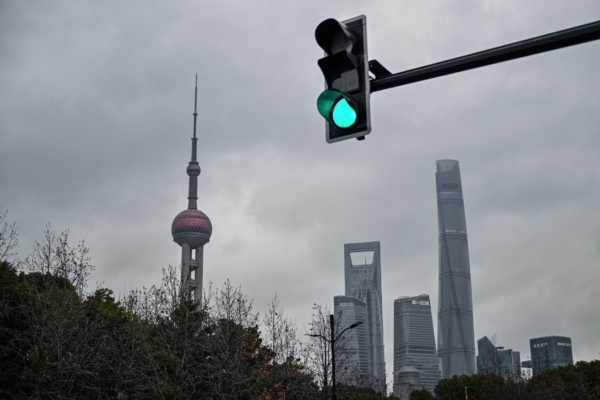
Under the Oriental Pearl Tower (468 meters) lies the core area of Lujiazui in Shanghai, where one can view up close the “Big Three” of Lujiazui: Shanghai Center, the Global Financial Centre, and Jinmao Tower. These three buildings near the Oriental Pearl collectively form the iconic skyline of Shanghai.
The distressed trend is also evident in the foreclosure housing market. According to public platforms, from October to December 2025, 70% of foreclosed houses in Shanghai were sold at a discount of 5-7%.
During this period, there were a total of 1318 foreclosed residential units listed for auction in Shanghai, with 527 units sold, accounting for 40%; 678 units remained unsold, making up 51%, including some selling at discounts of 60-70%.
In recent years, as China’s economy continues to decline, the once bustling aura of the international metropolis Shanghai is fading. Former commercial landmarks in Shanghai are now desolately quiet, with rows of shops closing down. Even in the central business districts, the bustling scenes of the past are hard to come by. This city, which once symbolized China’s vitality, is facing unprecedented challenges.
The wave of unemployment in Shanghai directly affects the family economic chain. A software engineer in Shanghai stated on social media that his wife worked in sales, and together they had an annual income of around 300,000 RMB. With the help of both sets of parents, they bought their first house with a down payment. However, their circumstances changed when his wife quit her job due to pregnancy last year, and he was subsequently laid off. Both unemployed now, he has been unable to find a new job.
Meanwhile, the price of their house dropped from 4.3 million to 2 million RMB, a steep decline of over 50%. He sadly mentioned that 2.3 million had vanished, but they still had a mortgage of over 2.8 million RMB. Selling the house couldn’t cover the remaining loan, leaving them with an additional 800,000 RMB shortfall. With a down payment of over 1.3 million gone, the principal and interest payments made over the years had gone to waste.
He shared that they decided to stop paying the mortgage and neglect it. After six months of non-payment, the bank sued them, leading to the auction of the house, which sold for only 1.5 million RMB. The court demanded they pay back over 1.3 million RMB as the outstanding amount, along with lawyer fees, litigation costs, and accumulated interest still needing repayment. They both ended up on a credit black list, marked with a bad credit record. “Our lives changed completely from the moment we bought the house.”
Recently, a video went viral on social media featuring a 41-year-old unemployed woman in Shanghai who had sent out seven to eight hundred resumes without any responses. She just wanted a job that paid three to four thousand RMB, preferably with social security benefits.
In recent years, Shanghai has witnessed a noticeable wave of store closures, affecting large retailers, boutique supermarkets, and coffee shops. Represented by locations like the IKEA Yangpu store and city supermarkets, several brands have been forced to shut down.
In another video circulating online, a restaurant owner expressed incredulity over the lack of customers at his large eatery at 12:24 noon. He invested a lot in the business but struggled with no customers, wondering about his future. “I use high-quality meat, expensive noodles, and fresh vegetables, but still can’t attract diners.”
A barbershop owner lamented, “For seven consecutive days, my revenue hasn’t surpassed one hundred RMB. Some days, we don’t have a single customer. This is the worst business I’ve had in my 12 years of running a barbershop. It’s simply unbelievable.” He acknowledged that his situation was not unique and that many other businesses were facing similar hardships.
A Shanghai resident raised questions in a video, reflecting on the increasing debt burden shared by the entire population. Business owners are being labeled as debt defaulters, individuals are struggling with mortgage repayments, and the available jobs are predominantly in delivery and takeout services. Despite earning money, it never seems to be enough. Prices drop rapidly for goods and rise for essentials.
He expressed, “On one side, there are people with bank deposits they can’t spend fast enough, and on the other side, there are debt-ridden citizens, struggling to repay debts. Wealth is concentrated in the hands of a few, yet the impoverished are continually urged to drive consumption and domestic demand. Do they understand how difficult it is for ordinary people?”
He further criticized officials who sit in their offices sipping tea, seemingly oblivious to the hardships faced by the common people. Money flows to those who don’t lack it, leaving the common folks to endure suffering.