
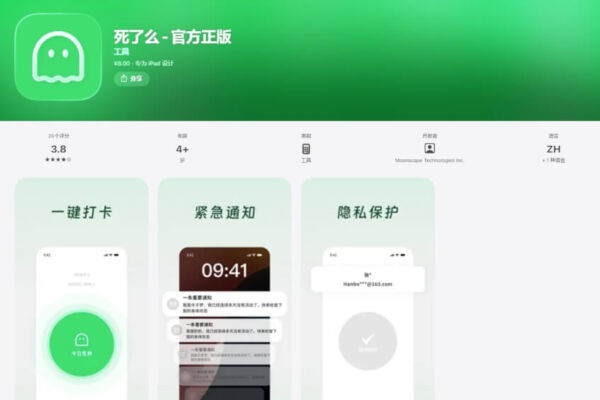
Recently, the app “Are You Dead Yet?” that has been causing a stir on the Chinese internet was unexpectedly removed from the Apple App Store in China this Thursday (January 15).
According to reports from the Chinese media outlet Blue News, Mr. Guo, one of the founders of “Are You Dead Yet?”, confirmed that the product has indeed been taken down but did not disclose the specific reason. Currently, Chinese users are unable to search for or download the app, but the overseas versions (such as in the US, Singapore) are still functioning normally.
At the same time, a large number of similar apps have emerged, such as “Are You Alive?”, “Dead Yet? Pro”, “Are You Dead Yet Drift Edition”, “Report Safety”, all targeting the demographic of people living alone. One app named “Demumu – Are You Still Alive?” is set to be launched on the 24th.
Regarding this, Mr. Guo stated that the true “Demumu” is their global brand, and the app “Demumu – Are You Still Alive?” is a counterfeit product that has no connection to them.
In recent years, the phenomenon of people living alone has become an undeniable issue in Chinese society. Data shows that the population of people living alone in China has surpassed 125 million. This app designed for individuals living alone allows users to set emergency contacts in advance and then confirm that they are alive by checking in daily. If there is no check-in for 48 consecutive hours, the system will automatically send a warning message to the emergency contact, alleviating the safety concerns of many people living alone. Therefore, the “Are You Dead Yet?” app skyrocketed in popularity immediately after its release on the Apple App Store on January 8, even reaching the top of the paid ranking in the Chinese Apple App Store.
However, as it gained popularity, the name “Are You Dead Yet?” also sparked intense controversy in the community. Some users found the name ominous and inauspicious, suggesting changing it to a more pleasant name like “Are You Alive?”. However, there were supporters who believed that the name precisely struck a chord with the social issue of “lonely death” among people living alone, showing alternative care for their well-being.
In the face of the controversy, the official Weibo account of the “Are You Dead Yet” app announced on the evening of the 13th that in the upcoming new version, the app will officially adopt the global brand name Demumu.
Just a day after the announcement of the rebranding, on the 14th, the official Weibo account of the “Are You Dead Yet” app posted again stating that the renaming attempt “did not meet expectations”, therefore they decided to return the naming rights to the users and publicly solicit a “catchy new name” across the entire internet. However, the day after the public naming solicitation, the “Are You Dead Yet” app quietly disappeared from the Chinese App Store.
Commenting on this, current affairs commentator “New Heights” posted on X platform, stating that on the surface, it seems like a failure to complete the name change registration in time — apps need to submit materials for name change review, or they face mandatory removal or fines. However, the underlying reason may be related to speech controls. Industry analysis suggests that app stores are very sensitive to irregular rankings, which could trigger misjudgments about inflated download numbers; furthermore, if there are mishandlings of private data, it could cross the red line of data security, as the scrutiny by the Chinese authorities has expanded to AI and data domains.
“New Heights” pointed out that in this digital age of 2026, the Chinese internet space resembles a tightly guarded fortress where any potential “instability factor” could be swiftly suppressed. Under the control of the Communist Party, while the app’s function may be practical, if it sparks discussions on social issues (such as the implied societal problem of safety for people living alone), it could be seen as a “guidance issue”. The fate of this app is a microcosm of numerous digital products that have had fleeting moments under the scrutiny curtain. Similar products like “Are You Alive?” and “Dead Yet?” could face similar risks as well.