
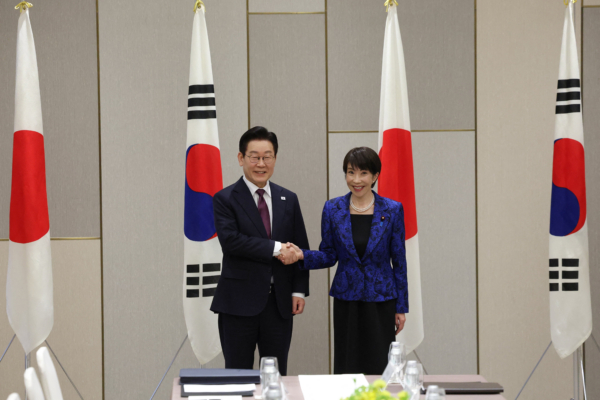
On Tuesday, January 13th, Japanese Prime Minister Sanae Takai and South Korean President Lee Jae-myeong held a summit in Nara, Japan. The two leaders pledged to strengthen cooperation in security and economic areas and committed to elevating bilateral relations to new heights.
This meeting took place in Takai’s hometown of Nara, emphasizing the strategic value of Japan-South Korea cooperation in maintaining regional stability.
At the beginning of the meeting, Lee Jae-myeong stated, “In the current complex and dizzying international order, I believe that cooperation between South Korea and Japan is more important than ever, and we must continue to move towards a new and better future.”
Takai responded, expressing her determination to further improve relations between the two countries, saying, “This year, we hope to take Japan-South Korea relations to a higher level.”
It is widely expected that the two leaders will discuss issues such as denuclearization of the Korean Peninsula, the whereabouts of Japanese citizens abducted by North Korea, and cooperation in areas such as artificial intelligence (AI) and semiconductor technology.
Furthermore, in an interview with Japanese NHK TV on Monday, January 12th, Lee Jae-myeong expressed his intention to seek Japan’s support for South Korea’s accession to the Comprehensive and Progressive Agreement for Trans-Pacific Partnership (CPTPP), a trade agreement consisting of 12 members.
Lee mentioned that this would involve South Korea lifting its import ban on products from regions near Fukushima and Japan affected by the 2011 Fukushima nuclear plant accident, despite lingering health concerns in South Korea.
While the two countries have reached consensus on strengthening the U.S.-Japan-South Korea trilateral security framework, geopolitical pressures still exist.
Previous remarks by Takai about potential Japanese intervention in the event of “trouble in Taiwan” have met with strong backlash from China, leading to a deadlock in Japan-China relations. In response, Lee Jae-myeong, who recently completed a visit to China, stated that he will not intervene in disputes between China and Japan.
Choosing Nara as the meeting location holds significant symbolic meaning. Nara was a center of cultural exchange between the Korean Peninsula and Japan in ancient times, with Lee Jae-myeong pointing out the “special significance” of strengthening exchanges at the current moment.
The two leaders are expected to visit the Horyu Temple on Wednesday, a site considered a historical testament to Japan’s introduction of Buddhism through the Korean Peninsula.
In addressing sensitive historical issues, the two sides may also discuss humanitarian cooperation, including excavating the remains of deceased Korean laborers at a underwater mine accident site in western Japan in 1942.
This meeting could bring political victories for Sanae Takai, who has announced plans to dissolve the Lower House at the end of January, with a possible snap election as early as February 8th.
Since assuming office in June of last year, Lee Jae-myeong has quickly prioritized fostering a positive relationship with Japan.
In August of last year, he personally visited Tokyo to hold a summit with then-Prime Minister Shigeru Ishiba, and the following month, he hosted Ishiba’s return visit in Busan, South Korea.
Through multiple meetings with Japanese counterparts, Lee Jae-myeong has reiterated the necessity for Seoul and Tokyo to cooperate in the face of global economic uncertainty.
On Tuesday, Lee Jae-myeong’s office issued a statement, saying, “Amid rapidly changing international circumstances, we look forward to the two leaders enhancing bilateral cooperation on global and regional issues, including Korean Peninsula affairs, through close communication.”
Before the Tuesday meeting, Sanae Takai posted on social media platform X, saying, “I hope to further advance forward-looking bilateral relations through continuing shuttle diplomacy efforts.”
The “shuttle diplomacy” she referred to is the practice of holding regular meetings between the leaders of two countries in each other’s nations.