
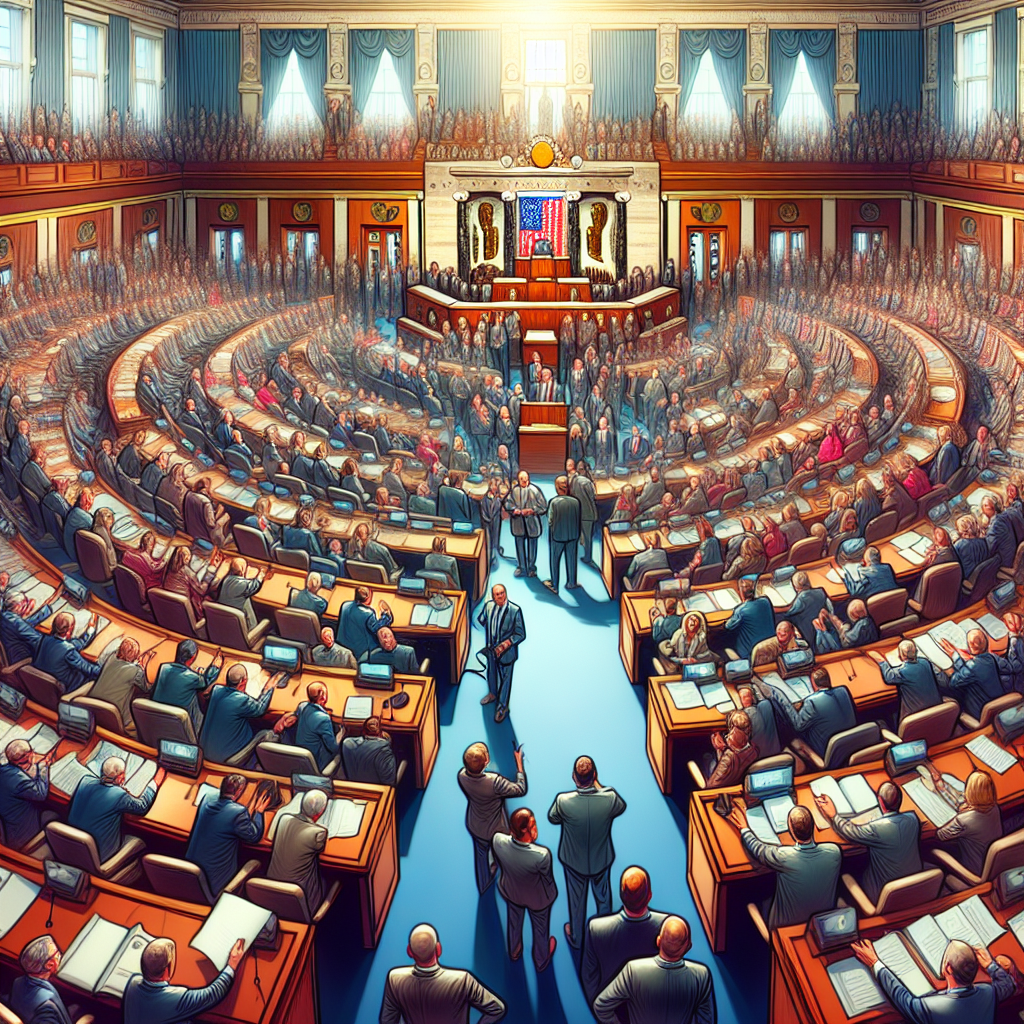
On Wednesday, December 17th, the United States House of Representatives passed a healthcare reform bill after a heated debate. The core of the dispute centered around whether to extend the expiring “Enhanced Premium Tax Credits” (EPTC) in the Affordable Care Act (ACA).
The bill passed by the House is called the “Lower Health Care Premiums for All Americans Act,” aimed at reducing health insurance premiums on the ACA exchange marketplace and the general market. The Affordable Care Act, also known as “Obamacare,” was pushed during the tenure of former U.S. President Barack Obama.
The legislation passed with 216 votes in favor and 211 votes against. Republican Kentucky Congressman Thomas Massie joined the ranks of Democrats in voting against the bill.
Following the vote, House Speaker Mike Johnson praised the passage of the bill, emphasizing that its impact goes beyond simply extending temporary subsidies.
“The bill we just passed will lower premiums for everyone by 11%,” Johnson said, contrasting it with extending Obamacare subsidies, which are expected to bring about a 5.7% reduction.
“We have done something better and more important for 100% of Americans, not just for 7% of Americans,” he said.
Pennsylvania Republican Congressman Brian Fitzpatrick, along with three other Republicans, had signed a “discharge petition” initiated by minority leader Hakeem Jeffries, in an attempt to force a House vote on the proposal to “extend enhanced subsidies for three years.”
Earlier, Fitzpatrick and Virginia Republican Congressman Jen Kiggans had each proposed two amendments that were rejected by the House Rules Committee. These amendments aimed to extend the enhanced subsidies for one to two years and included measures to reduce costs and prevent fraud.
With the addition of four Republican members—Fitzpatrick, Lawler, Bresnahan, and Mackenzie—the petition had gathered the required 218 signatures to initiate the vote.
Under House rules, after reaching the threshold of 218 signatures, there is a required waiting period of seven legislative days before signatures can request a vote, and the speaker then has two legislative days to schedule the vote. Democrats urged Speaker Johnson to forego the waiting period and immediately prioritize the bill.
When asked if members defecting within the party by signing the Democrats’ petition indicated a loss of control over the House, Johnson stated that this was not the case, emphasizing that it was not a normal period.
He straightforwardly indicated that the slim Republican majority in the House did indeed give some members political leverage that would be difficult to obtain under normal circumstances.
The “Lower Health Care Premiums for All Americans Act” primarily includes the following five highlights, with the aim of reducing healthcare costs and expanding coverage.
1. Drug Price Transparency: Requires increased transparency in the pricing of prescription medications.
2. Ease Financial Burdens: Allocates federal funds to reduce copayments and deductibles for Obamacare users.
3. Support Self-Insured Businesses: Facilitates self-insuring companies to purchase stop-loss insurance more easily.
4. Enhanced Bargaining Power: Allows small employers and self-employed individuals to pool purchasing power through Association Health Plans for better premium discounts.
5. Tax Incentives: Encourages employers to offer pre-tax funds for employees to purchase suitable insurance.
Republicans emphasized that these reforms are necessary due to the failure of Obamacare to fulfill cost reduction promises.
“Since the implementation of Obamacare, premiums have risen by 80%, and on average, patients have to pay $5,000 out of pocket to reach their deductible threshold,” pointed out Republican Kentucky Congressman Brett Guthrie during the bill debate. “The average yearly out-of-pocket limit even exceeds $20,000.”
“Obamacare has been proven to be both unaffordable and unsustainable,” Guthrie stated.
Democrats, however, countered that the expiration of enhanced subsidies would render healthcare insurance unaffordable for many Americans.
“Over 20 million Americans nationwide will see a massive increase in their healthcare insurance premiums,” emphasized Democratic New Jersey Congressman Frank Pallone in opposition to the bill.
“The Republican bill simply cannot reduce medical costs,” he stated, noting that the bill effectively promotes “junk insurance plans.”
The “Lower Health Care Premiums for All Americans Act” will now be sent to the Senate. On the Senate side, a Republican bill proposing to replace enhanced subsidies with Health Savings Accounts failed to pass on December 11th. Despite four Republican Senators and Democrats voting in support, the proposal to extend enhanced subsidies for three years did not advance.
Republican Senator Susan Collins of Maine, who had voted in favor of the three-year extension, stated on Wednesday that the “discharge petition” would help advance her agenda.
Louisiana Republican Senator Bill Cassidy told reporters on Wednesday that he personally is not against subsidies, but also emphasized that subsidies are not a “one-size-fits-all solution.”
“If someone truly needs a subsidy but has a deductible of up to $6,000, then they essentially are not insured,” Cassidy said.
Alaska Republican Senator Lisa Murkowski, who also supported the three-year extension, was asked if the bill could still pass if sent to the Senate. She responded, “I hope so.”