
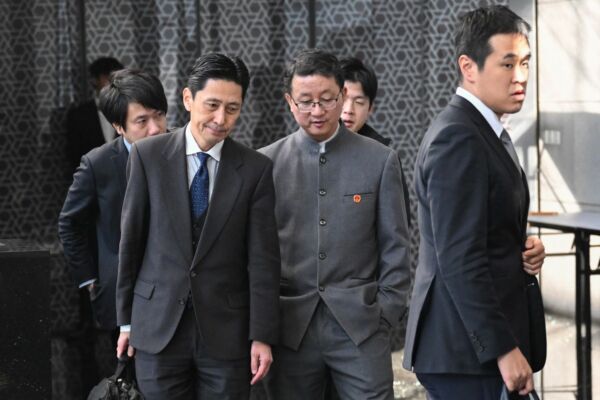
Amidst the tense backdrop of Sino-Japanese relations, a recent gesture by Liu Jingsong, the director of the Asian Department of the Chinese Ministry of Foreign Affairs, sparked a significant controversy. During a meeting with Japanese officials, Liu sent them off with his hands in his pockets, drawing attention. However, soon after, Liu Jingsong headed to inspect a major Japanese enterprise located in Dalian, Liaoning Province, stating that he “hoped Japanese companies could operate in China with peace of mind.” Analysts believe that this move also indicates the Chinese Communist Party’s (CCP) tough exterior but fragile interior, lacking confidence due to economic difficulties.
According to the Nikkei Asian Review on November 30, shortly after holding talks with Japan’s Ministry of Foreign Affairs’ Director-General for Asian and Oceanian Affairs, Akira Kanai, during his visit to Beijing on November 18, Liu Jingsong visited the office of a Japanese major corporation in Dalian. At the conclusion of the visit, the two sides even embraced each other.
Japanese media reported that despite the recent worsening of Sino-Japanese relations, the Chinese Communist Party seems to wish to prevent the political standoff from affecting business activities within China.
On November 28, Tsutsui Yoshinobu, the Chairman of the Japan Business Federation, met with the Chinese Ambassador to Japan, Wu Jianghao, in Tokyo. During the meeting, the importance of economic and trade exchanges between Japan and China was affirmed, and both sides agreed to continue dialogue. It was reported that this meeting was initiated by the Chinese side.
China’s economy has been facing challenges due to sluggish domestic demand, leading to a downturn in foreign investment. Chinese Premier Li Keqiang, during the China International Import Expo held in Shanghai, emphasized the need to strengthen investment in China.
In early November, Japanese Prime Minister Sanae Takai mentioned Japan’s response to “issues in Taiwan,” prompting a tense moment in Sino-Japanese relations. The CCP’s Consul-General in Osaka, Xue Jian, posted provocative remarks on social media, sparking further tensions. Following these events, Liu Jingsong, the Director of the Asian Department of the Chinese Ministry of Foreign Affairs, held talks with Akira Kanai, the Director-General for Asian and Oceanian Affairs of Japan’s Ministry of Foreign Affairs, in Beijing on November 18.
The details of Liu Jingsong talking with his hands in his pockets while escorting the visitors later were emphasized by China Central Television, creating an image of Kanai bowing his head and listening obediently. The gesture of bowing fully illustrates the high level of civility, modesty, and respect of Japanese diplomats, contrasting with Liu Jingsong’s behavior, which reveals the uncouth demeanor resembling a street thug lacking in civilized manners.
Against the backdrop of deteriorating Sino-Japanese relations, the Chinese government has urged Chinese tourists not to visit Japan and has canceled multiple flights to Japan.
Recently, performances and events by Japanese artists in China, such as singer Masaki Otsuki, renowned for singing the theme song of the popular Japanese anime “One Piece,” have been abruptly halted. The Shanghai concert of Japanese singer Ayumi Hamasaki, the activities of the idol group “Peach Lucky Grass Z” in Shanghai, jazz pianist Hiromi Uehara’s music concert, and the musical production of the popular Japanese anime “Sailor Moon,” have all been canceled due to “unforeseen circumstances.”
Regarding Liu Jingsong’s contrasting gestures towards Japanese officials, first displaying a standoffish attitude and then soothing Japanese enterprises, some overseas netizens commented, “Liu Jingsong putting his hands in his pockets is indeed a show for the domestic audience.” It is considered a political performance.
Commentator Li Linyi remarked that Liu Jingsong’s dual performance aligns with the CCP’s consistent strategy of using a “carrot and stick” approach, highlighting the CCP’s tough exterior but fragile interior, lacking in confidence. If foreign capital continues to retreat, and the economic downturn cannot be reversed, the maintenance of political power becomes uncertain, which poses the greatest fear for the CCP.