
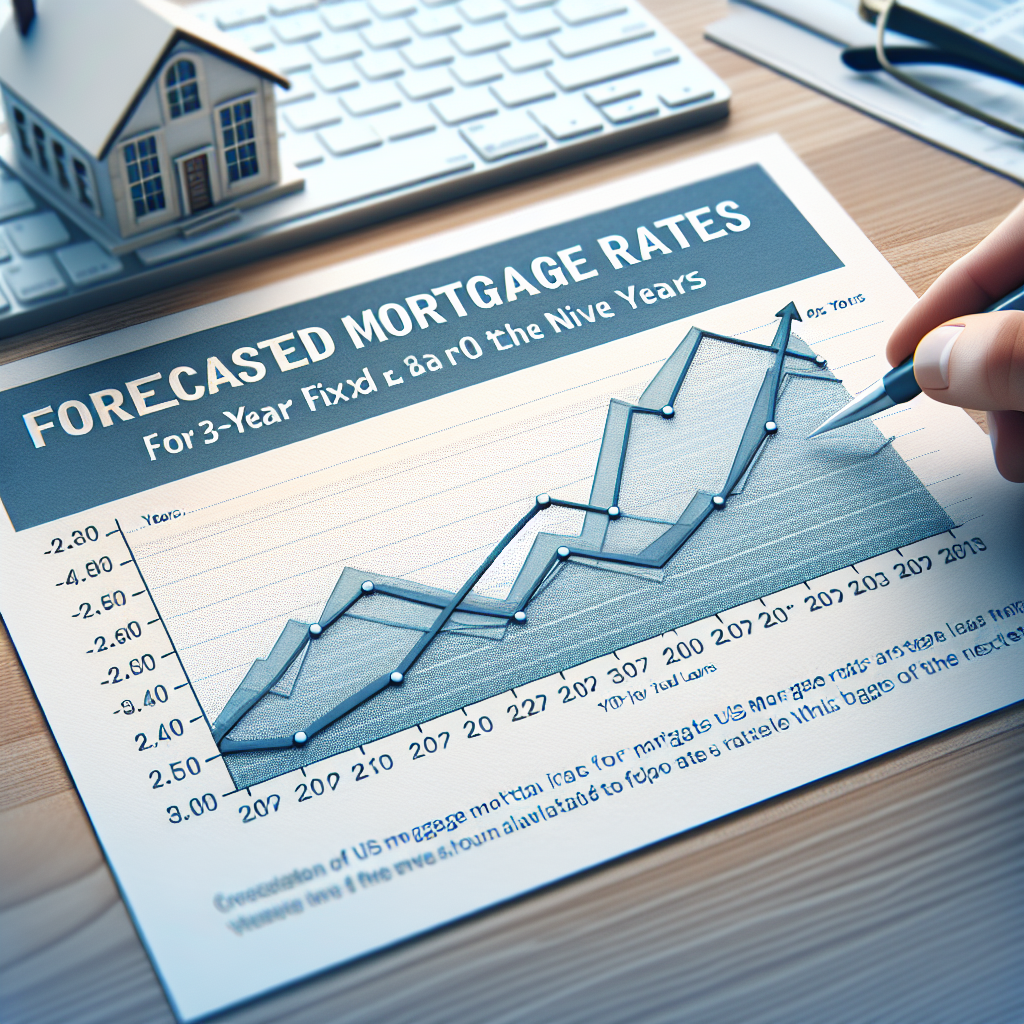
According to a recent report released by many mortgage market analysts, it is expected that in the next five years, US mortgage rates (30-year fixed loans) are unlikely to significantly drop, but rather fluctuate within a higher range.
A report published by Yahoo Finance on Friday, November 28, shows that mortgage rate predictions can be inferred from the trend of the government’s ten-year bond yields. Although the trends of both usually align, there still exists a certain spread between the two.
Regarding the trend of the ten-year bond yields, Deloitte Touche Tohmatsu Ltd.’s global economist Michael Wolf, in the US economic forecast report released by the institution in June, elucidated his expectations for the future ten-year US bond yields.
He wrote, “Despite soft economic data and the Federal Reserve’s 50-basis-point rate cut in the fourth quarter of 2025, we expect the ten-year US Treasury bond yield to hover around 4.5% for the remaining time of this year. The ten-year US Treasury bond yield is projected to slowly decline starting in 2026, reaching 4.1% by 2027 and maintaining that level until the year-end.”
Goldman Sachs analysts also share this perspective, believing that the ten-year US Treasury bond yield will remain around 4.1% until 2027.
At the same time, the Congressional Budget Office (CBO) forecasts that by the end of 2025, the US Treasury bond yield will reach 4.1%, decrease to 4% in 2026, and hold around 3.9% until 2029.
As mentioned earlier, there exists a spread between the ten-year US Treasury bond yield and the 30-year fixed mortgage interest rate. In recent years, the spread has been maintained at around 2.5 percentage points. This marks a significant change compared to the period from 2010 to 2020 when the spread was below 2 percentage points, typically close to 1.5 percentage points.
Assuming a 2.5 percentage point spread, with a ten-year bond yield of 4%, the mortgage rate would be 6.5%.
Taking recent mortgage rates as an example, as of November 26, the opening rate for the ten-year bond yield was 4%, while the 30-year fixed mortgage rate was 6.23%, resulting in a spread of 2.23%.
Combining the above bond predictions, the Yahoo Finance report adds the spread between bond market rates and the 30-year fixed mortgage interest rate to make a five-year forecast:
Based on the aforementioned predictions, it is expected that mortgage rates will not see a significant decrease in the next five years. However, economic recession or other unforeseen economic impacts such as a financial crisis or pandemic may alter the outlook.
Some analysts suggest that in recent months, the average rate for a 30-year fixed-rate mortgage in the US has fluctuated around 6.3% to 6.4%. With rates slightly decreasing, some buyers are returning to the market, leading to a slight resurgence in home sales and refinancing activities.
Nevertheless, for many potential buyers, even if rates drop to around 5.9%, high housing prices, down payment requirements, and overall expenditures still pose a significant burden, with affordability pressures remaining heavy.
Due to the likelihood of high mortgage rates persisting in the mid-term, individuals considering home purchase or refinancing are advised on the following points:
In conclusion, analysts unanimously believe that unless there is a significant economic and financial upheaval, US mortgage rates are likely to remain above 4% in the next five years. Even if they drop, they may only decrease to around the vicinity of 6%. This implies that for many prospective buyers, home purchasing still requires careful planning and cannot solely rely on the expectation of lower rates.