
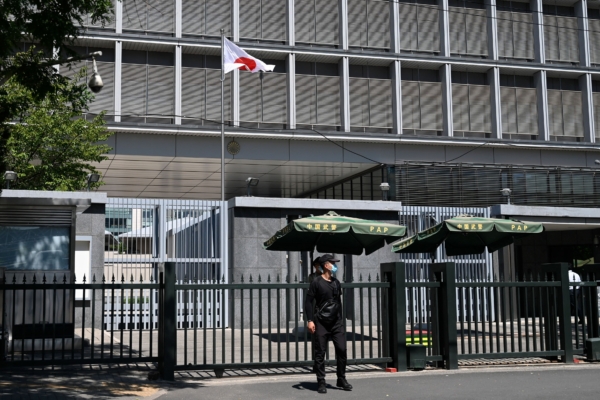
Recently, exclusive reports from Japanese media revealed that in 2015, a Japanese woman who went to Shanghai on a business trip was suddenly arrested by the Chinese Communist Party (CCP) and was sentenced to six years in prison in 2019 on charges of espionage. Observers believe that this incident clearly demonstrates the CCP’s long-arm jurisdiction operation, aimed at creating a chilling effect. It also proves that there are collaborators of the CCP not only in Taiwan but also in South Korea and Japan.
According to a report by Kyodo News on December 30, a Japanese woman was deemed a “spy” by Chinese courts due to her activities in Japan and was sentenced to six years in prison, a verdict seen as absurd by many. Sources from Japan and China informed Kyodo News that between 2012 and 2013, the woman had multiple conversations with personnel from the Chinese Embassy in Tokyo regarding the sovereignty of the disputed Senkaku Islands (Diaoyu Islands) and relayed the Chinese perspective on the issue to two Japanese government officials.
In 2015, while on a business trip to Shanghai, the woman was suddenly arrested by the public security forces. In 2019, she was convicted of “espionage” by the Higher People’s Court in Shanghai and sentenced to six years in prison.
Information obtained by Japanese media indicates that the arrest of the Japanese woman was due to her activities within Japan, which shocked many observers. Yabuta Akio, former chief of the Taipei bureau of Japan’s Sankei Shimbun, bluntly stated that this case highlights the seriousness of CCP’s “long-arm jurisdiction” extending to foreign countries and suggests the presence of CCP “collaborators” within the Japanese government.
Yabuta Akio mentioned that even though the information passed on by the individual to Japanese officials did not involve Chinese state secrets, she was still accused of espionage and sentenced to six years by the Chinese authorities.
Regarding this incident from several years ago, Lieutenant General Yu Zongji, former dean of the Institute of Political Warfare at Taiwan’s National Defense University, told Epoch Times that the CCP’s long-arm jurisdiction aims to create a chilling effect.
“By using baseless accusations like this to detain a Japanese woman, it seems challenging to understand. The goal is to make an example of her, not just for the Japanese, but to ensure that all foreigners must be cautious in words and actions regarding China (CCP) and refrain from making any statements unfavorable to China (CCP).”
Yu Zongji suggested that the current situation in China, whether it be Xi Jinping’s leadership, power struggles within the military, or the overall economy, has increased Xi’s sense of crisis. Xi must ensure his personal safety and maintain stability to prevent any potential color revolution in China, hence the need to create a chilling effect.
A CNN investigation published on December 28 revealed that Chinese President Xi Jinping’s recent crackdown on corruption and dissent has expanded to include a large-scale detention of public officials and even ordinary citizens through coercive measures like “residential surveillance at a designated location.” This has led to the establishment, expansion, or renovation of 218 facilities resembling detention centers known as “designated surveillance sites” across China.
Yu Zongji believed that in recent years, the expansion of detention centers in China demonstrates Xi Jinping’s use of terror tactics to reinforce internal control, safeguard his centralized authority, and prevent any foreign or anti-Xi forces challenging his regime.
In 2014, the Chinese Ministry of Public Security launched Operation “Fox Hunt,” utilizing INTERPOL’s red notices to hunt down corrupt officials fleeing overseas.
Huang Qinglong, Chairman of Taiwan’s Cross-Strait Research Association, told Epoch Times that the Japanese case indeed reflects the CCP’s long-arm jurisdiction. With Meng Hongwei, former Chinese Vice Minister of Public Security, being elected as President of INTERPOL in 2016, the “Fox Hunt” operation became even more aggressive. Taking cues from “Fox Hunt,” the CCP subsequently established many overseas police stations.
Addressing Yabuta Akio’s suspicion of possible CCP collaborators within the Japanese government, Huang Qinglong noted that the CCP has shifted beyond mere long-arm jurisdiction to a new phase involving collaborators. He suggested that without “friends” inside the Japanese government system taking actions such as reporting, the CCP would not have acted so brazenly.
Human rights group Safeguard Defenders first reported in September 2022 the presence of secret police stations established by the CCP overseas. It has been revealed that there are at least 102 known secret police stations in 53 countries, including in the UK where there are at least three, two located in London and one in Glasgow. These stations are dedicated to harassing dissenters and silencing voices of opposition.
Based on various foreign media reports, several countries, including the Netherlands, Germany, France, and the UK, have demanded the comprehensive closure of CCP-established secret police stations in their respective territories between 2022 and 2023.
Huang Qinglong further discussed some Taiwanese individuals who had been detained by the CCP on charges of espionage or other crimes in recent years and, upon their release, expressed concerns about the infiltration of CCP collaborators within Taiwan’s internal systems, including national security.
He noted that such local collaborators in Taiwan society have become increasingly bold and overt. He argued that the operation of a collaboration organization within the Japanese government by the CCP is entirely plausible.
Renowned journalist Guo Jun recently asserted in the Elite Forum that the CCP’s operations in South Korea are even more formidable. In addition to substantial investments by Korean companies in China, many ethnic Koreans from Northeast China study in South Korea and remain as collaborators. Some right-wing factions in South Korea even believe that the CCP’s influence in the country is sufficient to sway elections.
Yu Zongji emphasized that the exposure of the Japanese woman’s imprisonment case underscores the CCP’s pervasive infiltration tactics, not only towards Taiwan but to all neighboring democratic countries, particularly Japan and South Korea.
Recently, Taiwanese influencers Ba Jiong and PYC Chen Baiyuan independently produced a documentary on CCP united front tactics, revealing secrets of 200,000 Taiwanese holding Chinese identity cards, drawing intense attention.
Would Taiwanese collaborate with the CCP? Prominent YouTuber and current affairs channel host, Shen, who resides in Canada, pointed out that many local Taiwanese collaborators believe their actions are aimed at maintaining cross-strait peace by showing goodwill to the CCP in exchange for Taiwan not being annexed. However, such naive beliefs are clearly misguided in the face of the CCP.
Jason Hsien-Cheng Cao, founder of United Microelectronics Corporation, also stated that the CCP is more terrifying than any virus, employing continuous united front operations by uniting secondary enemies and striking primary enemies. In 2018, the CCP amended the constitution to declare that “Taiwan is an inalienable part of China.” In other words, the CCP has exploited legal warfare to garner public support for its claim to Taiwan as part of a deceitful document.
Yu Zongji commented that the Japanese case further illustrates that the CCP deliberately showcases its ability to penetrate neighboring democratic countries and access relevant information within the Japanese government. It confirms that Communist China is a highly perilous state, and by entering it, one must be prepared to face the unwarranted misfortunes that may arise out of nowhere or baseless accusations.