
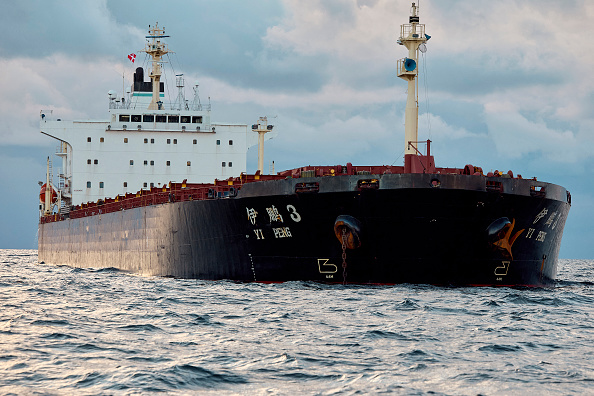
The Baltic Sea, connecting Northern Europe with Central Europe, experienced vandalism to two underwater cables on November 17 and 18, targeting the Chinese bulk carrier ship “Yi Peng 3”. Investigators suspect intentional damage to the cables. Recently, a Chinese patent for rapidly and covertly cutting underwater cables has raised concerns.
According to reports from international media such as The Wall Street Journal and Reuters, the captain of “Yi Peng 3” is Chinese, with a crew member of Russian nationality onboard. The ship dropped anchor in Swedish waters around 9 PM local time on November 17 but continued sailing. The dragging anchor cut the first cable between Sweden and Lithuania. At that time, the ship’s transponder was turned off, classified as a “dark event” in maritime terms.
Around 3 AM the following day, after sailing approximately 111 miles, “Yi Peng 3” cut the second cable between Germany and Finland. The ship’s coordinates matched the time and location of the damaged cables.
German Defense Minister Boris Pistorius, while attending an EU defense ministers’ meeting in Brussels, stated to the media that the damage to the two Baltic Sea cables was “clearly a deliberate act”, and it is hard to believe that the cables were accidentally cut by an anchor. He described it as a “hybrid warfare operation” targeting Europe.
Swedish Prime Minister Kristensen mentioned on the 28th that a “formal request” has been made to China for cooperation in the investigation of the submarine cable incident.
As of now, “Yi Peng 3” has been intercepted and detained by European warships in international waters and the Baltic Sea for over a week. Several NATO member countries have launched investigations into the ship. The focus of investigators is determining whether the Chinese ship’s captain was instructed by Russian intelligence to carry out the sabotage.
A recent submission by an informant named “Guohua” to Dajiyuan urged attention to China’s little-known technology for damaging underwater optical cables.
The article elaborated that underwater optical cables play a significant role in transmitting large amounts of data across oceans, holding substantial economic and strategic value. While most countries are developing technologies for laying, maintaining, and repairing these cables, China’s patent application reveals a secret and rapid method for damaging them.
China’s Patent Office published the data for the patent application titled “A towing-type underwater cable cutting device and its cable cutting method” in 2020. The patent includes illustrations showing a cutting blade installed on the anchor of a vessel, capable of swiftly severing underwater optical cables as the vessel tows the anchor, with detailed operational instructions.
According to the design principles and technical specifications of the patent, China’s technology demonstrates fast cutting speed and the ability to cut cables while the towing vessel continues to sail, ensuring discretion. However, due to the complexity of underwater terrain and sea currents, the technology may face challenges in accurately controlling the cutting location, potentially resulting in errors of several kilometers or more.
Nevertheless, the article pointed out that a limitation of the technology is the unpredictability of successfully hooking and cutting the cables as the anchor glides along the seabed, requiring multiple attempts for successful cutting if unfavorable conditions arise.
The article highlighted that the “Yi Peng 3” has been maneuvering extensively in the Baltic Sea area, matching the characteristics of the patented technology.
The patent holder, Li Shui College, is a government institution located in Zhejiang Province, China. In China, government-funded or directed research activities in government institutions are common.
In 2011, the “Naval Communication Application Research Institute” of China also applied for a patent titled “A deep-sea optical cable underwater cutting and salvage device”. The patent highlighted operations such as cutting and recovering undersea cables automatically at a depth of 2000 meters, with low cost and simplicity, addressing issues related to expensive tethered cables.
Further online searches revealed several similar technologies developed by the Chinese military, state-owned enterprises, and research institutions.
Commentator Li Linyi told Dajiyuan that China has various technologies of this kind, often under the guise of routine maintenance or salvage operations. However, in a regime like China, devoid of moral boundaries and emphasizing readiness to “struggle,” such technologies are frequently misused to serve political ends, including destructive acts against other countries.
This recent incident of a Chinese cargo ship damaging underwater cables is not the first. Over a year ago, a Hong Kong-flagged Chinese container ship named “Newnew Polar Bear” damaged a natural gas pipeline between Finland and Estonia. Authorities in Finland and Estonia have yet to clarify whether the incident was deliberate or accidental.
In early 2023, Matsu, Taiwan, experienced over fifty days of internet disruption. Taiwan’s National Communications Commission confirmed that the undersea cables connecting Taiwan and Matsu were severed by Chinese fishing and cargo ships on February 2nd and 8th, respectively. While there is no definitive evidence of Beijing’s deliberate involvement, data from Taiwan’s telecom operator Chunghwa Telecom revealed over 20 instances of cable damage in Matsu over five years, with these two instances occurring within six days.
Shen Mingshi, Director of the Institute of National Security Studies at Taiwan’s National Defense University, stated in an interview with Dajiyuan that China’s patent evidence suggests that the Chinese navy or government-supported research institutions have developed specialized equipment for cutting underwater cables. Whether in the case of cables between Taiwan and Matsu or the recent incidents in European waters, it is highly likely that these are deliberate acts by Chinese ships.
Analyzing the incidents, Shen Mingshi categorized underwater cable accidents into three scenarios:
Firstly, a ship accidentally severs a cable while anchoring, though the probability is low unless the vessel experiences malfunctions necessitating anchoring for repairs or rescue. However, the likelihood of anchoring directly above an underwater cable is minimal as vessels typically avoid such positions.
Secondly, intentionally using existing tools on a ship to drag and cut a cable, either with special tools or an anchor, passing over the cable in a manner that leads to its breakage. This scenario is more plausible but could result from deliberate or accidental actions.
Lastly, using specially designed tools targeting a specific area to precisely sever an underwater cable. In this scenario, tailored tools are commissioned to swiftly cut the cable, serving the intended purpose and potentially absolving responsibility.
Shen Mingshi pointed out that the presence of a Chinese cargo ship near the Baltic Sea cable rupture, with Russian nationals onboard and China’s established equipment for cutting cables, aligns motivation, capability, and evidence, confirming China’s adeptness in executing gray zone operations and hybrid warfare.