
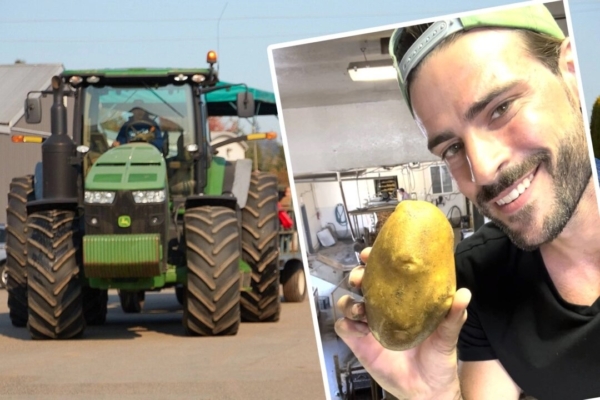
Thirty-year-old Canadian Tyler Heppell once believed he experienced “slave labor” on what he thought of as his family farm when he was a teenager. He swore he would never do it again. However, life unexpectedly led him back to the same land.
In February 2022, Heppell was job hunting when he received two job offers. At the same time, his father mentioned a job opening at the Heppell Potato Corp., a family potato farm in Cloverdale, British Columbia.
His father emphasized that he didn’t have to work on the family farm, but taking the job would help secure the farm’s future and keep it within the family.
“It was a very tough decision,” Heppell said. “I had two sales job offers, and both offered over $200,000 annually.”
After much deliberation, discussions with mentors and relatives, weighing the pros and cons, Heppell made a decision.
“I decided to give it a year. If the year was terrible, then I wouldn’t have any regrets living with that,” he said.
The year turned out to exceed his expectations, and he flourished in his new role. He has been a full-time farmer for two years now.
“I feel like I’ve learned more about business than business school ever taught me, like how to be a leader and manage employees,” Heppell said.
As an operations manager, he is learning how to run the farm, with the goal of becoming its owner in the future.
He started working on the farm in his teens but discovered what seemed like greener pastures when he left home for college.
In the summer of 2013, he found a seasonal weeding job in Langley town. “Once I started that job, my income doubled, and the hours were significantly less,” he said.
He quickly said goodbye to the farm. During his university years, he worked summers in Langley town.
Upon graduation, he had never thought of returning to the farm. He landed a stable sales job at a company called Cintas and became a successful professional.
However, before long, he began to feel aimless. He missed the sense of fulfillment from long and hard days of work. In his own words, he felt “like a number.”
During the years he was away, his father and business partners went their separate ways and formed a management team to execute the farm’s plans.
“My return was made very easy by my father because I wanted to own it,” Heppell said.
The restructuring of the management team undoubtedly helped Heppell make the pivotal decision in 2022. Not long after, he realized he had made the right choice.
“I feel like coming back, my father really respected my viewpoint because I worked in a very successful business for five years,” he said.
While working at Cintas was great – Heppell will forever be grateful for his time there – he happily embraced his new role. Now, he says, “My life goal is not just to work towards maximizing the company’s stock price but to grow food to feed Canadians.”
In 1920, Heppell’s great-grandfather bought undeveloped flat land in Cloverdale, British Columbia, beginning the family farm. In the 1960s, his grandfather Ron Heppell and his brothers bought the land, continuing to grow potatoes alongside turkeys and cows.
In 1990, Heppell’s father purchased the potato portion of the land and transformed it into what it is today. During the busiest times of the year, Heppell’s Potato Corp. ships 200,000 pounds of potatoes daily from its 600 acres of land.
For decades, most of the agricultural processes involved monotonous work. Tedious manual labor, potato sorting, boxing, and cleaning became ingrained in daily life. “There’s a lot of mind-numbing stuff. After doing it for eight hours, your brain just shuts off,” Heppell said.
Now, the farm employs 40 to 50 staff and utilizes a plethora of machines, replacing the tedious work Heppell detested in his youth.
Additionally, his role as an operations manager allows him to think strategically and make decisions from a broader perspective, rather than just performing routine tasks. “It’s more interesting,” he said, adding that he is now “steering the company’s growth.”
As more young people leave their parents’ family farms, Heppell is creating social media content to promote agriculture to the next generation. Similar to his own farm, a machine-driven farm with a decentralized management system is his optimistic vision for the future.
As a fifth-generation farmer, he is also an advocate for halting agricultural commercial development. After the Canadian government added a piece of land leased by Heppell Potato Corp. to a “disposal list” and claimed the farm couldn’t use it anymore, the First Nations of Canada began lobbying, asserting ownership of the land.
Heppell gathered 84,000 signatures to oppose this. “We believe [the land] should continue to be used for agriculture, but we also believe there are other economic and reconciliation ways the federal government can provide for Indigenous peoples,” he said.
He remains optimistic about the land’s future, believing it will be returned to his family. And he’s not the only one. “People in western Canada are very, very passionate about using the land for agriculture,” he said.
The fifth-generation farmer is currently working with his family to devise a plan for developing and safeguarding Heppell Potato Corp. for the decades to come. With hard work and strategic thinking, it will be a family farm for generations to come.