
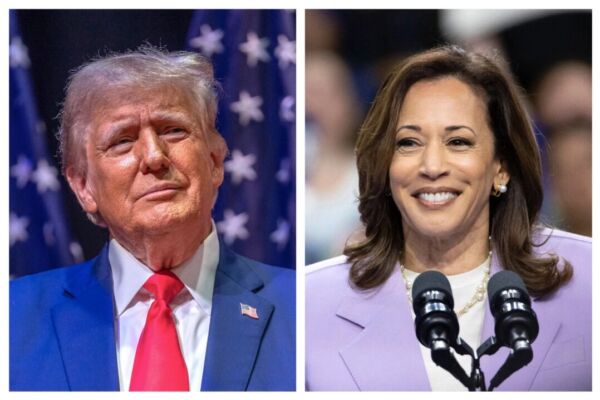
The competition between US Vice President Kamala Harris and former President Donald Trump remains in a deadlock as the tumultuous election enters its final 60 days.
With both campaigns entering the historic final two months, many pivotal events are on the horizon. The debate on September 10 on ABC is highly anticipated, early voting has begun in many states, and Trump’s impending judgment in New York is imminent.
Both candidates have recently acknowledged the critical nature of the remaining weeks. Harris reiterated during a speech in New Hampshire on September 4 that she believes she is at a disadvantage in the competition with the former president.
Harris stated, “New Hampshire voters, we have 62 days left… I’m telling you what you already know. This is going to be a tough fight until the end, so please do not focus too much on the polls because we are running from behind.”
The Trump team has cited the latest model from statistician and election analyst Nate Silver, which shows Trump slightly ahead of Harris in the electoral college odds, suggesting momentum for the former president to win in November.
In a statement, the Trump team wrote, “Three weeks ago, the Democratic Party’s nominee Harris was leading in Nate Silver’s electoral college prediction model, but since then, the predictions have shifted in favor of President Trump.”
Although Harris’ poll numbers have been on the rise since the start of her campaign, recent national and battleground state polls indicate a dead heat due to the candidates’ nearly equivalent support. Harris leads Trump in multiple polls in Michigan and Wisconsin, but in other states, the race is neck and neck, with some polls showing either candidate leading within the margin of error.
In the national polls average from FiveThirtyEight, Harris leads by 3.1%, and recent polls by Outward Intelligence and Emerson College show her ahead by 4%, while some polls still indicate a tie between Harris and Trump.
In battleground states like Michigan, Wisconsin, Pennsylvania, Georgia, Nevada, Arizona, and North Carolina, the race remains tight, with most states still in a deadlock.
In Michigan, Harris leads by 5% in a CNN/SSRS poll on September 4, while Trump is ahead by 1 point in a Glengariff Group poll on September 3. Harris leads by 6 points in the CNN/SSRS poll in Wisconsin, but falls behind Trump by 1 point in the Emerson College poll.
Since Harris took a slight lead in early August, Trump has regained a slight edge of 0.3% in the average polling in Arizona.
In the past elections, Republicans had seen promising numbers in Nevada before Election Day, only to lose to Democrats. Since mid-August, Harris has held a commanding lead in most polls in Nevada.
In 2020, Biden won Georgia unexpectedly but narrowly. After Trump seemed poised to win the Peach State a few weeks ago, Harris is now in a position to potentially secure another victory, leading by a slim margin in recent statewide polls.
However, after Harris trimmed her lead significantly last month, Trump now leads in many recent polls in North Carolina.
Pennsylvania, with its coveted 19 electoral votes, is considered a crucial battleground state. Despite being part of the Democratic-leaning “blue wall,” Trump won the Keystone State by less than 1% in 2016. Four years later, President Biden won by a similar margin of 1.17%.
Recent polls in Pennsylvania show that neither candidate has an advantage outside the margin of error. Some polls in the state indicate both candidates have seen a 1% or 2% increase in support, while the CNN/SSRS and Wicks polls suggest a tie.
Bill McInturff, co-founder of Public Opinion Strategies, emphasized the importance of Pennsylvania in a roundtable discussion with the American Enterprise Institute on September 4.
McInturff said, “I think this election is Pennsylvania’s election… The Democrats had a 10-point registration advantage over the Republicans; in 2020, this was about 7.5%, and now it’s 4.8%. Republicans have caught up. The registration advantage is only half of what Democrats used to have.”
McInturff noted that while Harris had previously supported a fracking ban in 2019 before retracting the stance a year later, it would be challenging to win over voters in Scranton and western Pennsylvania.
Chris Stirewalt, a senior researcher at the American Enterprise Institute, called Pennsylvania the “mother of all swing states” and indicated its pivotal position in swinging either way due to its partisan makeup, making it the most likely state to tip towards either side.
Looking at the electoral map, Harris could potentially lose Pennsylvania, Arizona, and North Carolina, but if she can secure Nevada, Georgia, Michigan, and Wisconsin, she still stands a chance of winning the election.
On the other hand, Trump might lose all battleground states except Pennsylvania, Georgia, and North Carolina but could still clinch victory in the electoral college. Trump’s campaign has sent former President’s running mate and Senator JD Vance to Pennsylvania several times in the past two months, underscoring the critical importance of Pennsylvania for Trump’s success.
Since becoming the Democratic nominee on July 21, Harris has also visited Pennsylvania, with her running mate, Minnesota Governor Tim Walz, gearing up for a campaign push in the state.
Discussing another potential path to victory for Trump, Stirewalt suggested turning Michigan, Wisconsin, or Pennsylvania red, as they share similar development patterns.
Stirewalt predicted that a similar outcome could occur if Vice President Harris wins Arizona, Georgia, or North Carolina.
Amy Walter, publisher and editor of the Cook Political Report, participated in a roundtable discussion on September 4. She emphasized the crucial remaining 60 days of the election for both candidates but noted the differences in their challenges.
Walter said, “Voters are finally going to be interacting with the candidates, especially with a candidate they’re not particularly familiar with, which is Harris; whether she can effectively present herself in the next 60 days is a question.”
She added, “From now till Election Day, people’s views on Trump won’t change, but their views on Harris might; in my view, this will not only affect who wins the presidential election but will fundamentally impact the voters in those critical swing states.”
This factor makes the debate on September 10 extremely vital for both candidates. According to CNN/SSRS polls, in six out of seven battleground states, 11% to 15% of potential voters say they might change their minds before Election Day. Harris and Trump have agreed to the terms set by ABC, including muting the microphone when the other candidate is speaking, a clause that Harris’ campaign had previously opposed.
Another potential concern is Trump’s criminal trial in Manhattan.
The trial is currently scheduled for September 18, but the former president’s lawyers are urging the court to postpone it until after the election. On September 3, Judge Alvin Hellerstein rejected their request to move the case to federal court, and Trump has appealed this decision.
Robert Y. Shapiro, a political science professor at Columbia University, highlighted the need for Trump’s campaign team to emphasize to voters, in the remaining 60 days of the election, that he is the better choice compared to the Biden administration’s poor performance, as the election is about a nationwide referendum.
Shapiro told The Epoch Times, “Harris and the Democrats need to focus on her positions, whatever they may be, making her stand out positively from Biden, and ensuring that Democratic enthusiasm leads to new voters and her other supporters coming out to vote on Election Day or sooner.”
Overall, the next 60 days leading up to the election will be pivotal as both candidates strive to secure their path to victory in what promises to be a fiercely contested race.