
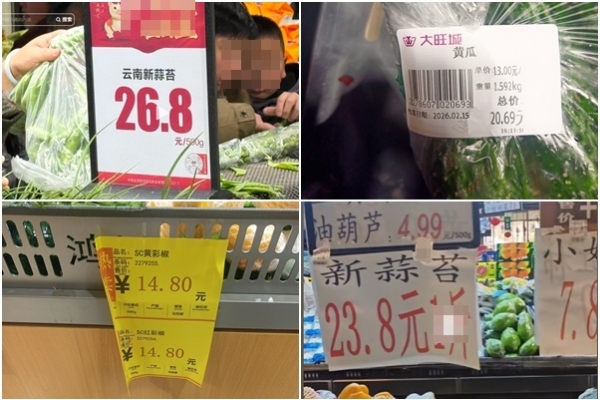
As the Chinese New Year approaches, households are busy buying a large amount of Lunar New Year goods. In previous years, vegetables were usually cheaper than meat, hence the saying “if you have money, you eat meat; if you don’t, you eat vegetables.” However, this year, vegetable prices have skyrocketed, causing hesitation among consumers. Some people reluctantly say, “This year vegetables are even more expensive than meat, and we can’t afford to eat.”
Shouguang in Shandong is known as the “Land of Chinese Vegetables” and is the largest vegetable production and distribution base in China. Wholesalers at the Shouguang Vegetable Trading Market reported that vegetable prices have generally risen before the Chinese New Year, especially leafy vegetables showing significant price increases.
For example, on February 15th, the prices of small chili peppers, bell peppers, and colored peppers have significantly increased; prices of cilantro, Chinese chives, garlic chives, and coriander shoots have also surged, with other vegetable prices seeing varying degrees of increase.
Many netizens have uploaded videos showing local vegetable prices. One netizen mentioned that in Xi’an, the price of garlic stems has risen to 53.6 yuan per kilogram; purchasing nearly 2 kilograms of garlic stems cost 103 yuan.
A netizen from Shanghai said, “The price of winter melon in the vegetable market has doubled.”
A netizen from Guangzhou commented, “Vegetables on the fifth day of the Lunar New Year are really expensive; with 100 yuan, it’s not enough for a family of four to eat for a day.”
A netizen from Heilongjiang expressed, “Vegetables are too expensive, almost on par with meat. If this continues, we might as well just eat meat.”
A netizen from Anhui said, “Prices at the vegetable market have surged, with two bunches of greens costing 20 yuan. Suddenly, the festive atmosphere has been diluted by these price hikes.”
Residents in Shaanxi expressed that during the Lunar New Year period, prices of fruits, vegetables, and meat have all increased, but vegetable prices have risen most significantly. Especially for chili peppers, they are generally priced at around eight to nine yuan per catty. Among them, small chili peppers have skyrocketed by two times. During normal days, they are about 10 yuan per catty, but during the Lunar New Year, they are priced at 30 yuan per catty; garlic chives have also increased from around 5 yuan per catty to 11 yuan per catty; green radishes have increased from 0.5 yuan per catty to 1.5 yuan per catty; and Chinese cabbage has risen from less than 0.5 yuan per catty to 1.5 yuan per catty. “The prices of both cheap and expensive vegetables have all gone up this year.”
Yingchun’s family has a monthly income of just over four thousand yuan, and they have to bear over a thousand yuan in medical expenses out of their own pockets, leaving them with almost no savings. “Vegetables that are too expensive are simply unaffordable. We dare not buy too much, so we only bought a head of Chinese cabbage and a few pounds of radishes to make dumpling fillings and get by for a few days.”
People in Shaanxi enjoy eating lamb, and during the Lunar New Year, each household usually buys a few pounds, or even a whole lamb. However, this year, such scenes are nowhere to be seen. Yingchun stated that when the price of lamb was not soaring, bone-in lamb was priced at 27-28 yuan per catty, but now in Xi’an, it has risen to 40 yuan. “With no purchasing power and such high prices, we originally wanted to buy lamb, but it’s too expensive, so we didn’t buy it.” The price of pork has also increased by 4 yuan per catty compared to normal days.
Many people mentioned that due to the economic downturn, they were mostly unemployed in 2025, but still had to bear expenses such as housing loans, car loans, children’s education, and elderly medical care. Coupled with the continuous rise in prices, everyone is feeling suffocated.
Mainland resident Wang Sheng told Epoch Times that in previous years, people would spend three to four thousand yuan on Lunar New Year purchases, but now many people don’t have the money to buy anything. “Just have a simple meal for the New Year, and after the holiday, find work. Without work, there’s no way to survive, and no one will care about you.”
(Interviewees in the article are all pseudonyms)