
Recent articles have pointed out that the rule of successive leaders of the Chinese Communist Party (CCP) has led to the formation of a “harem culture.” These articles have revealed scandals of sexual misconduct and family corruption involving the so-called “five generations” of CCP leaders, directly addressing this as a chronic issue within the CCP power structure.
According to commentator “New Heights,” the phenomenon of “harem culture” within the CCP refers to senior officials using various channels to place their spouses, mistresses, or relatives in positions to maintain their private lives, transfer assets, or avoid risks.
The article lists the five major units where officials’ wives and mistresses gather, including party schools/continuing education colleges, libraries/cultural centers/archives, literary and art organizations/women’s federations/writers’ associations, as well as central state-owned enterprises, the Red Cross/disabled persons’ federation, and other welfare institutions. There are also practices of placing mistresses in cultural troupes, trade unions, and sending them abroad for settlement.
The article analyzes the evolution of this “harem culture.” During Mao Zedong’s era, Mao had four formal wives, and the relationships with mistresses were even more complex, including Jiang Qing, who was packaged as a “revolutionary comrade” during the Yan’an period. Jiang Qing was initially placed in a literary arts unit in Shanghai, later gaining control of the cultural domain during the Cultural Revolution. He Zizhen was sent to the Soviet Union for “treatment” due to mental issues, which was actually an early form of overseas placement. This model led to many officials emulating the practice.
During Deng Xiaoping’s era, the harem culture shifted towards economic interests, with figures like Deng Pufang founding Kanghua Corporation and getting involved in corruption, and Deng Nan working in cultural/charitable institutions, among others. Rumors of family members relocating overseas align with patterns of transferring wealth abroad.
In Jiang Zemin’s era, Jiang’s wife, Wang Yeping, kept a low profile, but there were rumors of Jiang having close relationships with women in the literary and art world, most notably with singer Song Zuying. Song started from a naval cultural troupe, quickly rising to become a regular performer on CCTV’s Spring Festival Gala and a member of the National Committee of the Chinese People’s Political Consultative Conference, typical of placements from cultural troupes that provide stable positions and economic returns. The Jiang family’s confidants were involved in monopolistic industries such as petroleum and telecommunications, with rumors of the Jiang family relocating overseas for alleged wealth transfer.
During Hu Jintao’s era, Hu and his wife, Liu Yongqing, maintained a stable marriage without public rumors of mistresses. However, in cases like the Lei Feng Project, where Hu’s wife, Gu Liping, was involved in fundraising for organizations like the Red Cross, it fit the profile of low-profile placements focusing on “serving specific groups and having simple job roles.”
After Xi Jinping took office, various corruption scandals accumulated during the Jiang and Hu eras were exposed, with high-ranking officials like Zhou Yongkang and Lei Feng Project members confirmed to have a “harem” at CCTV. The article argues that Zhou Yongkang’s exposed network of mistresses demonstrates that the harem culture has become a systematized form of corruption.
“New Heights” further points out that under Xi Jinping’s rule, the anti-corruption campaign targets others but not oneself. Xi Jinping’s wife, Peng Liyuan, from a literary arts troupe background, rose from a singer to the “First Lady,” showcasing the conveniences provided by literary and art units. While Xi Jinping cracks down on political rivals in the anti-corruption campaign, his own “harem” is carefully protected through strict confidentiality. Additionally, rumors regarding Xi’s family’s overseas assets confirm paths of wealth transfer.
The author believes that the examples of the five generations of CCP leaders illustrate that the harem culture is a chronic issue within the CCP power structure resulting from a lack of supervision.
Previous articles did not mention the scandal involving Zhang Gaoli during Xi’s era that caused a sensation at the time.
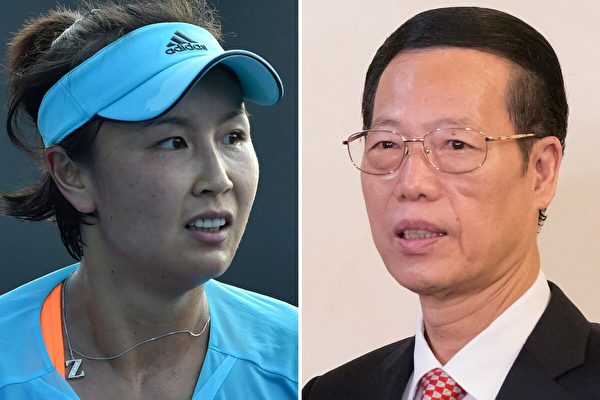
Chinese tennis star Peng Shuai revealed on Weibo on November 2, 2021, that she was sexually assaulted multiple times by former CCP Politburo Standing Committee member and Vice Premier Zhang Gaoli.
Peng Shuai wrote: “About three years ago, Vice Premier Zhang Gaoli, you had retired, and contacted Dr. Liu from the Tianjin Tennis Center to arrange for me to play tennis at Kang Ming Building in Beijing.”
Retired Central Party School professor Cai Xia revealed on Twitter: “Near Kang Ming Building, on a road south of Ping’an Avenue within the second ring road in Beijing, is a retreat center for retired officials of the State Council.”
Peng Shuai wrote that on that day three years ago, “after playing tennis in the morning, you and your wife, Kang Jie, took me to your home,” where Zhang Gaoli forced her into a sexual encounter. She mentioned that the situation was similar to over a decade ago when Zhang Gaoli was the Party Secretary of Tianjin.
In a shocking revelation, while Zhang Gaoli was committing these acts, he left his wife, Kang Jie, alone outside. Peng Shuai continued, stating that after this forced sexual encounter three years ago, she and Zhang Gaoli resumed a romantic relationship when he was promoted to the Politburo Standing Committee in Beijing, but they eventually had a quarrel…
After Peng Shuai exposed the scandal involving Zhang Gaoli on Weibo, she disappeared from public view for several weeks, and the CCP officials refused to respond directly, turning the incident into an internationally watched scandal. Peng Shuai later denied being sexually assaulted in an interview with international media, but it was believed that she lacked freedom of speech under the control of the CCP.
During the CCP’s 20th Congress that opened on October 16, 2022, Zhang Gaoli appeared for the first time since the sexual assault scandal, indicating that he had not been affected in any way. Subsequently, Zhang Gaoli appeared regularly at various events involving former high-ranking CCP officials or was listed in relevant name lists.
Commentator Li Lin told Da Ji Yuan that in the case of Zhang Gaoli and Peng Shuai, if it were in the West, there would be open investigations, and politicians would either resign or go to jail. However, under the CCP’s rule, Zhang Gaoli received protection from top officials. While the authorities claim there are no forbidden areas in the anti-corruption campaign and would disclose issues like power-for-sex exchanges when dealing with some officials, someone like former Politburo Standing Committee member Zhang Gaoli was let off lightly. This raises questions among the Chinese public about how many other high-ranking CCP officials have similar crimes. Are they forced to protect Zhang Gaoli to conceal their own wrongdoings?