
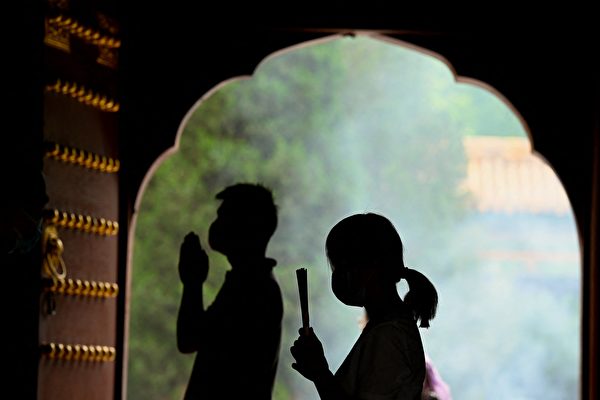
During the Chinese New Year, worshippers in mainland China flock to temples to pray for blessings, hoping for a smooth and prosperous year ahead. On February 21st, the fifth day of the Lunar New Year, there is a custom known as “welcoming the God of Wealth” among the people. Ling Shun Temple, also known as the “Number One Temple of the God of Wealth in the World,” located at the peak of Beigaofeng in Hangzhou, attracted a surge of visitors.
Ling Shun Temple, commonly referred to as Huaguang Temple, consists of two sections and is mainly visited by tourists for blessings. Many people visit the temple around the Lunar New Year to pray for prosperous business in the coming year, hence the temple’s reputation as the God of Wealth Temple. Despite the cable car available to reach the temple at the mountaintop, most worshippers still choose to walk the ancient Taoist path as a sign of reverence.
According to Up Guan News, starting from the early hours of the morning, a large number of residents and tourists from Hangzhou began climbing the mountain throughout the night on the footpath, resulting in overcrowding where many were stuck halfway up the mountain and the temple at the peak was packed with people, with queues stretching endlessly.
The staff at the scenic area used megaphones to advise visitors to return home as there were no toilets, grilled sausages, or tea eggs available on the path. It was estimated to take about 4 to 5 hours to reach the peak due to flow control.
Elsewhere, Hangzhou’s Lingyin Feilaifeng Scenic Area saw its first long holiday after implementing a “double exemption” policy. The online booking system for the scenic area shows that ticket reservations for February 22nd to 24th are in a waiting list status, while reservations can still be made for February 25th to 28th.
Under the new regulations of the scenic area, visitors can make reservations seven days in advance or queue online before 8:00 p.m. the day before entry for prioritized allocation.
How prosperous were the God of Wealth Temples in other places on the fifth day of the Lunar New Year? A video shared by netizens showed the Shanghai God of Wealth Temple in Pudong New Area overflowing with worshippers, causing a fire hazard. Firefighters were seen using water hoses on site.
Reportedly, the Shanghai God of Wealth Temple remained open all night from the night of February 20th (the fourth day of the Lunar New Year) to the fifth day of the Lunar New Year, with a continuous stream of worshippers burning incense.
Burning incense during the Chinese New Year is a traditional custom used primarily to worship gods and ancestors for peace and prosperity. Key time points include: New Year’s Eve (worshipping gods and ancestors, with some families conducting rituals from 11:00 p.m. to 1:00 a.m. of the following day), the first day of the Lunar New Year (honoring the Buddha at sunrise, an auspicious time for worshipping gods at temples or homes), the fourth day (welcoming gods), the fifth day (receiving the God of Wealth) (a crucial day for seeking financial prosperity in the new year), the ninth day (birthday of the Jade Emperor, a day for grand ceremonies). The burning of incense usually involves three incense sticks representing “heaven, earth, and mankind.”
In recent years, there has been an increasing trend among mainland Chinese people to visit temples and burn incense during holidays. Hangzhou has seen a consecutive increase in visitors to the Lingyin Temple during the Lunar New Year, where everyone comes to “burn incense and pray for good luck in the new year.”
In Beijing, the Lama Temple has also been crowded with tourists. Beijing media reported that since implementing an online booking ticket system in 2024, the Lama Temple has been receiving 60,000 visitors daily on New Year’s Day and the fifteenth day of the Lunar New Year, and 40,000 visitors daily on other days. Tickets for the period from the first to the fifth day of the Lunar New Year were sold out weeks in advance.
Due to the overwhelming number of people visiting temples for blessings in Beijing, online video guides such as “Where to Burn the First Incense of the New Year in Beijing? 8 Must-Visit Temples for Blessings” have been circulating on the internet.
For decades, the Chinese Communist Party has used all means of propaganda to brainwash the people with atheism, waving the flag of “eradicating feudal superstition” in an attempt to cut off the roots of the Chinese people’s respect for heaven, earth, and worship of gods and Buddhas. However, over the years, people have not stopped burning incense, worshipping, and seeking divine guidance. Their most genuine beliefs often revolve around seeking peace, health, and blessings.