
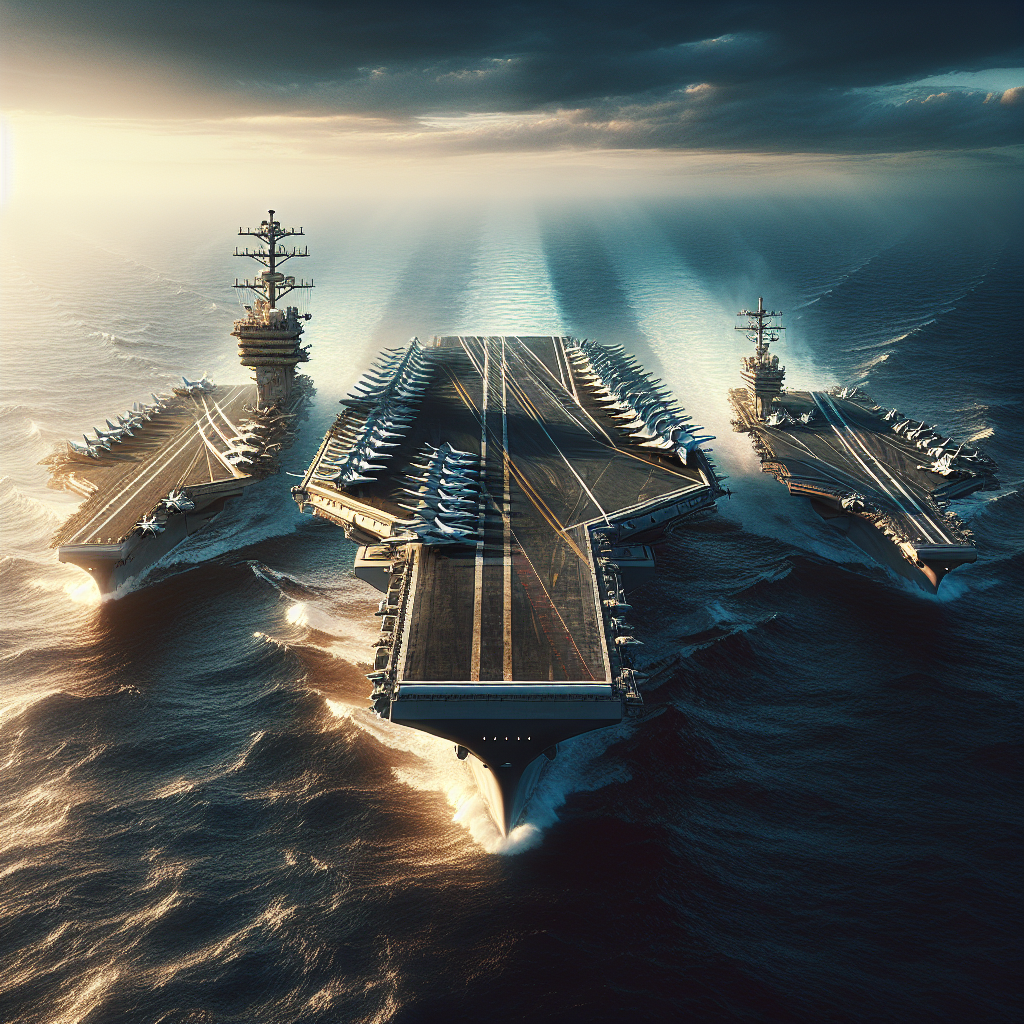
The Trump administration in the United States has dispatched the aircraft carrier USS Gerald R. Ford to the Iranian waters, to rendezvous with the USS Abraham Lincoln, forming a massive dual-carrier strike group.
The USS Abraham Lincoln (CVN-72) is a Nimitz-class nuclear-powered aircraft carrier, currently operating near the Iranian coast. The carrier is equipped with a formidable carrier air wing consisting of about 90 aircraft, including the F-35C Lightning II stealth fighter and F/A-18 Super Hornet fighter jets, capable of penetrating deep into enemy territory for strikes.
The USS Gerald R. Ford (CVN-78) has been redirected from the Caribbean to the Middle East to join the Lincoln. This deployment coincides with President Trump’s efforts to increase pressure on Iran, urging them to reach an agreement on nuclear weapons. Trump has warned of “very serious” consequences if negotiations do not yield results in the coming weeks.
With the deployment of both carriers in the Arabian Sea region, the United States will possess a naval aviation force consisting of nearly 180 fixed-wing aircraft and helicopters. This joint firepower surpasses the total size of many air forces of other countries, enabling the US military to strike strategic targets round the clock.
The Ford-class aircraft carrier is the newest and largest in the US Navy. It is equipped with an Electromagnetic Aircraft Launch System (EMALS), which can launch aircraft at faster speeds compared to conventional steam catapults. Combined with an advanced arresting gear system (AAG), higher levels of automation, and an efficient flight deck design, the stress on aircraft is reduced, increasing its operational availability by 33%.
The Ford-class aircraft carrier has a full load displacement of approximately 100,000 tons.
Displacement refers to the weight of water displaced by a ship when fully loaded and prepared for combat, which is essentially the total weight of a warship. Understanding displacement helps to grasp the physical and operational capabilities of a warship.
For the Ford-class carrier, this figure reflects its capability as a nuclear-powered floating base, enabling the carrier to deploy long-term without the need for frequent refueling.
The Ford-class carrier is approximately 1106 feet (334 meters) long, featuring a spacious flight deck for aircraft operations and an internal hangar below deck. With a height of around 134 feet (41 meters), equivalent to 10-13 stories, the carrier has a top speed exceeding 30 knots (34.5 miles per hour).
The displacement is sufficient to accommodate 60 to 75 aircraft, 4000 to 4500 crew members, and all necessary mission equipment.
The nuclear propulsion system significantly enhances the carrier’s displacement. The Ford-class carrier is powered by two A1B nuclear reactors, providing nearly unlimited endurance at sea for decades without the need for conventional fuel. This sustained operational capability allows the US Navy to maintain a continuous presence wherever deployed.
The carrier carries multiple squadrons, including F/A-18 Super Hornet fighter jets, E/A-18G Growler electronic attack aircraft, E-2D Advanced Hawkeye early warning aircraft, and a helicopter detachment. This robust air combat capability solidifies its position as a core component of US naval power projection.
Carriers do not operate alone but are accompanied by a fleet escort of missile destroyers and cruisers. These warships, including Arleigh Burke-class destroyers, are equipped with Aegis Combat System for missile defense and anti-submarine warfare, forming a robust defensive shield above the fleet.
Sending two carrier strike groups is a rare tactic used only in times of significant crisis to demonstrate steadfast determination.
The US aims to deter the Iranian regime and prevent further aggression, particularly concerning Iran’s ballistic missile program and support for regional proxy organizations, by showcasing overwhelming military strength.
The region currently faces a high-risk standoff scenario, with concentrated firepower in a confined area. While diplomatic channels between the US and Iran remain open, the presence of the Ford-class aircraft carrier alongside the Lincoln signals US preparedness for all eventualities, including potential military action if the deadlock persists.