
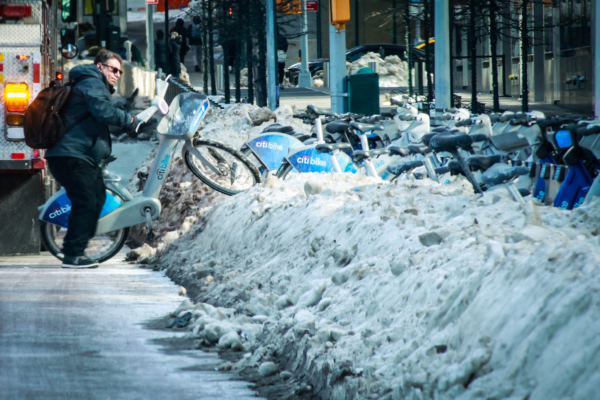
Over the weekend, a powerful “bomb cyclone” swept across the eastern half of the United States, causing a widespread and extreme cold snap from the Gulf Coast to New England. Meteorologists have warned that dangerous low temperatures will persist until Monday morning, with approximately 150 million Americans under various levels of cold weather alerts.
Since late January, a series of winter storms have resulted in over 110 deaths across the United States. Peter Mullinax, a meteorologist at the National Weather Service (NWS) in College Park, Maryland, stated that on Sunday, approximately 150 million people in the East Coast were under cold weather advisories and extreme low temperature warnings. Southern states saw temperatures drop below 10°F (-12.22°C), with southern Florida experiencing its coldest air mass since December 1989.
Mullinax said, “This cold snap is truly remarkable, with record-breaking low temperatures being set daily in the southern regions.”
North Carolina was hit hard by the storm, with snowfall reported in all 100 counties during this historic winter storm. The largest city, Charlotte, saw nearly 12 inches (about 30 cm) of snow, marking it as one of the top five snowfalls in the city’s history.
In Davidson County, Lexington recorded 16 inches (about 40.6 cm) of snow during the storm, setting a new historical record for single-day snowfall in the county.
According to flight tracking and data company FlightAware, over 2,800 flights in the U.S. were canceled on Saturday, with an additional 1,800 flights canceled on Sunday, including over 800 flights at Charlotte Douglas International Airport (CLT) alone.
Governor Josh Stein announced on Sunday that there have been over 1,000 traffic accidents and 2 fatalities statewide.
In the Outer Banks, strong winds and giant waves caused an uninhabited coastal house on Hatteras Island to collapse.
Local resident Susan Sawin described the astonishing wind gusts, “The wind was blowing crazily, the roaring winds made the entire house shake.”
She believed that the term “bomb cyclone” accurately described the storm.
“Last night’s wind carrying snow felt just like that,” she said. “The term fits well.”
Even the usually warm state of Florida experienced rare phenomena. Tampa reported snowfall, and due to the cold weather, some witnessed frozen American iguanas falling from trees and lying motionless on the ground.
In southern Florida, iguanas go into dormancy during the cold; although they typically awaken when temperatures rise, prolonged extreme cold could lead to the death of these reptiles.
Local farmers in Florida have been spraying water on strawberries and citrus fruits in advance to use the ice layer as a “protective shell” against the low temperatures. As of Sunday afternoon, over 12,000 households in Florida were without power.
In the southern regions, damaged infrastructure has left tens of thousands of people struggling. Tennessee and Mississippi still have over 81,000 households without power, with some homes facing days without electricity.
Jamita Washington, a resident of Vicksburg, Mississippi, said her home lost power during a previous storm, leading her and her son to stay in a hotel for three nights until power was restored last Thursday.
However, one of the two furnaces in her home froze and malfunctioned; upon returning home, with nighttime temperatures still near freezing, she had to resort to sleeping on the living room sofa.
“It’s frustrating, but I think to myself: there are people in worse situations than us,” she said. “I know a few homeless people, so I feel that, to some extent, we are fortunate.”
Weather forecasts indicate that while temperatures will slightly rise on Monday, the Ohio Valley and Mid-Atlantic regions (including Washington D.C. and New York City) may continue to see light snowfall from Tuesday to Wednesday.
(Partial references from The Associated Press and The Washington Post)