
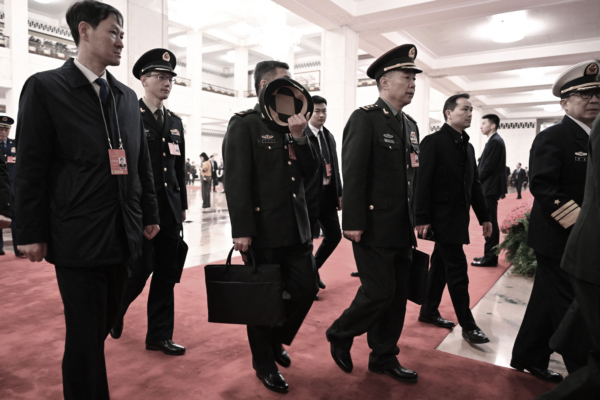
On January 24th, Vice Chairman of the Central Military Commission of the Communist Party of China (CPC), Zhang Youxia, and Military Commission member Liu Zhenli were both announced to have fallen from power, causing strong attention from various sectors. However, except for the military newspaper’s characterization of the two that night, the subsequent propaganda from the CPC remained silent, the military did not collectively make a statement, and the military camps were instead focused on learning the so-called “Strong Military Thought” of the leader. Today, on January 30th, the military newspaper published a high-profile article on anti-corruption, but avoided mentioning Zhang and Liu, leading observers to consider it abnormal.
The CPC military newspaper published an article titled “Advancing the Anti-Corruption Struggle with Greater Clarity and Determination” on its seventh page on January 30th. The author was from the so-called “Xi Thought” Research Center of the National Defense University.
The article presented a series of slogans: “Fighting against corruption is a major struggle that we cannot afford to lose and must not lose,” “Resolutely wage a tough, protracted, and overall struggle against corruption,” “There must be no place for corrupt elements in the military,” “We must win the significant political struggle against corruption completely without relenting,” and so on.
However, in this significantly high-pitched anti-corruption article, there was no mention of Zhang Youxia and Liu Zhenli, who were reported to have fallen from grace a few days prior.
Commentator Li Linyi stated that in the past, when similar high-ranking “big tigers” like Guo Boxiong, Xu Caihou, and Zhou Yongkang were removed from their positions, if the official media immediately published such high-profile anti-corruption articles, it was definitely to eliminate the remaining influence of these “big tigers.” Now, as the military newspaper avoided mentioning Zhang and Liu, it seemed somewhat out of the ordinary.
Moreover, a check on the content of the CPC’s military website in recent days revealed that some war zones and military branches, such as a certain unit of the Armed Police and a unit of the Beijing Garrison, were engaged in political study sessions, focusing on the “Xi Jinping Strong Military Thought.”
Li Linyi expressed that the downfall of Zhang Youxia and Liu Zhenli should theoretically have been the climax of the so-called “tiger-hunting,” but it appeared that various military regions were using the study of “Xi Strong Military Thought” to indirectly resist studying documents related to Zhang Youxia’s fall.
On the 28th, Epoch Times exclusively reported that after Zhang Youxia and Liu Zhenli were investigated by the CPC authorities, several directives issued by the Central Military Commission to the military were generally resisted at the grassroots level. Among them, at least two documents issued by the General Office of the Central Military Commission to major war zones and group armies were not implemented, orders within the military went unacknowledged, and the operational state of the CPC military experienced a rare abnormality.
Epoch Times reporters found that as of the early morning of January 30th Beijing time, the latest information on Zhang Youxia and Liu Zhenli on Chinese websites still remained at the notification of their investigation announced on January 24th, as well as the editorial published by the military website on that night.
On the 26th, the CPC military newspaper featured a commentary on the front page titled “Forever Sounding the ‘Charge Bugle,'” emphasizing, “Identity does not exempt one, merits are not a get-out-of-jail-free card,” listing the executions of several so-called “meritorious” individuals like Liu Qingshan, Zhang Zishan, Xie Busheng, Xiao Yubi, and Huang Kegong in the CPC’s past, without mentioning Zhang Youxia and Liu Zhenli. However, some observers felt that there were implications pointing towards Zhang and Liu.
By the 27th, the front page article of the CPC military newspaper discussed “Military Oil Supply Security,” only touching on “Technological Anti-Corruption” in the second section.
Senior Beijing media personality Gao Yu summarized on X platform on the 27th that the military newspaper’s criticism of Zhang and Liu on the 25th created a stir domestically and internationally; their article on the 26th had a strong start but weak ending; by the 27th, it was essentially “just going through the motions.” The changes over these three days brought to mind the idiom story of “Cao Gui discussing warfare” (referring to the military theory of “making initial progress, then fading, and finally exhausting”).
On the 28th and 29th, the CPC military newspaper did not have any significant anti-corruption articles. On the 30th, they published a vigorously worded article on anti-corruption, yet made no mention of Zhang Youxia and Liu Zhenli.
Currently, major CPC political and government websites have not removed Zhang Youxia’s information as a leader, and various military entities, war zones, and branches have not shown a similar wave of statements that followed the fall from grace of former Vice Chairmen of the CPC Central Military Commission Guo Boxiong and Xu Caihou.
China expert Zhang Tianliang analyzed in a video program that this kind of silence may reflect three situations: firstly, high-ranking military officials choose to wait and see before the situation becomes clear; secondly, the operation of some command systems has been affected; and thirdly, a temporary state of “suspension” in power dynamics has emerged.