
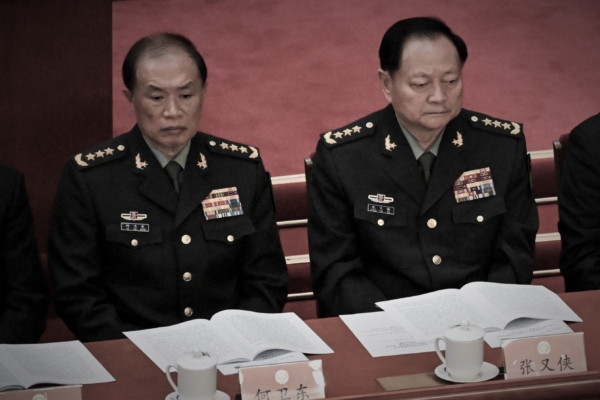
The Vice Chairman of the Central Military Commission of the Chinese Communist Party (CCP), Zhang Youxia, and the Member of the Central Military Commission Liu Zhenli, have been placed under investigation, sparking international attention. Not only have foreign media outlets reported on this matter, but many Western experts and scholars have taken to social media to discuss the latest purge within the CCP’s military.
With the downfall of 75-year-old Zhang Youxia and 61-year-old Liu Zhenli on grounds of “serious violation of discipline and law,” the top echelons of the CCP military are almost entirely wiped out.
The Central Military Commission has two vice chairmen, and Zhang Youxia is considered the more experienced and powerful of the two vice chairmen, being one of the highest-ranking military officers in the CCP and a member of the CCP Central Political Bureau. Liu Zhenli, at 61 years old, served as the Chief of the General Staff of the Joint Staff Department of the Central Military Commission, responsible for operational planning and being one of the core institutions of the military.
Taylor Fravel, Director of the Security Studies Program at MIT and a board member of the National Committee on U.S.-China Relations, posted on social media that with the investigation of Zhang Youxia and Liu Zhenli, the Central Military Commission is now left with only one military officer – compared to six around two years ago. This vacuum in the top leadership of the military is unprecedented.
Chinese-American journalist Lingling Wei from The Wall Street Journal posted on social media that this is far from over, as thousands of officers who were promoted under Zhang Youxia and Liu Zhenli’s leadership now realize they are targets of the purge.
She revealed that indicators show a crisis has erupted: mobile devices of officers at all levels have been confiscated, and all units are on high alert.
Epoch Times cannot independently verify this information.
Henry Gao, a law professor at the Singapore Management University, posted saying that in simple terms, what is happening in China is that under dictatorship, there is absolute power. This means you cannot trust anyone, you must eliminate close associates, and unless they become you, no one is safe.
Fravel also discussed the impact of this purge on the combat readiness of the CCP’s military. “Rebuilding the officer corps and restoring morale takes years, not days or months—thus, the timeframe is critical for any risk-taking, determining whether the rebuilding can achieve the desired goals,” he said.
Decker Eveleth, a research analyst at the CNA Corporation specializing in satellite imagery, stated on social media that there are three possibilities, perhaps overlapping, but all detrimental to the combat effectiveness of the CCP: A) The military is corrupt to an alarming degree, with almost anyone of a certain rank involved or aware, thus implicated. B) Xi Jinping perceives the loyalty of the military to him and his plans as insufficient. C) Xi is not adept at management and will purge anyone he deems performing poorly, possibly due to his fixation on unrealistic timelines.
Yatabe Akio added that China’s (CCP) military is being hollowed out by this power play. Since 2013 under Xi Jinping’s leadership, the military has repeatedly undergone anti-corruption efforts, but the result is not the institutionalization and professionalization of the military, but rather round after round of political purges. In the end, it seems as though everyone has turned into corrupt officials.
Gao believes that anyone who thinks Zhang Youxia’s failure will accelerate a war with Taiwan misunderstands the basic logic: in China, the primary function of the military is as a tool for internal control within the party, not as a force against external enemies.
China expert Gordon Chang posted on social media that Xi Jinping is tearing apart the CCP in order to seize absolute power.
Gao stated on social media that history is seldom shaped by great individuals, but more often by ordinary people. After all, the first shot of the 1911 (Xinhai) Revolution was accidentally fired by a careless soldier. Remember, a powerful empire can collapse due to the loss of a single horseshoe nail.
Yatabe concluded on social media that China today is gradually approaching a similar historical juncture. When power is held together by fear, when loyalty replaces competence as the sole criterion, the outward appearance of this country may still be vast, but internally it is already fragile. Such a structure may not collapse immediately, but it is almost certain not to withstand a real storm.