
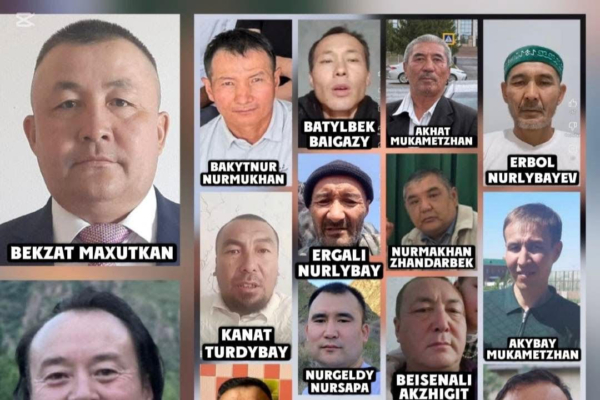
Kazakhstan authorities are set to hold a public trial for 19 members of the Kazakh human rights organization Atajurt Kazakh Human Rights on January 23 at 3:00 p.m. in Almaty time. The individuals are facing charges for publicly protesting against the Chinese Communist Party’s policies in Xinjiang, a case that has recently gained international attention from human rights organizations and societies worldwide.
According to members of the Kazakh human rights organization Atajurt Kazakh Human Rights, the scheduled court hearing for the 19 members that was supposed to take place on the morning of January 21 has been postponed to the afternoon of January 23.
Several human rights organization members have noted that Kazakh authorities in various regions have been summoning individuals associated with Atajurt Kazakh Human Rights and their families, urging them to refrain from participating in any gatherings or public activities related to the trial. Meanwhile, official and pro-government media have been issuing accusatory statements against Atajurt Kazakh Human Rights and its leaders, raising concerns about the tightening of freedom of speech in the region.
Founder of the volunteer organization Atajurt Kazakh Human Rights, Serikzhan, told Epoch Times, “With the increasing attention from the international community, there are divisions within the higher echelons of Kazakh leadership on how to handle the case. Some advocate for harsh measures, while others believe consideration should be given to reactions from Western countries and international human rights organizations.”
Serikzhan also mentioned that the location of the trial, Talghar, has been under high security measures recently, with a heavy deployment of armed forces in the area and restrictions on personnel and traffic control being implemented. Additionally, members of Atajurt Kazakh Human Rights and their families have been summoned and warned by the police in various locations to avoid participating in any gatherings associated with the trial.
Regarding the accusations made by some official and pro-government media against himself and Atajurt Kazakh Human Rights, Serikzhan denied them, stating that Atajurt Kazakh Human Rights has long been engaged in public human rights documentation and assistance work, unrelated to any foreign influence.
International human rights organizations have voiced their concerns about the case. Amnesty International released a statement calling on Kazakh authorities to respect the legitimate activities of human rights organizations and ensure the defendants’ right to due process. Several international human rights groups have also issued a joint statement demanding the immediate and unconditional release of the human rights defenders facing charges.
Furthermore, a United Nations human rights mechanism official expressed on social media that they will be monitoring the progress of the trial. Organizations such as Human Rights Watch have called on Kazakhstan to fulfill its international human rights obligations.
Atajurt Kazakh Human Rights has long been focused on human rights issues in Xinjiang and has been assisting victims in speaking out. It is widely believed that this case has transcended the usual scope of judicial matters and has become an important test for Kazakhstan in terms of human rights conditions, international relations, and domestic governance, with the trial’s outcome expected to continue garnering international attention.
As previously reported by Epoch Times, Kazakh judicial authorities have formally charged the leader of the Atajurt Kazakh Human Rights volunteer organization, Bektzhati, and 19 members with “inciting ethnic hatred.” The charging documents indicate that the case stemmed from a collective protest action that occurred on November 13, 2025, in Uighur County, Almaty State. The prosecution alleges that the individuals burned Chinese flags and portraits of Chinese leaders along the roadside and uploaded the images to foreign social platforms, constituting incitement of ethnic antagonism through mass media.
Several legal experts familiar with the case have pointed out that one of the controversial aspects of this case is the inclusion of a full diplomatic note submitted by the Chinese authorities to the Kazakh Ministry of Foreign Affairs in the criminal prosecution materials. Defense lawyers have stated that using a foreign government’s diplomatic notes as significant evidence in a criminal case is extremely rare in local judicial practice.