
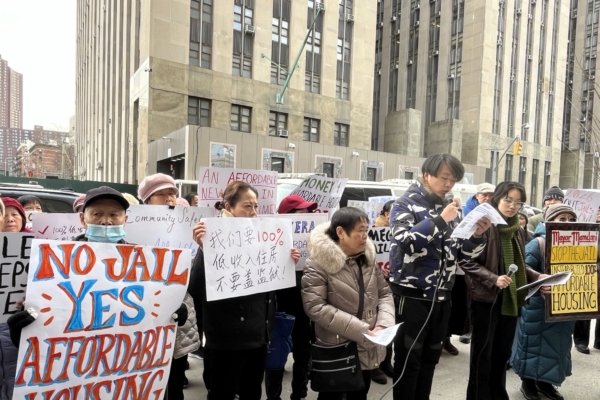
In New York City, Chinatown and the Lower East Side community groups gathered near the proposed prison site on the 22nd, urging Mayor Mamdani to immediately halt the construction of the “Chinatown New Prison” project and instead utilize city-owned land to build 100% truly affordable housing. The organizers pointed out that the upcoming prison construction meeting by the city government follows the arrangements made during the previous mayor Adam’s administration, symbolizing a policy of “change in personnel, not in direction,” which will exacerbate displacement and harm the livelihoods of small businesses and residents.
The rally was hosted by the “Chinatown and Lower East Side Alliance” and youth organization “Youth Against Displacement” member, Alice. She expressed that the community had hoped for a “new era” with the city government, but what they see now is the continuation of “the same disastrous policies.” She criticized that since the prison plan was proposed, surrounding areas have seen small businesses being forced to relocate, housing environments being affected, and construction demolition causing concerns like dust. If the new prison is completed, it will further raise community costs, drive out residents, and label Chinatown and the Lower East Side as “criminalized.”
Alice emphasized that for years, Chinatown has lacked new affordable housing, as residents face the harsh realities of skyrocketing rents and the closure of old shops, closely tied to property tax increases and “developer-oriented” policies. She noted that the large public space left behind after the demolition of the original prison is an opportunity to address the city’s housing crisis, stating, “What we need is not a smaller Rikers Island relocated to Chinatown, but homes that people can afford to live in.” The crowd responded with slogans: “Build affordable housing, stop the prison!”
A Chinese tenant living near Chinatown, Hou Zhuying, shared her own experiences at the rally. She said that due to her age, her landlord had harassed her for a long time and even filed eviction lawsuits against her, treating her as a “criminal.” With the help of student, worker, and tenant groups, she eventually fought back successfully and won her case. Hou extended her personal experience to public policy, criticizing the previous city administration for pushing the Chinatown prison project, similarly disrespecting the community and treating residents as criminals, and urged the new mayor to “correct the mistakes of their predecessor,” stop the prison, and build 100% affordable housing, stating, “We will unite and resist.”
Representing the arts and culture group “Art Against Displacement,” Cindy Huang, a Chinese delegate, pointed out that the city government proposed building four new community prisons, with one located in Chinatown. While the official goal is to “close Rikers Island,” if there is no fundamental reform in the penal system, the harsh environment of Rikers Island could be “transferred” to the new prison. She emphasized that investing public funds in incarceration facilities, rather than low-income housing and community resources, is not the path to true community safety and prosperity.
Lower East Side resident Louis Velez cited housing affordability as an example, noting that local rents have become alarmingly high. “In my neighborhood, rents have risen from $5,000 to $7,000,” with even senior apartments renting close to $5,000, making it unaffordable for retirees and the working class. She mentioned that shelters are overcrowded, with waiting lists numbering tens of thousands; if the city government insists on building prisons instead of housing, it will only worsen homelessness and displacement issues.
At the end of the rally, the organizers once again called on Mayor Mamdani to demand that the city government stop continuing the policies of the previous administration and collaborate with the community to redevelop the Chinatown prison site into truly affordable housing that can retain residents. The organizers stated that Chinatown and the Lower East Side do not lack prisons; what they truly lack are homes where people can thrive. “To be safe, we need housing; to prosper, we must fight against displacement.”