
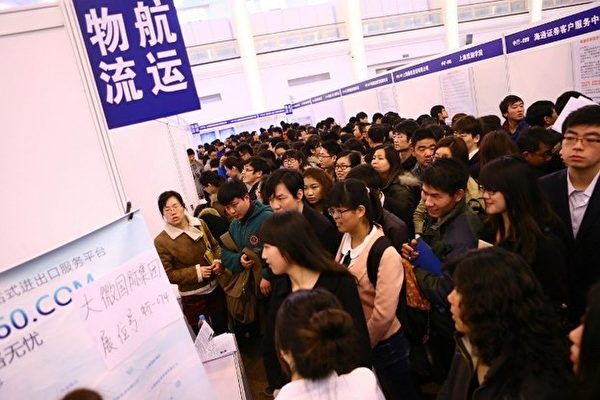
On Thursday (January 22), the official Chinese Communist Party (CCP) released data claiming that the unemployment rate for Chinese non-students aged 16-24 in December was 16.5%, which has been declining for four consecutive months. Analysts believe that this unemployment rate indicator by the CCP does not reflect the true situation.
The National Bureau of Statistics of China announced statistics on the unemployment rate by age group in December 2025 on Thursday. In December last year, the urban unemployment rate for the labor force aged 16-24, excluding students, was 16.5%, a decrease of 0.4 percentage points from the previous month and a continued decline for four months. The unemployment rate for the labor force aged 25-29, excluding students, was 6.9%, a decrease of 0.3 percentage points compared to the previous month. The unemployment rate for the labor force aged 30-59, excluding students, was 3.9%, an increase of 0.1 percentage point from the previous month.
Additionally, in December, the national urban surveyed unemployment rate was 5.1%, unchanged from November. The average national urban surveyed unemployment rate for the whole of 2025 was 5.2%, lower than the expected target of around 5.5%.
The above data provided by the CCP is based on adjusted standard statistics. Since 2022, the youth unemployment rate in China has significantly increased, reaching a peak of 21.3% in June 2023. Subsequently, the authorities stopped publishing the youth unemployment rate. Only on January 17, 2024, after “adjustment,” did they release the urban labor force unemployment rate “excluding students.” The unemployment of college graduates is a significant factor contributing to the unemployment rate. The number of ordinary college graduates in China has been increasing year by year, reaching 12.22 million in 2025, setting a new historical record.
Moreover, China’s so-called “national urban surveyed unemployment rate” only samples surveying 340,000 urban permanent residents (living for more than six months) in 31 provinces (regions, cities), excluding rural agricultural labor force.
Many experts believe that the official statistics provided by the CCP cannot reflect the actual unemployment situation.
Chinese issues expert Wang He analyzed to Epoch Times that the CCP’s statistics focus on the urban youth unemployment rate, while a large part of China’s youth live in rural areas, where much of the hidden unemployment is not captured in these statistics.
Commentator Xiao Yi pointed out in an article that a group of nearly 300 million people (rural migrant workers) are systematically underestimated or omitted. He mentioned that a large number of migrant workers are mobile and tend to return to rural areas when unemployed, not meeting the official unemployment standards, hence not being accounted for. This results in the urban surveyed unemployment rate appearing stable, while, in reality, a significant amount of hidden unemployment has shifted to rural areas.
He also noted that the CCP sets the employment standards very low, masking the true situation of the labor market and exacerbating issues like hidden unemployment (such as flexible employment).
In China, casual labor, part-time jobs, ride-hailing drivers, platform delivery workers, and food delivery riders are all considered part of the employed population. In contrast, in the United States, working at least 15 hours a week counts as employment, and for France, the threshold is 20 hours.
Regarding the official unemployment rate data, Chinese capital market veteran Xu Zhen also told Epoch Times that besides labor force data, attention should be paid to non-labor force data and composition. He stated, “In the CCP’s calculation of the unemployment rate, through manipulation, it is very likely that parts of the unemployed people in the numerator or denominator are classified as non-labor force.”
For example, “a large number of ‘lying flat’ individuals giving up job search, ‘hidden unemployment’ supported by families, and zero-income ‘flexible employment’ personnel.”
“If considering these unemployed individuals,” said Xu Zhen, “the unemployment rate for non-students aged 16-24 would only increase along the lines of June 2023’s youth unemployment rate of 21.3%, instead of decreasing. That is the current true situation in China.”
Regarding the CCP’s claim of a continuous four-month decline in the youth unemployment rate, Xu Zhen believes that it is likely the result of technical manipulation through “narrowing the numerator” or “synchronously narrowing the numerator and denominator,” rather than actual improvement in the economy and job market.
He stated, “The continuous decline in the unemployment rate shows obvious traces of artificial tampering from an economic logic perspective, which aligns perfectly with the current political narrative of the CCP.”
Currently, the Chinese economy continues to deteriorate.
Recently, Wang He wrote,
“The economic situation is already unstable, as evident from the ‘first time’ in two official data sets. The first is the three consecutive years of deflation, unprecedented in history. The second is the national fixed asset investment negative growth, the first since the data was released in 1996.”
Xu Zhen mentioned that in recent years, the Chinese economy has continuously worsened, “young people are increasingly feeling uncertain about their future and losing confidence in the CCP, actively withdrawing from the labor market. This is not ‘improvement in employment’ but rather discontent and despair.”
Wang He believes that there is currently no hope for improvement in the Chinese economy, so for young people in China, the low employment rate may persist for a long time.
So, how significant is the specific unemployment data? Zhang Dandan, an associate professor of economics at Peking University, previously revealed that in March 2023, the peak value of the youth unemployment rate in China reached 46.5%, far exceeding the 19.7% officially announced that month.
Wang He said, “If this economy has innovative and breakthrough developments, then the employment rate for young people, especially university students, should improve rapidly. But now there is a reverse trend, indicating the severe deterioration of the entire Chinese economy, where these young people basically have no job opportunities.”
Wang He believes that this not only affects one generation but also indicates the extremely severe degree of the overall Chinese economic crisis, a situation that most CCP media downplays but is actually very dangerous.
Xu Zhen also believes that the fundamental reason for the economic deterioration lies in the CCP’s system itself, caused by the national system and party-controlled economy. It will continue down a dark path.