
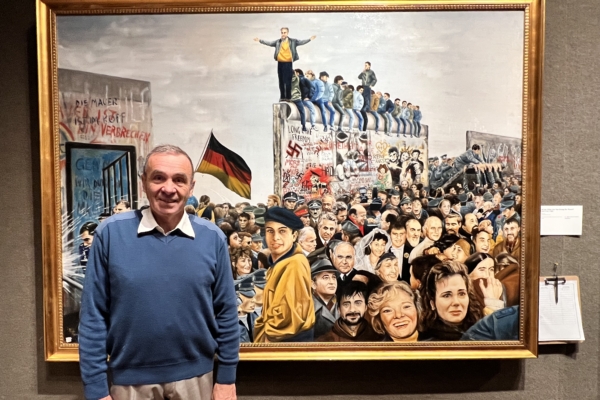
On the evening of January 22nd, the 7th NTD Worldwide Realistic Portrait Oil Painting Contest was held at the Salmagundi Club in Manhattan, New York. French artist Alain Amar won the “Outstanding Humanities Award” with his work titled “What Have You Done for Peace?”
Amar brought two pieces to the exhibition: “The Call for Revival of Faith” and “What Have You Done for Peace?” During an interview, he spoke about his years of contemplation on peace and human spirituality in his artistic creation. He strongly believes that the source of art comes from humanity’s perception of a “higher existence” – whether people call it God, spiritual power, or the light of the universe, and art is the way to connect with that unseen world.
“The Call for Revival of Faith” explores the spiritual emptiness of humanity and the redemption of spiritual power.
Describing his creative process, Amar mentioned that his pace is “very slow.” He builds the composition with 8 to 9 layers of paint, intentionally pausing for two to three weeks between each pair of layers to let the painting “sleep” and to meditate on the theme, reconnecting with the work.
“If you rush, you will lose inner peace. My paintings take over a year to complete because I must create in a calm state of mind,” he said.
He hides the artwork for two weeks, completely forgetting it, before facing it anew. This distance allows him to return to the piece with a fresh perspective.
“Turning the invisible into visible” is Amar’s summary of his artistic mission. He explained, “I believe everything is created by God. If we paint what God has created, whether it’s landscapes, seascapes, or figures, we must elevate it rather than change it. The mission of an artist is not to destroy or reshape the world but to reveal it.”
To him, the truly important things are often the “invisible things” – “goodness, hope, spirituality, love – these are all real. My work is to make these things visible.”
In the painting “The Call for Revival of Faith,” the dying soul symbolizes spiritual hunger, while the giant, outstretched hand crossing the water surface represents spiritual power – “not oppression, but giving, resurrection.” The drop of water between the fingers signifies his understanding of life: “The power of spirituality is so strong that just a drop can bring rebirth.”
The desert and solitary island in the artwork serve as a metaphor for modern society in his eyes. “Many people live in cities, surrounded by others, yet inside they feel like they are in a desert or on a deserted island, very lonely,” he expressed. “There is an abundance of material things, but spiritual poverty.”
As a Christian, Amar believes that the artist’s responsibility is to witness and present the beauty created by God. He supports the NTD Realistic Portrait Painting Contest’s concept of “reviving truth, goodness, and beauty” and believes that true beauty can elevate the soul, seeking “profound and serene joy” rather than fleeting good feelings.
In a contemporary art world dominated by abstract art, Amar upholds realism and considers it a form of respect for the audience. He stated, “People can resonate with authentic images directly and honestly.”
However, he emphasized that realism is not about reproducing photographs. “If it’s just copying, it’s meaningless. Realism is about elevating reality to show deeper truths.”
He cited Vermeer’s “Girl with a Pearl Earring” as an example, highlighting the irreplaceability of realism. “A photo can never replace a painting because the artist adds soul in the subtle details.”
“At the studio, they tried to reproduce a photo, brought in a model that resembled the girl in the painting, took a picture. But if you look at that photo, you will realize Vermeer’s genius because compared to the actual painting, the photo is very poor, too artificial.”
This underscores the master’s genius: true art goes beyond visual representation; it carries the artist’s sublimation and interpretation of reality.
The award-winning work “What Have You Done for Peace?” with its title itself poses a direct question to the heart of people. Amar emphasized that it’s not a question for political leaders but for every ordinary individual.
“Peace is not something given by leaders”, he said. “Peace is the result of each one of us making a choice. Just saying ‘I haven’t done anything wrong’ is not enough; you must actively build peace.”
The inspiration for this piece came from the historical moment of the fall of the Berlin Wall on November 9, 1989. Amar was deeply moved, stating, “It was a rare peaceful collapse in history. No violence, no deaths.”
The painting incorporates different historical scenes into one composition, depicting the convergence of multiple eras and figures: West German Chancellor Kohl and Gorbachev symbolize political cooperation; cellist Rostropovich and conductor Bernstein represent the peaceful power of music; a little girl presenting a rose to a policeman tells a true story of innocence and goodwill; the graffiti on the wall preserves the traces and memories of history.
He believes that the root of war often lies not in institutions but in the human heart. “When we only seek possession and control, conflicts arise. The root of peace lies in sharing, respect, and love,” he expressed.
He particularly mentioned the power of “non-revenge.” “Not seeking revenge is actually harder than revenge,” he said. “But this is the true way to break the cycle of hatred.”
Using the fall of the Berlin Wall as an example, he explained how systemic change doesn’t necessarily rely on violence. “It didn’t happen overnight; it was the result of many years, countless individuals accumulating slowly in their hearts. It’s a collective spiritual force.”
He stated that this force is not limited to Germany or Russia but is present worldwide. “People are like drops in the ocean, individually small, but enough drops can create waves of change in the world. This force is like water hitting a wall day after day – the wall may seem immovable, but at some point, it crumbles.”
This “invisible yet powerful” force resonates with his alignment with NTD’s mission. He believes that what the organizers pursue – truth, goodness, beauty – is a way to change the world without resorting to violence. “It’s a fight that doesn’t require combat, the most powerful force.”