
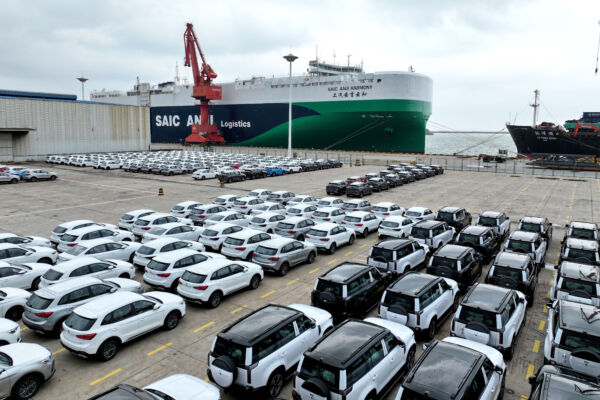
Poland may ban Chinese-made cars from entering military facilities to protect national security, according to Deputy Minister of National Defense Cezary Tomczyk.
In an interview with Polish Radio 24 on Tuesday, Tomczyk stated that the Ministry of National Defense in Poland is evaluating the potential risks posed by “a large number of vehicles equipped with electronic devices” and considering restricting such vehicles from entering military facilities.
Tomczyk declined to disclose when a final decision would be made, citing that due to national security concerns, more details may continue to be classified.
Despite China’s support for Russia’s full-scale invasion of Ukraine, Poland maintains trade connections with Beijing. Warsaw has repeatedly accused Moscow of carrying out hybrid attacks on Polish territory.
Chinese Foreign Ministry spokesperson Guo Jiakun said on Monday that Beijing has noted reports of Poland potentially making such a decision and argued against overly expanding the concept of national security.
According to data from the Polish Automotive Industry Association PZPM, the market share of Chinese brand cars in Poland increased over fourfold in 2025, jumping from 2% in 2024 to 8.2%. The association predicts that with a price advantage, this figure could quickly rise to 15%.
In December 2025, Chinese car sales surged in Poland, with 9,821 registrations, over four times higher than the same period in the previous year, accounting for 14.5% of new passenger car registrations for the entire year. Leading Chinese-manufactured cars in Poland include models from SAIC Motor Corp.’s MG brand, Chery Automobile Co., and BYD Co.
Previously, Polish experts have issued warnings about this matter. The Center for Eastern Studies (OSW) in Warsaw released a report in December last year warning that these Chinese vehicles could pose espionage risks, describing the intelligence gathering capabilities of new cars as “smartphones on wheels.”
Author of the report Paulina Uznańska pointed out that Chinese-made cars bring two major risks: susceptibility to cyber-attacks (such as remote hijacking or sensor interference) and massive collection of sensitive data, including critical infrastructure and biometric information. Processed data could reveal sensitive locations, such as military units and surrounding traffic conditions.
She emphasized that Beijing views smart vehicles as a groundbreaking technology with significant national security implications and suggested Poland adopt China’s cautious attitude toward foreign-made smart cars, such as Tesla being restricted from approaching all military zones in China.
Israeli military also implemented a similar ban on Chinese-made cars last year, concerned about sensors and cameras in the vehicles leaking sensitive information.
When asked if there are concerns that Chinese-produced vehicles could be used for surveillance and data collection, Tomczyk stated, “This is not a possibility – this is a fact.”
Recent restrictions in Poland include prohibiting military personnel from driving Chinese-made vehicles into certain facilities.
A Tesla was denied entry into the 1st Warsaw Armored Brigade base, as reported by CyberDefence24. Paulina Uznańska, Deputy Director of the China Division at the Center for Eastern Studies, stated to Interia that some Tesla vehicles are manufactured in China, with their data centers also operated there.
The Ministry of National Defense in Poland confirmed that in response to threats posed by using Chinese-made equipment, and to protect the security of military facilities, the Military Counterintelligence Service (SKW) issued relevant guidelines in 2025.
Furthermore, Poland’s “2022 Homeland Defense Act” was strengthened last year, adding provisions that prohibit producing or transmitting images or videos of locations with special significance to national security or defense. These restrictions also apply to vehicles equipped with image and sound recording devices. Military unit commanders have the authority to decide autonomously whether to allow such vehicles entry based on the actual circumstances.