
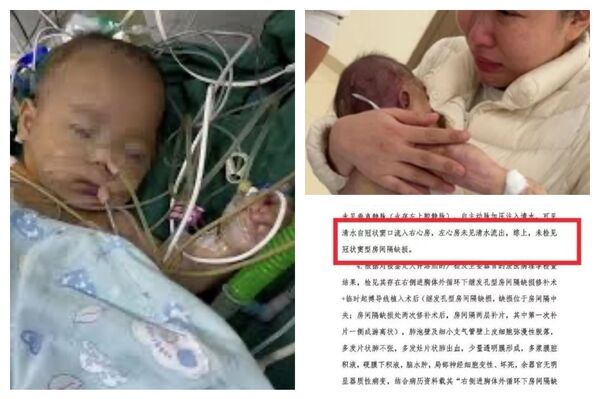
On January 19th, the trial of the “Xiao Luoxi” case in Ningbo took place. A large number of netizens from various places rushed to the courthouse spontaneously to show support. Xiao Luoxi’s mother and grandmother bowed to the crowd to express their gratitude. Xiao Luoxi’s grandmother even knelt down on the spot, bringing tears to many netizens.
On November 14th last year, the premature infant Xiao Luoxi, who was only five months old, passed away after undergoing heart surgery at the Ningbo University Affiliated Women and Children’s Hospital. Since then, Xiao Luoxi’s parents have continued to seek justice, demanding the truth behind their child’s death. Parents collectively voiced their support online but faced strong censorship. The “Xiao Luoxi incident” sparked nationwide discussions on the quality of Chinese healthcare and doctor-patient relationships.
On the morning of January 19th, the medical dispute case of “Xiao Luoxi” was heard in the Haishu District Court of Ningbo. According to reports from Southern Net, many concerned individuals from across the country had gathered outside the courthouse to follow the progress of the case.
Videos circulating on Chinese social media showed a large crowd gathering outside the courthouse to cheer for Xiao Luoxi’s family. However, a significant number of police officers were stationed there, preventing people from approaching the courthouse gates. The verdict was not announced on that day.
After the court session ended, the crowd on-site shouted words of encouragement, with Xiao Luoxi’s grandmother kowtowing to express gratitude to the supportive individuals. The scene moved many to tears.
Many netizens expressed their emotions online, with comments like, “I cried seeing her kneel down, the Rong Rong family has been through so much hardship,” and “Seeing the grandmother kneel down made me burst into tears, I have been following this matter closely, Luoxi’s mother has been through a lot.” Some also pointed out the broader significance of seeking justice for the future safety and reliability of medical care to benefit countless children.
One netizen bluntly stated that this incident reflects the flawed legal system in China: “In a normal society, justice should be found in the hammer of the court, not in the cheers of the onlookers; right and wrong should be written in the verdict, not on the trending list.”
On November 14th last year, the five-month-old premature infant Xiao Luoxi passed away after heart surgery at the Ningbo University Affiliated Women and Children’s Hospital. Following this tragic event, Xiao Luoxi’s mother, Deng Rongrong, publicly accused the doctor of making inaccurate preoperative assessments and questioned the validity of the surgery. The surgery duration was originally stated to be 2.5 to 3 hours but ended up lasting around 7 hours, resulting in the unsuccessful resuscitation of the child in the ICU.
Under public pressure, the Ningbo Health Commission issued two statements announcing the suspension of the involved doctor, Chen, and commissioned the Hubei Chongxin Forensic Appraisal Center to conduct an autopsy at the family’s request.
On November 27th, the police accepted the family’s report. On December 12th, Xiao Luoxi’s parents filed a lawsuit, initiating the judicial process.
On December 19th, Deng Rongrong released the autopsy report on social media, pointing out details such as “a 6.5cm horizontal surgical incision in the 3rd to 4th ribs on the right side, left unstitched,” and “a 5.0cm unstitched surgical incision on the right side of the heart sac.”
Mr. Xu, Xiao Luoxi’s father, shared a video revealing that the autopsy results indicated the hospital’s surgical records were falsified.
Mr. Xu raised three points: mismatch between the diagnosis and the actual condition of the child, direct causes of death including surgical mishaps, and accusations of medical record forgery leading to the tragic outcome.
Xiao Luoxi’s mother, in a video, tearfully accused the doctor of deceiving the family, alleging medical record falsification that resulted in the child’s death due to unattended wounds.
On January 5th this year, Xiao Luoxi’s father received the Ningbo Health Commission’s final conclusion stating that there was no tampering with medical records but only “some issues with improper documentation,” which was met with skepticism from netizens.
This ongoing incident continues to garner widespread attention and outrage within society. While parents voice their support online, the Chinese authorities have resorted to heavy censorship.
In response, Chinese issues expert Wang He analyzed that the hospital involved in the case is one of China’s highest-level, Tier 3 Class A hospitals. However, discrepancies between the preoperative diagnosis and the autopsy results, loss of control during surgery, lack of critical monitoring, and other issues have reignited the trust crisis in Chinese healthcare.
According to official reports from the National Health Department, in 2006, there were 10,248 medical disputes nationwide. By 2016, this number had surged to 100,700, marking a tenfold increase in medical disputes over a decade.
Supreme Court judicial big data shows that in 2024, there were 12,857 medical malpractice liability dispute cases nationwide, averaging 35 cases per day, a 77.29% increase from 2021.
Wang He believes that after decades of healthcare reform in China, hospitals, especially prestigious ones, have become profit-driven entities. Doctors and nurses have transitioned from “angels in white” to “wolves in white coats.” The issues of difficulty and high costs in healthcare have become one of the “new three mountains” for the Chinese people, leading to increasing public grievances and escalating doctor-patient disputes.
The “Xiao Luoxi incident” has brutally illuminated the longstanding challenges in Chinese healthcare quality and doctor-patient relationships.