
Newly appointed New York City Education Director Kamar Samuels recently stated that the city government will make adjustments to the controversial math teaching reforms implemented in recent years. While retaining the “understanding-oriented” teaching concept, there will be a focus on strengthening students’ proficiency in basic arithmetic skills, including multiplication and division.
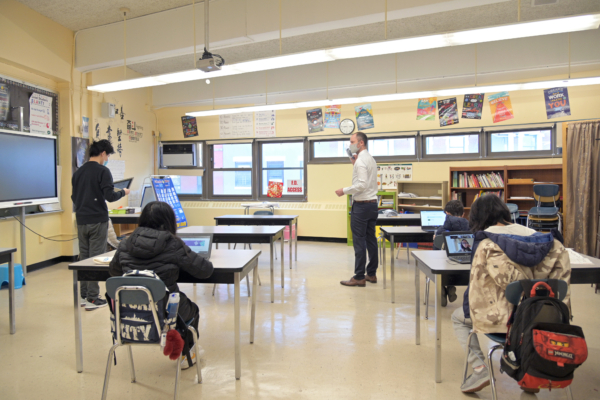
During the Adams administration, the math teaching reforms were collectively known as “NYC Solves,” primarily focusing on middle and high school math courses. The core idea of NYC Solves shifted from the traditional model of “teacher demonstration, students follow” to a student-led approach of discussing and exploring problem-solving. In the classroom, students typically first discuss solutions in groups, then teachers guide the concepts, emphasizing practical application and “understanding first” rather than simple repetitive calculations.
Former Education Director described this method as “productive struggle,” hoping that students would truly understand mathematical concepts through thinking and discussions.
However, many teachers criticized the curriculum for “assuming students already have foundational skills,” which is not the case in reality, leading to many students feeling frustrated during the learning process, especially those with learning disabilities and English language learners.
Samuels admitted that this is the focus of his proposed adjustments. He pointed out that currently, slightly over half of students in grades three to eight citywide meet the “proficient” standard in math assessments. If students lack proficiency in basic arithmetic, it will be even harder for them to keep up in higher grades. He specifically emphasized the importance of students being able to quickly and instinctively calculate basic multiplication and division, saying, “You have to be able to do quick calculations, otherwise the subsequent learning will be very difficult. Knowing the times tables by heart is really important.”
Samuels stressed that this adjustment is not a complete overhaul of the reforms but rather a “tweaking” of the curriculum. He also highlighted the importance of explaining to teachers and parents that practicing basic skills does not mean reverting to old-fashioned rote learning. He stated that the new teaching materials do “a great job” in conceptual understanding but emphasized that students must first master the basics.
The latest state test data shows a slight increase in math scores for grades three to eight, with a proficiency rate improvement of approximately 3.5 percentage points, reaching 56.9%. However, whether this improvement can be attributed to the NYC Solves teaching reforms still needs long-term observation.
On the other hand, Governor Huo Chu also called for a “return to basics” in math education in the latest state of the state address, indicating a gradual alignment of state and city levels in direction.