
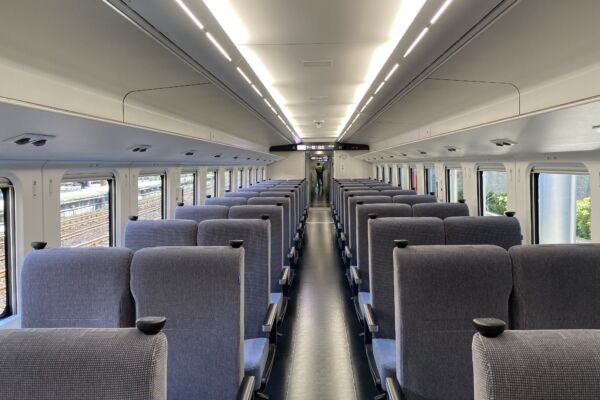
Have you ever seen seat belts on a train seat? Probably not. Even Japan’s high-speed Shinkansen bullet trains do not have seat belts installed. Why do cars, buses, and airplanes have seat belts, but trains do not?
American travel and lifestyle writer Sunny Fitzgerald wrote in Reader’s Digest that she always buckles up when traveling by car, bus, or airplane. However, in her over two decades of global travels, she has never seen seat belts on trains, including the Shinkansen she rode while living in Japan.
To address why trains, as a mode of transportation, lack seat belts, Fitzgerald interviewed safety expert Thomas Barth, a former investigator at the National Transportation Safety Board in the United States.
Barth explained that, with very few exceptions, train passengers do not need seat belts for the following reasons:
Although train collisions occasionally make the news, such accidents are extremely rare, especially compared to car accidents.
According to statistics from the Federal Railroad Administration in 2024, there were a total of 2,261 highway-rail collisions at public and private railroad crossings, resulting in 262 fatalities. In contrast, the National Highway Traffic Safety Administration estimated a staggering 39,345 deaths from traffic accidents in the same year.
Barth pointed out that trains have a controlled operating environment, running on tracks and managed by professional operators/dispatchers. This environment is considered very safe, hence the perception that the risk, even without seat belts, is deemed reasonable.
The impact force generated from a vehicle collision depends on the stopping speed of the vehicle. Barth explained: “A car hitting a brick wall comes to an almost immediate stop, resulting in very high impact force. On the other hand, trains are the opposite. With their large size and heavy weight, the impact force generated when hitting something relatively lighter is significantly lower.”
This difference in impact force between train collisions and car accidents makes the need for restraint systems on trains unnecessary, unlike in cars.
Barth also mentioned exceptional cases where head-on train collisions or derailments could produce high impact forces, but such situations are extremely rare.
Due to the more controlled operating environment of trains and their infrequent accidents, train safety focuses on avoiding severe collisions and derailments. A relatively new system called Positive Train Control helps in preventing severe collisions and derailments.
As for whether trains should be equipped with seat belts, Barth stated that it is a matter of personal risk tolerance. Regulatory bodies have not deemed the risk high enough to mandate seat belt use. Factors to consider include:
Current train seat designs are not suitable for certain types of seat belts. Installing seat belts on trains would require costly redesign, and the potential benefits may not outweigh the costs, given the low accident rates.
Even if seat belts were provided on trains, people might not use them—especially on trains that stop frequently, like subways. Passengers’ constant buckle and unbuckle actions might slow down train operations and cause delays.
Passenger seats that are compatible with seat belts would likely be harder and less mobile, potentially increasing discomfort and posing greater risks in the event of an accident where unbelted passengers could be thrown towards these seats or even sustain injuries or fatalities.
Some trains or routes only offer standing space, making it impractical to have every passenger wear seat belts. Mandatory seat belt use could lead to reduced passenger capacity on trains.
In conclusion, Barth emphasized that no mode of transportation is completely risk-free, but the designs and regulations of different transportation modes aim to mitigate risks to an acceptable level. For trains, the current acceptable level of risk does not necessitate passengers wearing seat belts.