
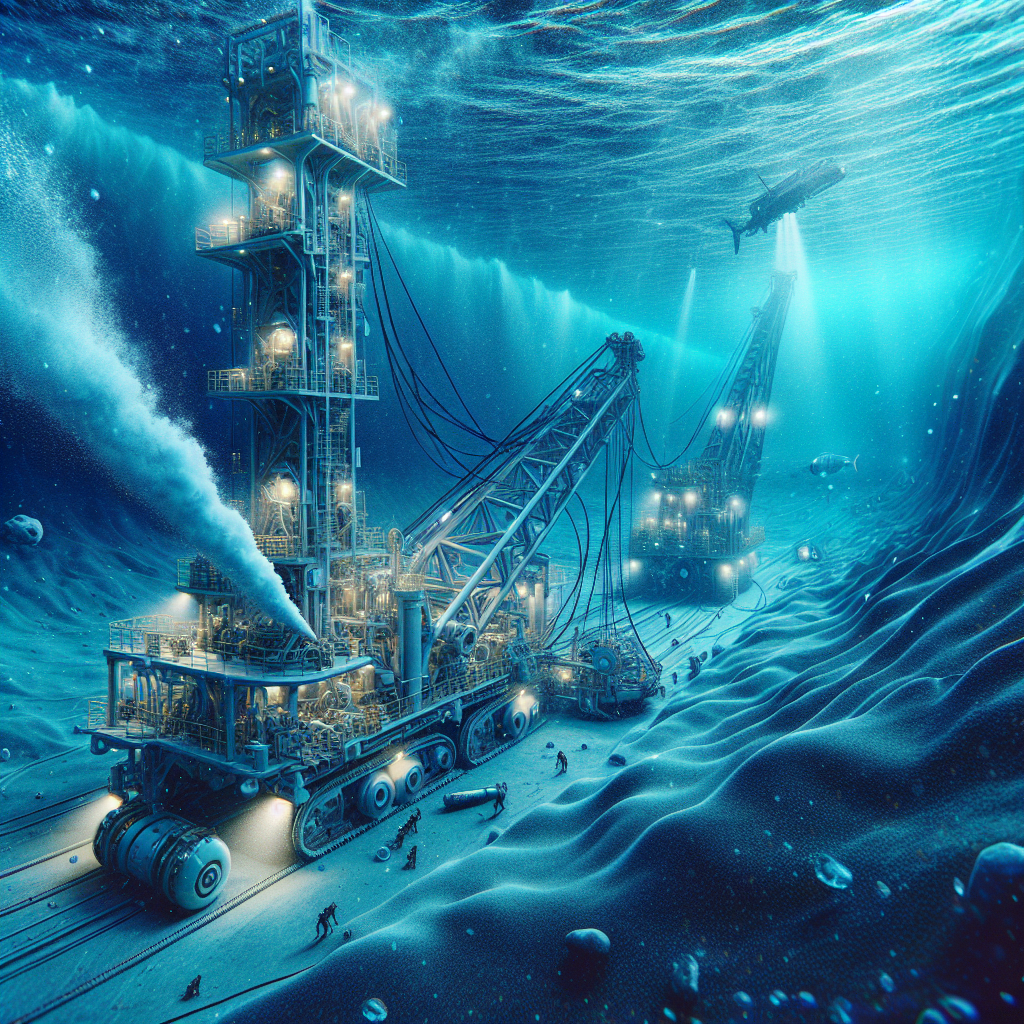
On January 12, Japan initiated the world’s first deep-sea rare earth trial mining in the waters of Minami-Tori-shima, attempting to recover rare earth sea mud from a depth of 6,000 meters. Experts have analyzed that against the backdrop of China’s use of rare earths as an economic pressure tool, Japan is expected to gradually reduce its dependence on Chinese rare earths.
The Japan research vessel “Chikyu,” equipped with drilling equipment, set sail from Shimizu Port in Shizuoka Prefecture on January 12, heading about 1,900 kilometers southeast of Tokyo to the waters near Minami-Tori-shima to carry out a month-long deep-sea rare earth trial mining mission. This marks the first time globally that rich rare earth seabed slurry is being transported to the ship through a pipeline at a depth of 6,000 meters.
The project is led by the Japanese government’s “Cross-Ministry Strategic Innovation Promotion Program” (SIP), with the Japan Agency for Marine-Earth Science and Technology (JAMSTEC) responsible for execution. The project leader, Masakazu Ishii, stated that after seven years of preparation, if successful in recovering rare earths from 6,000 meters deep sea, it would be not only a significant technological achievement but also hold profound implications for diversifying Japan’s rare earth sources.
Scientific research shows that the waters around Minami-Tori-shima contain over 16 million tons of rare earths, ranking third globally in terms of scale. Among them, the high-performance magnetic element “Dysprosium” used for electric vehicle motors can supply Japan for 730 years, while the reserves of “Yttrium” used in lasers and medical devices are even higher, lasting around 780 years.
The radioactive element content of these deep-sea rare earth mud is lower than that of land-based ore deposits, providing environmental advantages in waste disposal.
Japanese authorities plan that if this trial mining is successful, a larger-scale collection test will be conducted in 2027. Japanese Minister of Economic Security, Norimi Onoda, stated at the December 2025 SIP results briefing that the government’s goal is to “achieve stable domestic rare earth supply, which is of paramount importance for economic security.”
Su Ziyun, Director of the Strategic and Resource Institute at the Taiwan Institute for National Defense Security, told Dajiyuan that “Japan’s move is an important measure to reduce its reliance on Chinese rare earths.”
He pointed out that since China began to hype up the rare earth issue in 2012, various countries have made preparations, with Japan being the most proactive. At that time, Japan was working on two major technological directions to address the rare earth issue: extracting rare earths from seawater and seafloor, and reducing the demand for rare earths in industrial design.
Su Ziyun said that China has long been favored in the international market for rare earths mainly due to its low prices and years of investment, making its extraction technology relatively mature. “Once China weaponizes rare earth resources as a threat or pressure tool against other countries, democratic countries will inevitably accelerate their efforts to reduce reliance on China and further recognize the long-term strategic risks posed by China.”
He estimated that the Chinese rare earth threat is short-term, and “probably within two years, Japan can free itself from its reliance on Chinese rare earths.”
Wang Xiaowen, Assistant Researcher at the Institute of Communist Party and Military Concepts and Operations at the Taiwan Institute for National Defense Security, pointed out that although it will take some time from mining to production of key minerals, this demonstrates the determination of Western countries to break away from China’s rare earth coercion. “Once alternative sources for rare earths are established, China’s rare earth coercion will gradually become ineffective, and its market share will also shrink.”
She also noted that Minami-Tori-shima is the starting point of the second island chain in the Western Pacific and the easternmost point of Japan’s territory. “Japan’s rare earth mining there also serves a military purpose for preventing and monitoring Chinese naval activities in the second island chain.”
The background of this deep-sea trial mining operation is the ongoing tension in Sino-Japanese relations. In November 2025, Japanese Prime Minister Sanae Takai made security remarks related to Taiwan. She stated that China’s potential use of force against Taiwan could be seen as a threat to Japan’s survival.
After China’s demand for Takai to retract her remarks was rejected, a series of retaliatory measures commenced, including the announcement on January 6, 2026, of a ban on the export of dual-use military-civilian items with potential military use to Japan. Japan has formally protested to China.
Rare earths are essential key materials for electric vehicles, smartphones, wind turbines, and military equipment. During the tense period of Sino-Japanese relations in 2010, Beijing cut off rare earth exports to Japan. Since then, Japan has accelerated investment in overseas projects, promoted rare earth recycling, developed low rare earth manufacturing processes, and reduced its reliance on China from 90% to 60%.
For a long time, China has controlled about 70% of the global rare earth supply and has repeatedly used it as a geopolitical pressure tool. On January 12, US Treasury Secretary Scott Bessent chaired a meeting urging G7 member countries and other nations to intensify efforts to accelerate the reduction of reliance on key mineral supplies from China.
Japanese Finance Minister Gaku Yamamatsu stated in an interview with Nikkei News on January 9 that Japan should cooperate with the United States and Europe to establish a rare earth supply chain to prevent Beijing from turning critical minerals into economic “weapons.”
In October 2025, the US signed an agreement with Australia aimed at countering China’s dominance in critical mineral resources. Australia has since received cooperation intentions from Europe, Japan, South Korea, and Singapore.
Su Ziyun analyzed that G7 democratic economies will implement cooperation, with Australia, Greenland, and Ukraine having rare earth resources.
He said that former President Trump actively cooperated with Southeast Asian countries, such as Cambodia, which exports 50% of its rare earth ore to mainland China, hence, “Trump is approaching the issue from various angles.”
Wang Xiaowen stated, “Currently, the US is leading the push for diversified rare earth supply sources, and Japan has initiated projects such as rare earth exploration in Minami-Tori-shima. These measures are responses by democratic countries to China’s long-standing use of rare earth control as a coercive tool, demonstrating the firm resolve of democratic countries to break free from China’s rare earth coercion.”
She mentioned that the US will strengthen cooperation with countries rich in rare earth deposits such as Australia, India, and Ukraine, while actively rallying allies to mine and produce rare earths in third countries. “Therefore, in the long run, China’s rare earth control will gradually become ineffective.”
US Treasury Secretary Scott Bessent stated that China’s threat to halt rare earth exports is a “real mistake.” He predicted that China’s advantage in the rare earth field will only last for 1 to 2 years at most, expressing confidence that the US can secure alternative sources of rare earths within 2 years.