
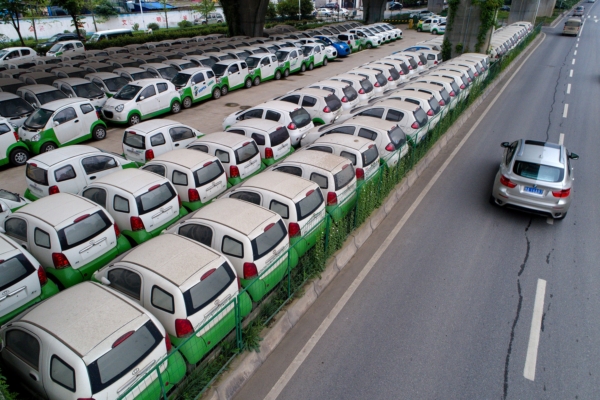
In 2026, young people in mainland China are rushing to scoop up the inventory of bankrupt car companies at around 39% off, triggering concerns. Some analysts believe that this seemingly opportunistic behavior actually hides risks.
As we enter 2026, with the wave of bankruptcies in the new energy car industry and year-end promotions overlapping, the topic of “39% off buying leftover cars” has become a hot topic among young people, resurfacing on the trending searches on January 13.
Since 2023, the Chinese new energy vehicle industry has accelerated into a reshuffling period, with many once active brands in the market like WM Motor, Dearcc, NEZHA, and CHJ Automotive becoming history overnight.
Statistics show that over the past five years, more than 400 new energy car companies have exited the market, leaving behind millions of “unclaimed inventory cars.” These “leftover cars” have seen significant price drops, attracting many young consumers.
At 30,000 yuan for a WM EX5, 80,000 yuan for a Dearcc L, 90,000 yuan for a CHJ 01… the tempting prices have presented a “treasure hunting” opportunity for millennials and post-millennials with limited budgets.
The debate over the balance between cost-effectiveness and hidden risks is heating up. While some may have grabbed a “bargain,” they face high risks as the factories cease production and after-sales services close down, with potential issues shadowing their every move.
Recently, the inventory of new or nearly new cars from bankrupt companies is generally being sold at 30-40% of their original price:
– Dearcc L top version: original price 149,900 yuan → 77,000 yuan (including subsidies)
– CHJ HiPhi Y: starting price 339,000 yuan → can be purchased for 120,000 yuan
– CHJ 07 Long-Range version: original price 219,900 yuan → sold for 150,000 yuan
A post by the blogger “Hotspot Decoding Office” analyzed the costs behind the “deep discount” prices:
– Collapse of after-sales system – parts unavailable: Special parts (such as laser radar, custom bumpers) have a waiting period of over half a year, leading to soaring maintenance costs (e.g., battery module replacement costing 60,000 yuan).
– Technical reliance: Lack of factory technical support, leading to permanent malfunction of some functions (e.g., WM cars losing connection to the on-board computer).
– Lack of insurance and legal protection: Insurance companies refuse to provide commercial insurance, forcing owners to only purchase compulsory insurance, self-bearing the risk of accidents. After the car company goes bankrupt, lifetime quality warranty promises are invalidated, and seeking rights becomes nearly impossible (consumer association mediation success rate is extremely low).
The article also points out that reselling these vehicles is difficult, with second-hand prices plummeting close to the value of scrap metal, and a higher risk involved in long-distance travel, often limiting use to short commutes.
On social media platforms, many owners of “leftover cars” express frustration with comments like, “Selling it won’t make much money, buying another brand will cost tens of thousands more. If we don’t sell, we don’t know when the car will suddenly break down, catching us off guard.”
Data shows that by the end of November 2025, the inventory of passenger cars in China had reached 3.79 million vehicles, which is 590,000 more than the same period last year, marking a new high in two years.