
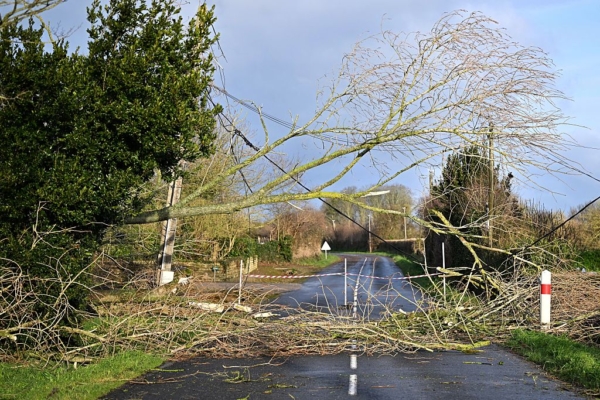
As the first named storm of the year “Goretti” swept through Northern Europe, France and the UK were hit by strong winds and heavy snow on Friday, causing power outages for hundreds of thousands of households.
In France, the national power company Enedis reported that around 380,000 households were without electricity, mainly concentrated in the regions of Normandy and Brittany.
On Thursday night, winds exceeding 150 kilometers per hour (93 miles per hour) were recorded in the Manche region of Normandy, with the town of Barfleur experiencing gusts up to 213 kilometers per hour. The French national railway company SNCF has suspended train services between Paris and Normandy.
In the UK, the National Grid company stated that after a week of severe cold weather, storm Goretti brought more snow, resulting in power outages for 57,000 households.
In Scotland and central parts of England, which were heavily impacted by storm Goretti, hundreds of schools are expected to remain closed.
Rail operators in central England have warned passengers to avoid travel, with some train services being suspended.
“Goretti” is the first named storm of the year, bringing a “weather bomb” phenomenon. This weather event, also known as a “bomb cyclone,” has the potential to bring powerful winds and snow capable of breaking trees and causing structural damage.
Before the arrival of storm Goretti, the UK Met Office issued rare red weather warnings for Cornwall, Scilly Isles, and Jersey, signaling a threat to life.
Although the warning has been lifted, millions of Britons remain under amber and yellow weather alerts.
The Met Office mentioned that this process is similar to a figure skater tucking their arms in to accelerate the spin.
Sky News meteorologist Jo Robinson explained that a weather bomb results from the intensification of a storm.
Robinson elaborated that when the central pressure of a storm drops by 24 hectopascals or more within 24 hours, this weather phenomenon occurs.
For storm Goretti, “the storm’s central pressure may have rapidly dropped by nearly 40 hectopascals within the 24-hour period from Thursday midnight to Friday midnight,” which could lead to peak winds in just a few hours, causing significant destruction.
Furthermore, the UK Health and Safety Executive extended the yellow cold weather warnings across regions until January 12, indicating a severe health risk, particularly for individuals aged 65 and above and those with existing health conditions.
In the Netherlands, adverse weather conditions began to ease on Thursday, with Amsterdam’s Schiphol Airport experiencing temporary power outages on Thursday despite several hundred flights being canceled over the previous work week.
In the southeastern countries of the Balkan Peninsula in Europe, widespread transport disruptions continue due to severe weather.
Serbia faced transport paralysis due to heavy snow, while Slovenia temperatures plummeted to minus 25 degrees Celsius (minus 13 degrees Fahrenheit).
Bosnia, Kosovo, and Montenegro experienced river flooding caused by heavy rain and snow, forcing dozens of families to evacuate.