
On December 27, 2025, Mr. Xiao and his wife, residents of the Bushwick neighborhood in Brooklyn, who own a two-family house, recently welcomed their first child. Their parents stayed in their second property to help with childcare, but they also occasionally rented it out to short-term tenants.
They recently spent $20,000 to repair the basement damaged by a hurricane, which added to the financial burden of a young family busy with paying off student loans, childcare, and basic living expenses. Xiao, a young father studying dentistry, wrote in a written testimony to the city council that for them, home sharing is not just a business, but a lifeline.
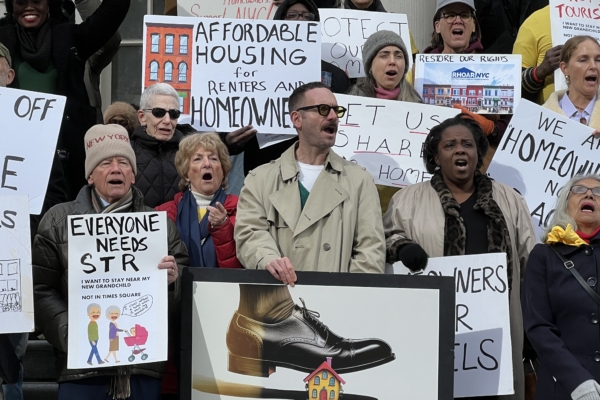
Xiao, like hundreds of small property owners in New York City, gathered in the city council chambers on November 20 to speak about their personal experiences in support of a proposal to protect the interests of small property owners – Intro.948-A.
The legislation was prompted by a severe housing shortage in New York City. Supporters of the LL18 law argued that the city should prioritize housing over renting out rooms.
According to a city report, New York City is currently facing a housing crisis with a vacancy rate of only 1.4%, the lowest in over 50 years. Short-term rentals may contribute to the housing crisis and potentially drive up housing prices and rents. Mayor Adams stated in a statement, “Illegal short-term rental operators harm our hotel industry and make it harder for New Yorkers to find affordable housing. We must hold them accountable.”
However, two years after the implementation of LL18, aside from a 90% decrease in Airbnb listings, none of the expected changes have occurred. Rent has not decreased, housing availability has not increased, and hotel prices continue to rise, leading to growing complaints from small property owners. They believe that LL18 failed to target large corporations and instead penalized small property owners who rely on short-term rentals to make a living.
One Asian American woman named Joanna Vu shared that when her daughter was born, their relatives came to help with childcare but had nowhere to stay. “My neighbors have a two-bedroom apartment available, and they were willing to help— but under Law 18, they can only legally host my two relatives,” she said. “A Manhattan hotel room with two beds can accommodate four adults, while a spacious two-bedroom apartment can only accommodate two people.”
Small property owners argue that their properties were not originally intended for rent, so they believe the housing crisis in New York cannot be solely blamed on them. However, LL18 treats them the same as large rental companies, infringing on their private property rights.
In the city council’s Housing Committee meeting on November 20, a proposal known as 948-A, drafted by the New York Homeowners Alliance (NYHOA) CEO Tony Lindsay and introduced by Council Member Mercedes Narcisse, was discussed. Representatives from various districts, community organizations, and government agencies spoke at the hearing to express their support or opposition to the proposal.
The content of the 948-A proposal specifies that it only applies to one and two-family homes, expands the limit on renting to four people, and allows homeowners to rent out their property when they are not present, such as during vacations.
Council Member Narcisse stated that her proposal aims to protect the homes of vulnerable working-class families. “Some of my constituents, such as home health aides, certified nursing assistants, and licensed practical nurses, sometimes have to work three or four jobs, and now they could lose their homes. They need this lifeline. That’s why I’m here,” Narcisse said during the hearing. She added, “This legislation is straightforward – it allows responsible homeowners to legally and safely earn extra income without violating any laws.”
Lindsay mentioned that 948-A “restores the right of private property owners to use their homes according to the 100-year-old laws of New York State.”
“It is a balanced, caring, and community-building approach,” said Chinese homeowner Xiao. “We want to continue living here, raising our children, but to do that, we need stability. So I fully support Proposal 948 and urge the City Council to vote in favor.”
Support for the proposal came from Brooklyn Borough, including Borough President Antonio Reynoso and numerous community organizations. Sydone Thompson, the district manager for Brooklyn’s 16th Community District representing 100,000 residents, testified that the legislation allows small property owners to responsibly share their homes to generate additional income to support mortgages and home maintenance, safeguard intergenerational wealth, stimulate local business development, and protect housing integrity.
While there were 50 strong voices in favor of Proposal 948-A during the hearing, there were another 50 voices in fierce opposition. Representatives from the Hotel Trades Council and tenant organizations expressed concerns that short-term rentals would exacerbate the housing shortage crisis, drive up rents, and threaten hotel jobs and community safety.
One resident from southeast Queens, Narissa Morris, testified that 948-A would bring serious hazards to the community. “Our concern is that allowing up to four guests plus children to stay in the absence of the homeowner means more strangers frequenting our neighborhood, putting additional pressure on local law enforcement,” Morris said.
Unlike the Brooklyn Borough President, Manhattan Borough President Mark Levine and Queens Borough President Donovan Richards both declared their opposition to the proposal.
Following the hearing, the City Council’s Housing Committee did not vote on Proposal 948-A as scheduled but instead shelved it. Lindsay, the drafter of the proposal from NYHOA, stated on December 3 that the biggest obstacle to the proposal was the spread of a large amount of “lies” and “false information.”
Lindsay provided several examples of misinformation. The first false claim was that “948-A will eliminate thousands of rental units and increase rents.”
“If short-term rentals in private homes are the cause of the housing crisis in New York, then the LL18 law should have at least made some measurable improvements in long-term rental supply, right?” Lindsay said. “But that’s not the case. We have seen the opposite: reduced supply, rising rents, over 50,000 rent-regulated housing units still vacant, and over 7,300 vacant apartments owned by the New York City Housing Authority (NYCHA).”
The second false claim was that “the proposal will encourage speculators to purchase homes and turn them into Airbnb rentals.”
Lindsay clarified, “Speculators have been legally prohibited; only natural persons who reside in their primary residence can legally short-term rent; limited liability companies and out-of-town homeowners are still barred from short-term rentals; and 948-A does not change any of these requirements.”
The third false claim was that “948-A is unsafe and poses a fire hazard.” Lindsay stated that 948-A does not change any safety standards or fire regulations.
“948-A only applies to owners residing in the home, who are not required to be stuck in the house 24/7 like prison guards,” he said. “They simply allow temporary access to their own homes with a key or a code, which fundamentally distinguishes this internal responsibility from hotels or commercial short-term rentals.”
Therefore, Lindsay concluded that the shelving of the 948 proposal by the council was “due to political reasons,” not due to flaws in the policy itself.
As the year draws to a close, a new City Council Speaker will soon be elected, and New York City will have a new mayor, both powerful political figures who may oppose the 948-A proposal.
On December 18, the City Council’s Housing Committee did not vote on 948-A.
“Because council members are too afraid of the Hotel Trades Council,” Lindsay told reporters on December 18. “I’ve heard that the incoming speaker, Julie Menin, is using her influence to try to dissuade support for this proposal because she supports the hotel union.”
Nevertheless, Lindsay vowed not to give up his efforts. Just as he led the small property owners struggling to keep their homes on the steps of City Hall on November 20, chanting, “Our homes are our rights!”
Finally, Lindsay pledged that if the City Council does not vote on the proposal, they will file a federal lawsuit.