
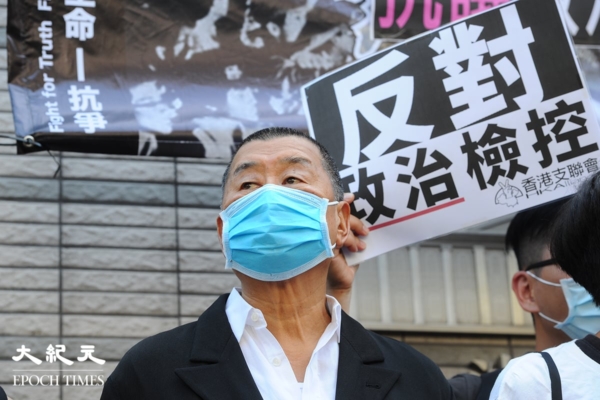
Hong Kong media mogul Jimmy Lai, founder of Next Digital, was convicted this morning (15th) at the West Kowloon Magistrates’ Courts on two counts of “conspiracy to collude with foreign forces” and one count of “conspiracy to publish seditious publication”.
After the court ruling, Jimmy Lai’s wife and children, along with retired Bishop Joseph Ha Chi-shing of the Catholic Diocese of Hong Kong, left the court together. Lai’s wife did not respond to reporters’ questions, including whether they plan to appeal.
Jimmy Lai and three related companies of Apple Daily were charged with one count of “conspiracy to publish seditious publication” and one count of “conspiracy to collude with foreign or external forces to endanger national security”. Lai faced an additional charge of “conspiracy to collude with foreign forces”.
Eight other defendants in the same case had previously pleaded guilty to “conspiracy to collude with foreign forces”, including six former senior executives of Apple Daily, one of the “12 Hong Kongers” Li Yu-hin, and lawyer’s assistant Chan Tsz-wah. They have been in custody for over 4 years, awaiting sentencing after the conclusion of this case.
The court stated that all defendants will make pleas together, rescheduled to January 12 next year for oral submissions, with a 4-day buffer, and instructed that written submissions must be submitted before 4 p.m. on January 2 next year. The sentencing date is yet to be determined.
Three designated judges under the National Security Law characterized Jimmy Lai’s testimony as “inconsistent and unreliable”, refusing to admit his self-defense testimony.
Regarding the charge of “conspiracy to publish seditious publication”, the court ruled that the articles in question objectively had “incitement”, and found that Jimmy Lai deliberately used Apple Daily and his personal influence to continue activities that “undermine the legitimacy or authority of the Central Government, Hong Kong SAR Government and its institutions; and harm the relationship between the Central Government and the Hong Kong SAR Government with the residents of Hong Kong”.
The court also ruled that the previously guilty defendants acknowledged Jimmy Lai, were aware of his activities, and were willing to participate in them.
Regarding the charge of “conspiracy to collude with foreign or external forces to endanger national security” faced by Jimmy Lai and associated companies of Apple Daily, the court observed from Lai’s articles, Twitter posts, and live chat programs that Lai continued to express his “anti-China” stance and engage in activities such as lobbying for foreign sanctions after the implementation of the Hong Kong National Security Law, albeit in a more indirect and subtle strategy, toning down the aggressive rhetoric.
The court determined that Jimmy Lai’s activities requesting foreign sanctions on Hong Kong before the enactment of the National Security Law did not cease after its implementation, with the only adjustment being in form rather than substance, even though Lai was aware of the risks involved.
In the case of the charge of “conspiracy to collude with foreign forces” solely faced by Jimmy Lai, the judgment cited prosecution evidence stating that Lai, along with Chan Tsz-wah, Mark Simon, Li Yu-hin, and Roy Tseng, agreed to request foreign sanctions, block or take other “hostile actions” against the Hong Kong SAR or China, using “Stand with Hong Kong Fight for Freedom” (SWHK) as a platform.
The court ruled that Jimmy Lai and Chan Tsz-wah had an agreement to conduct “international lobbying” and intentionally incorporate the request for sanctions against China and the Hong Kong SAR into their activities. Evidence in the case showed that on the eve of the enactment of the National Security Law, Lai continued to arrange for personnel to lobby the international community for sanctions against China and the Hong Kong SAR, with others continuing to implement relevant agreements according to Lai’s instructions to unite the three fronts, and was determined that these agreements persisted even after the law came into effect.