
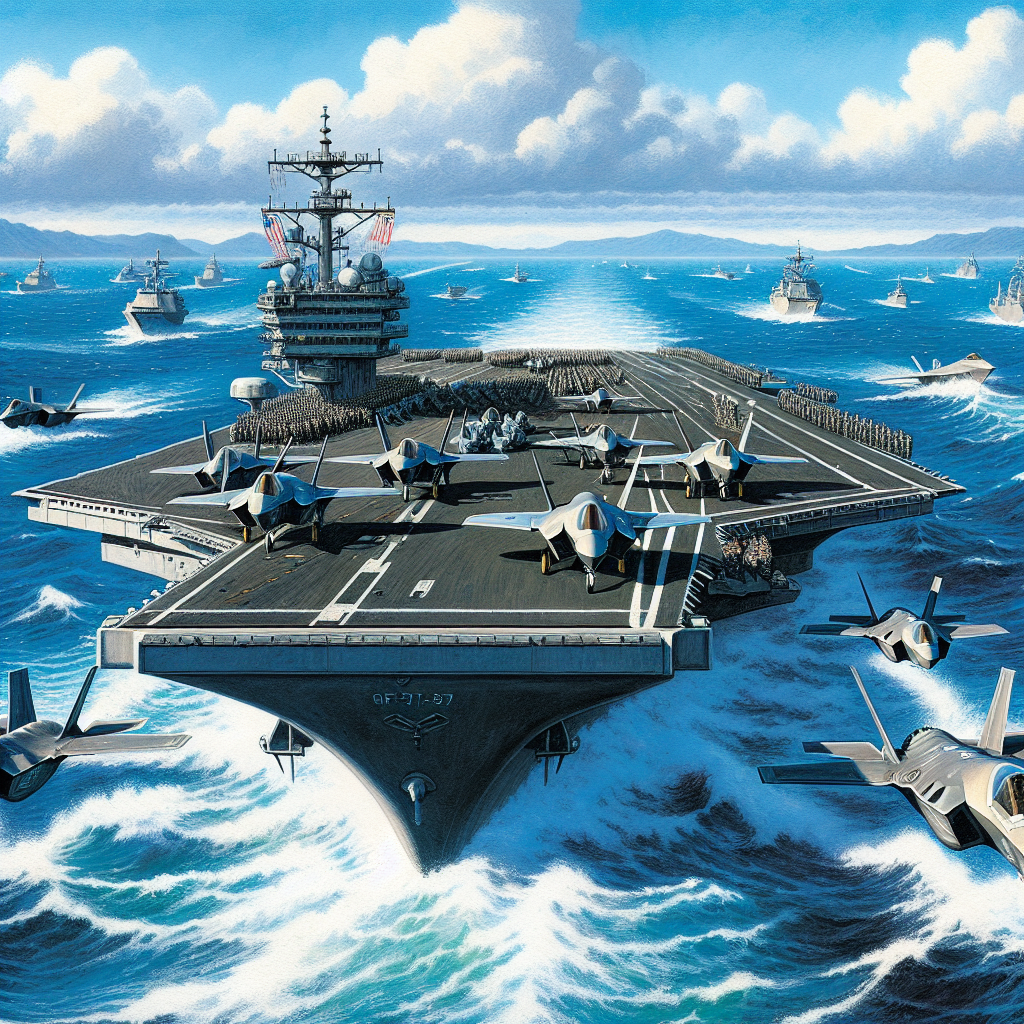
Recently released photos show that the navies of the United States, NATO, and Indo-Pacific allies conducted aircraft carrier exercises in the Western Pacific, showcasing the capabilities of carrier-based F-35 stealth fighters right under the nose of the Chinese Communist regime.
As part of the exercises, F-35B fighters from the US and UK navies took part in flight exercises from the Japanese Kaga-class aircraft carrier. Currently, this light aircraft carrier has not been equipped with F-35B fighters.
In June of this year, the Chinese navy sent two aircraft carriers to cruise in the Western Pacific, with one each deployed near Japan, Taiwan, and the Philippines, while also increasing maritime surveillance near the disputed Diaoyu Islands. This move has spurred Japan to enhance cooperation with its security treaty partner, the United States.
The F-35 comes in three variants, currently in operation in several countries worldwide, including Japan and the UK. The F-35B is designed for short takeoff and vertical landing on ships lacking full-length flight decks, while the F-35C is specifically designed for carrier-based operations.
Photos released by the British carrier strike group last Saturday showed the first F-35B fighter landing on the Kaga aircraft carrier. The Kaga was previously a helicopter carrier, technically classified as a destroyer, but completed its carrier conversion in April to become capable of launching and retrieving F-35B fighters.
The carrier modifications include a deck coated with heat-resistant materials to withstand the thrust of F-35B’s vectored engine, as well as night operational lighting and a redesigned flight deck, converting the bow from a trapezoid to a rectangular shape.
Apart from the Kaga, other participants in the multinational naval exercise included the US aircraft carrier USS George Washington, the amphibious assault ship USS America, and the British aircraft carrier HMS Prince of Wales on an eight-month mission.
Both the USS America and HMS Prince of Wales are equipped with F-35B fighters, while the USS George Washington is outfitted with F-35C fighters.
Another photo released by the British carrier strike group last Sunday depicted a group of carrier-based aircraft flying over a fleet of ships in the northern Philippine Sea. In addition to the four carriers capable of carrying F-35s, at least eight warships participated in the exercise.
The Japan Maritime Self-Defense Force confirmed the flight operations on Tuesday, stating that the training enhanced coordination with allied and partner navies. The first batch of F-35B fighters designed for Japan’s carrier operations were delivered on August 7.
The successful conversion of the Kaga paves the way for another Japanese helicopter carrier, the Izumo, to be refitted as an aircraft carrier. Once both the Kaga and Izumo receive full certification for jet fighter operations, Japan will possess naval capabilities unprecedented since World War II.
The US and Japan are increasingly engaging in close military cooperation to counter China’s hostile actions in the East China Sea and South China Sea. For Japan, having the ability to deploy its own or US F-35B fighters on converted light aircraft carriers could be highly effective in deterring potential Chinese aggression, especially amid heightened tensions in the Indo-Pacific.
Japan’s light aircraft carriers will pose another significant challenge to China, with the superiority of the F-35B fighters bolstering the Japanese navy’s capabilities. Additionally, Japan’s enhanced military cooperation with countries like the US has Chinese authorities uneasy.
Following the exercises, HMS Prince of Wales and two ships, including a British destroyer and a Norwegian frigate, arrived at the Japan Maritime Self-Defense Force’s Yokosuka Naval Base on Tuesday. Photos shared by local photographers show multiple F-35B fighters parked on the flight deck.
The visit to the port, as stated by the Japanese Ministry of Defense, underscores the commitment of the UK and Norway to maintaining peace and stability, aiming to achieve a “free and open Indo-Pacific” in light of increasing uncertainties in Japan’s security environment.
In the recent Defense White Paper, Japan described China as “the greatest strategic challenge ever,” noting China’s expanding military presence in the Western Pacific.
According to the Japan Times, HMS Prince of Wales is scheduled to conduct a six-day visit to Japan starting from August 28.
On Friday, the Japanese Ministry of Defense stated in a press release, “The Ministry of Defense and the Self-Defense Force will continue to cooperate with like-minded countries such as the UK and Norway, sharing common fundamental values and strategic interests, actively uphold and strengthen the free and open Indo-Pacific region, and address global security challenges to contribute to regional peace and stability.”
Furthermore, on Wednesday, the Ministry of Defense announced that the Japan Maritime Self-Defense Force escort ships have conducted “weapon and other protective measures” on the carrier strike group centered around the British aircraft carrier HMS Prince of Wales, utilizing security related laws for the first time in Japan, following similar actions taken with the US and Australia.
In a news release in April of this year, the British Royal Navy noted that from now until December, the HMS Prince of Wales carrier strike group will engage in a series of exercises and operations with the land, sea, and air forces of more than a dozen allies, including the Mediterranean, Middle East, Southeast Asia, Japan, and Australia.
It remains unclear if the US, UK, and Japan will conduct more F-35B fighter exercises following the visit of HMS Prince of Wales to Japan.