
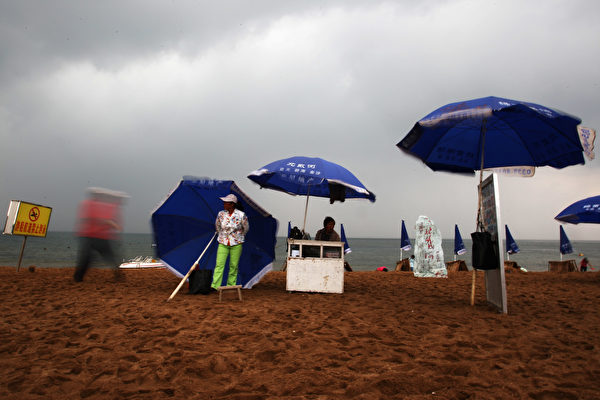
Recently, it has been observed that the Chinese Communist Party’s annual Beidaihe Conference usually takes place from the end of July to early August. On August 1st, the spokesperson of the Chinese Ministry of Foreign Affairs, Guo Jiakun, announced that the routine press conference would go on break during the summer recess. This move is widely seen as an indication that the Beidaihe Conference has begun. Despite the recent severe flooding in mainland China and the outbreak of the Chikungunya fever in Kenya, analysts believe that internal power struggles within the upper echelons of the Communist Party are not being hindered, and the political situation in China is tumultuous.
According to Guo Jiakun, the Chinese Ministry of Foreign Affairs will be on a break from August 4th (Monday) to August 15th (Friday) for the summer recess and will resume on August 18th (Monday).
Commentator Li Linyi told Dajiyuan that traditionally, when the press conferences of the Ministry of Foreign Affairs are on break, it signifies the time for the collective seclusion of the high-ranking members of the Communist Party at the Beidaihe Conference.
On August 1st, Chinese leader Xi Jinping did not make any public appearances but exchanged congratulatory messages with the President of Nepal, Bidhya Devi Bhandari, regarding the 70th anniversary of diplomatic relations between China and Nepal. On the same day, Chinese Vice Premier Zhang Guoqing visited the flood-hit area of Xinglong County in Chengde City, Hebei Province.
In recent days, the Beijing-Tianjin-Hebei region has experienced historically rare extreme rainfall, with Xinglong County becoming one of the severely affected areas. Official reports stated that the flooding has caused 8 fatalities and left 18 people missing. However, local residents informed Dajiyuan that numerous individuals were swept away by floodwaters, leading to a devastating situation where the actual death toll may have exceeded a hundred. The flooding came suddenly, isolating several villages, disrupting communications, and delaying rescue efforts.
On August 1st, Chinese Vice Premier Liu Guozhong conducted a research on the prevention and control of the Chikungunya fever outbreak in Shunde, Foshan, Guangdong.
In early July 2025, a local outbreak of Chikungunya fever transmitted by Aedes mosquitoes occurred in Shunde, Foshan, Guangdong. According to the Guangdong Provincial Center for Disease Control and Prevention, 12 cities in Guangdong have reported cases of Chikungunya fever. As of July 29th, the number of Chikungunya fever cases in Shunde, Guangdong has exceeded 6,000.
The Chikungunya fever outbreak has now spread beyond Guangdong, affecting regions such as Macao, Beijing, and Hunan.
There have been no reports of activities by other members of the Political Bureau.
Commentator Li Linyi told Dajiyuan that the CCP is a gang-like cult known for its internal power struggles, and the current leadership group handpicked by Xi Jinping is far from being solid. The Beidaihe Conference this year will be a critical turning point in the escalated infighting within the upper echelons of the CCP, where neither the floods nor the mosquitoes will hinder the internal power struggles of the party.
Though the Beidaihe Conference is “symbolic” in nature, it has long served as a significant platform for the senior members of the CCP to engage in battles and compromises over internal ideological disagreements and is regarded as a barometer of the political trends within the Party.
Multiple sources and interviewees informed Dajiyuan last month that security measures along the route from Beijing to Beidaihe, a small coastal town in Hebei province, had been escalated in late June. There has been an increase in guard posts along the route, and multiple inspections have been implemented at stations and on trains. Recently, dissidents and activists, whether in Beijing or visiting Beidaihe, have faced strict controls, and there have been reports of dissidents going missing or being detained in secret black prisons across the country.
On July 30th, a meeting of the Politburo of the Chinese Communist Party announced that the 20th Fourth Plenary Session of the Party would be held in Beijing in October this year to discuss the “15th Five-Year Plan.”
The previously postponed Fourth Plenary Session of the CCP, which was originally scheduled for last autumn, has been speculated to be delayed due to intensifying power struggles within the Party. Since 2023, two successive Ministers of National Defense, Li Shangfu and Wei Fenghe, have stepped down. In November of last year, Miao Hua, a member of the Central Military Commission and Director of the Political Work Department of the Commission, stepped down, and Vice Chairman of the Military Commission, He Weidong, has been missing since the Two Sessions earlier this year.
Keizo Naka, a senior contributor for Nikkei Asia, wrote on January 16th of this year that as this year would largely determine the next leadership lineup of the CCP, potential political storms within the party are likely to erupt.
Lately, there have been various rumors circulating about the control of the Party by the senior leaders of the CCP, the potential disruptions during the Fourth Plenum, and even multiple versions of successors to Xi Jinping being rumored. A recent online leak included a new list of members of the Politburo Standing Committee, which consisted of 9 members. It suggested that Xi Jinping would step down as General Secretary but continue to hold the positions of President and Chairman of the Military Commission.
There are also online claims that the senior leaders of the CCP have authorized Zhang Youxia to form a “Special Action Team” to prevent counterattacks from Xi Jinping by unconventional means.
In response to the continuous speculations in foreign media about challenges to Xi Jinping’s power, The Wall Street Journal reported on July 30th that senior members of the party may be gearing up to challenge Xi Jinping. While there is currently no concrete evidence, these rumors reflect a growing opacity in the political landscape of Zhongnanhai under Xi Jinping’s rule.
The report further highlighted that although the true instigators behind these rumors are yet to be verified, Xi Jinping’s ongoing purges of political enemies have undoubtedly angered many individuals. With the Chinese economy facing serious challenges, including a real estate crisis and soaring youth unemployment rates, many people are hopeful for change.