
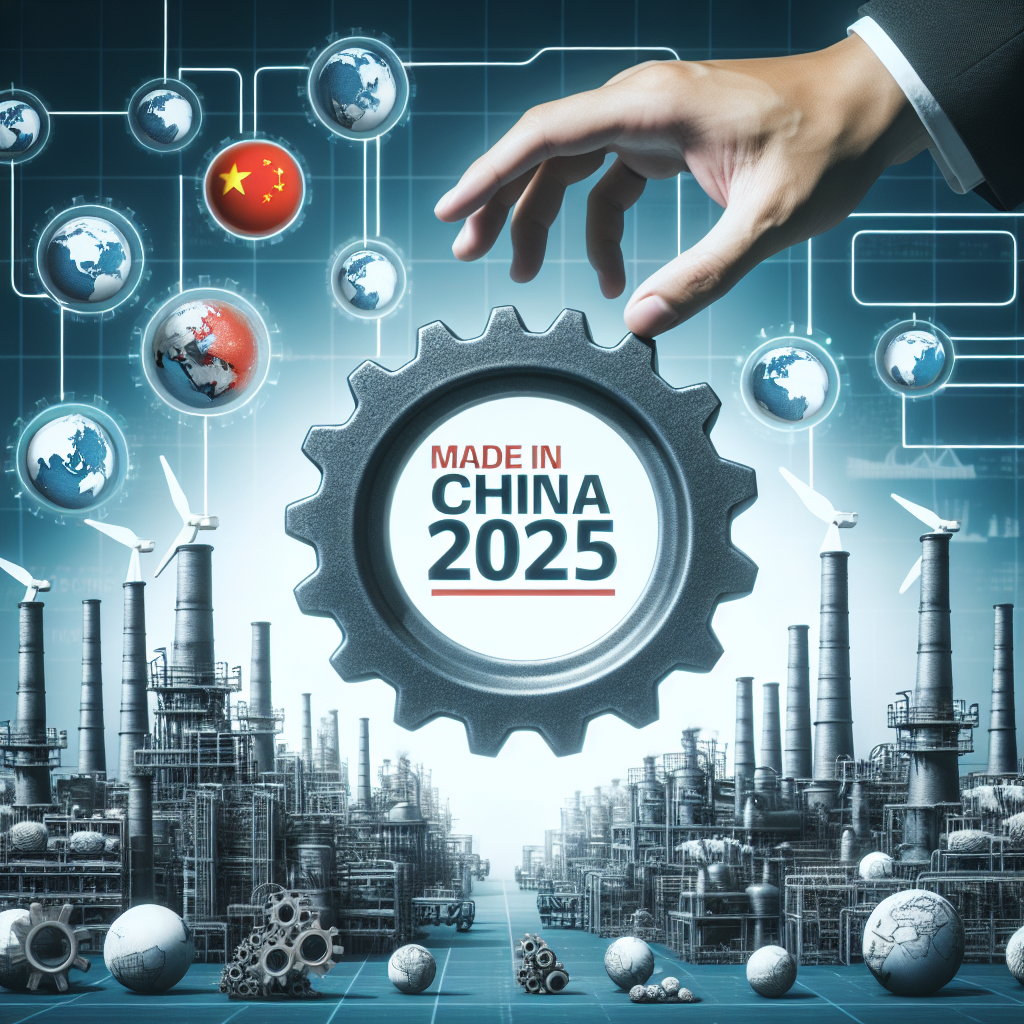
The European Union Chamber of Commerce in China (EUCCC) released a report on Wednesday (April 16) directly pointing out that China’s state-led “Made in China 2025” strategy, while promoting industrial upgrading, also distorts market mechanisms through excessive state intervention, squeezing out foreign investment opportunities, and intensifying global trade tensions. The report stated that this policy is one of the key root causes of the escalating global economic and trade confrontations.
The report, titled “China Manufacturing 2025: Putting Industrial Policy Ahead of Market Forces,” highlights that since the launch of the “Made in China 2025” strategy in 2015, the Chinese Communist Party has been propping up the monopoly position of domestic enterprises through subsidies, mandatory technology transfers, local protectionism, and discriminatory procurement practices, systematically excluding foreign investment. These non-market operations violate the principle of fair competition and continue to erode international companies’ confidence in the Chinese market.
While this policy has propelled China to become a global leader in high-tech fields such as solar energy, high-speed rail, and lithium batteries, its highly top-down policy orientation and centralized national resource allocation model have raised concerns among other countries about China’s overcapacity and low-price dumping practices, further escalating trade frictions with major economies in Europe and America.
In strategic industries such as new energy vehicles, semiconductors, and industrial robots, the Chinese government not only provides substantial subsidies to domestic enterprises but also imposes conditions of “technology transfer in exchange for market access” on foreign companies, forcing European companies to transfer key technologies to enter the Chinese market. The report criticizes such practices for violating the basic principles of the World Trade Organization (WTO) and jeopardizing the stability of global supply chains.
Furthermore, in sectors like medical equipment and telecommunications, the Chinese government directly excludes foreign companies from government procurement processes, leading to a significant shrinkage in their market share in China. Meanwhile, Chinese enterprises supported by the Chinese government aggressively occupy the European market through unfair competition, taking advantage of unequal advantages.
In addition to market barriers, China also acquires European companies with technological advantages through state-owned investment funds, internalizing advanced technologies, and gradually squeezing out existing brands and supply chain systems, further narrowing the space for survival of foreign enterprises. Such strategic operations have prompted a reevaluation of China’s investment openness policy within the European Union.
Jens Eskelund, Chairman of the European Union Chamber of Commerce in China, stated in a public speech prior to the report’s release: “The current situation indicates that China must rethink its way of interacting with the world. Industrial policies need to change.”
He admitted that the “Made in China 2025” plan has indeed made China the world’s sole manufacturing powerhouse but has also attracted increasingly strong backlash from the international community, leading to a continuous escalation of global trade tensions.
Eskelund added that some Chinese officials have realized the current model is unsustainable, especially amidst a combination of domestic demand deficiencies and external pressures. Beijing has prioritized expanding domestic demand as the primary economic task for 2025, attempting to adjust the economic structure overly reliant on exports.
The report highlights that while there are still disagreements within the EU on how to interact with China, some members advocate for a more pragmatic approach to maintaining cooperation, with the precondition that China must show a genuine willingness to open its market.
Amid the escalating pressures of the new round of US tariffs and geopolitical tensions, the European Union Chamber of Commerce in China explicitly warns that if Beijing does not promptly adjust its industrial policies, it may face the risk of accelerating detachment from the global market.
The report recommends that China revert to a market-oriented reform and opening-up path, abandoning the highly centralized and state-led industrial policies, and creating a competitive environment where both Chinese and foreign enterprises can fairly compete.
Lastly, the report emphasizes that if China continues to push exclusionary policies under the guise of self-reliance, it will not only severely impact economic and trade cooperation between Europe and China but also undermine its own economic resilience and international reputation.
The European Union Chamber of Commerce in China (EUCCC) was established in 2000 as a non-profit organization representing European businesses in China. Currently, with over 1,700 members covering various industries, the EUCCC is dedicated to promoting a fair and transparent market environment. Through policy dialogues, research reports, and advocacy mechanisms, it has become an important bridge and policy advocacy platform in China-Europe economic and trade relations.
(Reference: Bloomberg)