
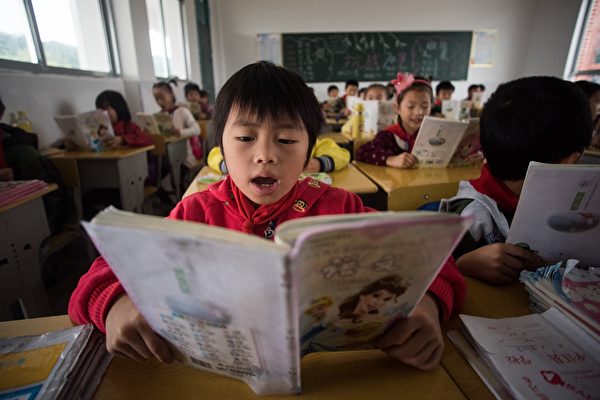
The Chinese Communist Party is implementing ideological brainwashing, with children becoming a key target. This year, they launched a set of “successor series of Communist books,” claimed to be specially tailored for young children, aimed at implementing the directives of the CCP leader, Xi Jinping. Analysts point out that this tactic by the CCP is ruthless but ultimately not sustainable.
According to an official report from the “China Youth Daily” on December 21, a symposium for the “successor series of Communist books” was held in Beijing on December 20. The series supposedly uses “children’s words” to explain “how to become a good successor of communism” and similar topics.
Xi Jinping, the CCP leader, has always emphasized starting political indoctrination from childhood, which has sparked condemnation from various quarters.
French media reports suggest that as the CCP promotes ideological education, even children are not spared. These so-called “politically enlightening reading materials tailored for young children” aim at cultivating talents who will support the CCP leadership through generations, starting the brainwashing process from an early age.
Commentator Li Linyi stated that communism is an ideology long bankrupt. The CCP merely dresses it up with various nonsensical elements, forcing people to learn, knowing well that it serves no real purpose except to cultivate obedience to the leadership since childhood. He believes that the Marxist “children’s words” in these so-called series books are a suppression of independent thinking in young children, representing a hidden political hijacking of families and individuals with a highly malicious approach.
However, Li Linyi believes that in recent years, many former “little pink” supporters have openly discussed how they escaped from the CCP’s brainwashing education and turned against it, proving that the CCP’s “start brainwashing from childhood” tactic is not effective in the long run. When faced with the truth, the effects of brainwashing will vanish into thin air.
In September of this year, as the new school year began, Xi Jinping published a signed article in the Party journal “Seeking Truth,” explicitly warning that CCP education must not produce “gravediggers of socialism.” This article was based on Xi Jinping’s speech at the National Education Conference on September 10, 2018, where he stated that CCP education aims to cultivate so-called “builders and successors of socialism” and must not produce individuals who “look Chinese but lack a Chinese heart, emotions, or essence.”
On overseas platforms, netizens are debating: “Only those without a conscience can take over.” “They are nurturing slaves.” “The scariest are those who appear Chinese but have a Soviet heart.” “Slave owners naturally do not want to cultivate slaves with dissenting thoughts. It’s a ‘one beats the other to death’ scenario.”
Gong Xiangsheng, Deputy Researcher at the Taiwan Institute for National Defense and Security Studies, previously told Epoch Times that since the so-called reform and opening up in China, the CCP has always feared Western ideologies entering the country, with Western countries hoping to help awaken the Chinese people after modernization, leading them to demand democracy and freedom, potentially overthrowing the CCP. “Xi Jinping is deeply afraid of a revolution within the CCP and has a high sense of insecurity about his position, hence continuing to bind the CCP and China together, and using ‘patriotic’ education to brainwash the next generation to be obedient.”
Chen Shimin, Associate Professor at the Department of Political Science at National Taiwan University, told Epoch Times that Xi Jinping’s statement originates from a growing number of people considering going abroad. Even if many elites do not emigrate, they seek ways to transfer their wealth overseas, ready to leave at the first sign of trouble. All of this is related to Xi Jinping’s increasingly autocratic rule, indicating a lack of confidence in the CCP’s governance.
Regarding Xi Jinping’s statement about not wanting to cultivate individuals who “look Chinese but lack a Chinese heart, emotions, or essence,” Chen Shimin said these Chinese people are not devoid of Chinese feelings, but they have seen through the CCP’s lies.
Qiu Jiajun, former Associate Professor of Political Science at Tongji University in Shanghai, pointed out to Radio Free Asia that recent events in China, such as the “blank paper movement,” demonstrate that despite the authorities’ reinforcement of ideological education, there is still a resistance force among the younger generation. He believes that in an era of highly liberalized information, the CCP cannot truly control the thoughts of young people, and the stricter they are on ideological control, the more likely they are to provoke strong public backlash.