
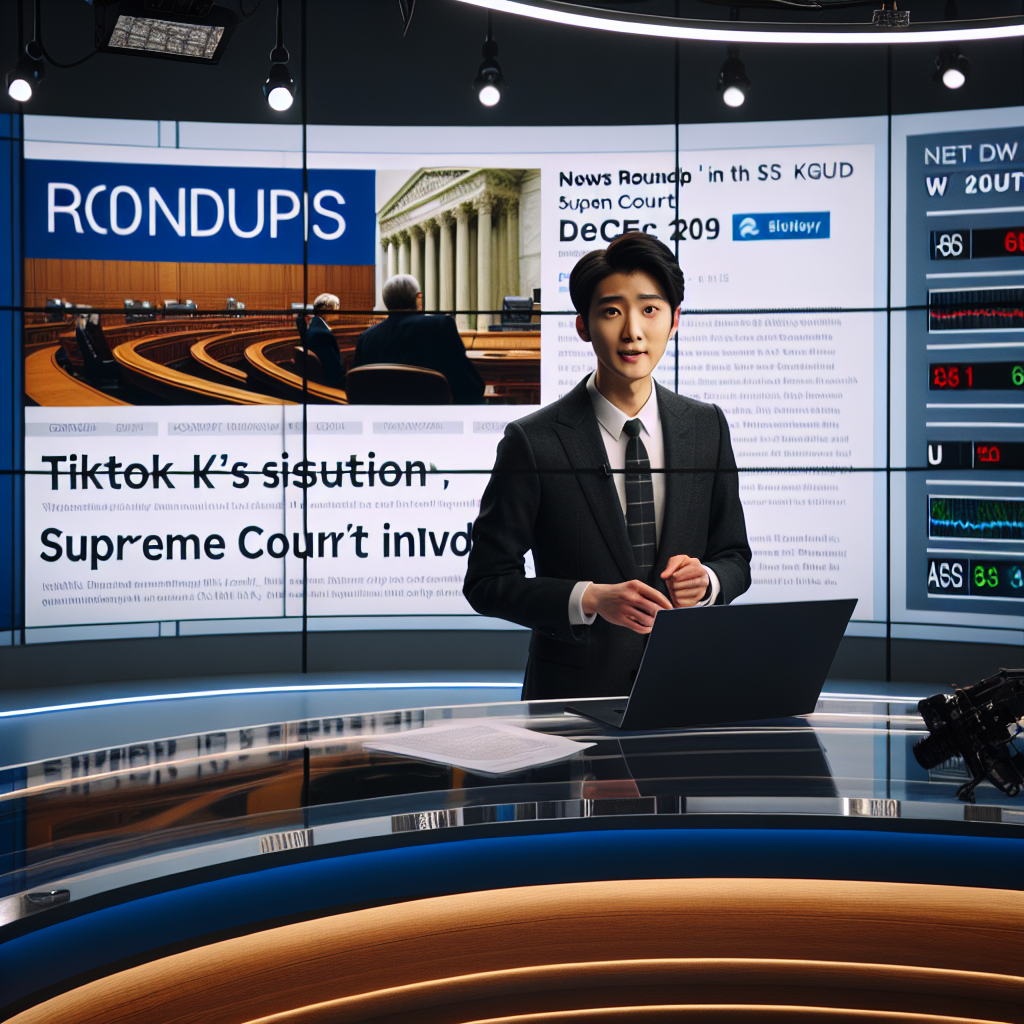
Hello everyone, welcome to “News Roundup”, I am Jinshi, today is December 20, Friday.
Today’s news focus is: The deadline approaching, TikTok makes its final move in the US, with the Supreme Court stepping in to make the final decision. The fate of Yoon Suk-yeol handed over to the Constitutional Court of South Korea, will the greatest diplomatic legacy be preserved?
Our guests for this episode are: Senior political commentator Mr. Tang Jingyuan; Senior political and economic analyst Mr. Qin Peng. Welcome to both of you.
According to a law signed by US President Biden in April this year, TikTok, a short video platform with 170 million users in the US, must separate from its Chinese parent company ByteDance, or face a complete ban on January 19, the last day of the Biden administration.
TikTok has stated that it will not separate from its parent company and hopes that the US courts will reject the ban.
Earlier this month, the US Court of Appeals for the District of Columbia Circuit upheld the government’s ban, prompting TikTok to appeal to the Supreme Court.
The Supreme Court decided this week to accept the case and will hear arguments on January 10.
Therefore, TikTok’s ultimate fate will be determined by the US Supreme Court. The focus of the Supreme Court’s ruling will be whether the ban on TikTok violates the free speech protection of the First Amendment of the US Constitution.
We know that the US Supreme Court is very selective in accepting cases. The Supreme Court receives around 7,000 case applications each year, but only about 100 of them are accepted. Cases that are accepted must be of significant importance.
And this time, the Supreme Court has adopted a expedited acceptance approach by scheduling the hearing just 9 days before the ban takes effect, and may quickly make a decision, which is rare for the Supreme Court itself.
1. Mr. Tang Jingyuan, how do you view the Supreme Court’s swift action, and why do you think they decided to accept the TikTok case quickly?
2. Mr. Qin Peng, TikTok and the US government have been at odds, with TikTok claiming that the ban violates free speech, while the US government emphasizes the ban’s ties to national security. With both parties having differing arguments, how do you think the Supreme Court justices will clarify their relationship?
The fate of TikTok may also be influenced by another key figure, the incoming US President: Trump. Trump’s recent attitude on this matter has drawn attention.
According to reports from multiple US media outlets, on December 16, Trump met with TikTok’s CEO Zhang Shuzi at Mar-a-Lago in Florida, and on the same day, during a press conference, he expressed his favorable view towards TikTok. Let’s see what he said at that time.
3. Mr. Tang Jingyuan, how do you view Trump’s attitude, do you think he will intervene to save TikTok?
Follow-up question: But if the Supreme Court also rules against TikTok’s appeal, and the ban goes into effect on January 19, does Trump still have the power to intervene, as this is a law passed by Congress and the President cannot overturn it?
This case also highlights the separation of powers in the US system, where banning a social media platform not only requires congressional support but also needs to pass through the Supreme Court. Even the President cannot interfere with the independent rulings of the Supreme Court.
On the other hand, what might be more familiar to the Chinese people is that with a command from the party leader, all institutions must comply without question.
4. Mr. Qin Peng, how do you see the differences in institutional systems between the US and China?
Recently, the world has also been paying attention to the ruling of another country’s Supreme Court: the Constitutional Court of South Korea on the impeachment case of President Yoon Suk-yeol.
Yoon Suk-yeol was impeached and suspended by the South Korean National Assembly last week due to the martial law incident. The Constitutional Court of South Korea will now have up to six months to review the impeachment. The conclusion will either be impeachment upheld, leading to Yoon Suk-yeol’s formal dismissal and new elections in Korea, or impeachment rejected, allowing him to resume his duties and continue governing.
In South Korea’s history, two presidents have been impeached, with each scenario happening once before, with Roh Moo-hyun retaining the presidency and Park Geun-hye being impeached and stepping down.
5. Mr. Tang Jingyuan, what do you think about Yoon Suk-yeol’s prospects? What will be the key factor in determining his fate?
Yoon Suk-yeol has been in office for over two years and has achieved little in domestic affairs due to opposition party obstacles. However, his diplomatic performance has been commendable.
Yoon Suk-yeol’s diplomatic achievements can be seen in three aspects:
1) A shift from appeasement to a tougher stance towards North Korea;
2) Resisting public pressure, adopting a pro-Japan policy to improve relations, leading to a trilateral alliance between the US, Japan, and South Korea;
3) Drifting away from China, reducing economic dependence, and fully aligning with the US.
These accomplishments align well with the strategic goals of the Biden administration in Northeast Asia, especially the US-Japan-South Korea alliance aimed at counterbalancing China, and without Yoon Suk-yeol’s contributions, this alliance would not have been possible.
Therefore, many believe that these diplomatic achievements will be the greatest legacy of the Yoon Suk-yeol government.
6. Mr. Tang Jingyuan, do you think this legacy might be jeopardized due to the martial law incident and impeachment of the President?
7. Mr. Qin Peng, Trump has threatened to withdraw nearly 30,000 US troops from South Korea unless South Korea pays more, combined with the possibility of a more pro-China president in South Korea, do you think the US-South Korea alliance could be damaged?
8. Mr. Tang Jingyuan, Mr. Qin Peng, finally, let’s discuss the democratic process of South Korea since its establishment after World War II, going through periods of dictatorship and military rule before achieving democratization in 1987. Why do you think the martial law incident has caused such a significant shock and backlash in South Korean society today, and as a free democratic country, what lessons can be learned from it?
Feel free to subscribe to the YouTube channels:
https://www.youtube.com/channel/UC_78IIcKAIDpp6SJOlf3vDA
https://www.ganjingworld.com/channel/1eiqjdnq7go5grer6fQLmhsYe1g60c