
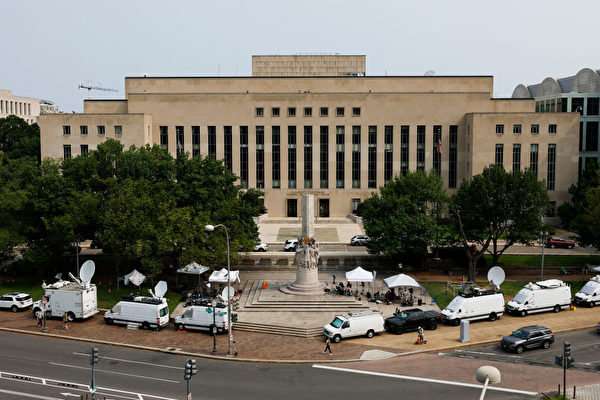
On Monday, federal judges expressed doubts about TikTok’s appeal against the US government. Three judges stated that they do not believe the law signed by President Biden in April, known as the TikTok “sell or ban” law, is unconstitutional.
The DC Circuit Court of Appeals began hearing the lawsuit filed by TikTok and its Chinese parent company against the US government. In the first two-hour debate on Monday, TikTok’s opposition to the impending law raised questions from the judges. However, it is still unclear how the judges will rule.
The lawsuit could potentially mean the end of the TikTok platform in the US, as the TikTok ban based on national security concerns is set to go into effect in January.
The three-judge panel of the Appeals Court began hearing the case on Monday. The judges, appointed by Presidents Obama, Trump, and Reagan, discussed historical and metaphorical precedents related to the case, trying to resolve how TikTok’s foreign ownership affects its constitutional rights under US law.
They mentioned analogies to terrorist propaganda and the possibility of war between the US and China. They also reviewed past cases where the US Postal Service was used to distribute communist propaganda. Recent Supreme Court rulings on online speech were also brought up during the court debate.
Judge Sri Srinivasan referenced two cases from the Supreme Court this summer, saying that if the law only targeted US companies, it would be a “major First Amendment concern.”
He added that this is not the case since it involves a Chinese company catering to foreign users, including 170 million Americans watching sports, fashion, and political videos through its algorithm.
Judge Srinivasan told the government’s representative, Daniel Tenny, “The curation happens overseas.”
Tenny responded to the court, saying, “Our core point is what they (TikTok, etc.) have conceded, that TikTok’s code is written in China.”
TikTok’s lawyers countered, saying that only a portion of TikTok’s code comes from China, and the vast content on TikTok is equivalent to TikTok’s own expression—which they argue would violate their free speech if the law passed in April is upheld.
In Monday’s debate, the focus was on TikTok’s algorithm and whether the Beijing government could manipulate it to spread chaos and misinformation to the unsuspecting American public.
If TikTok succeeds in the Appeals Court, it may block the legislation. However, if it fails, TikTok will need to find a new home before mid-January 2025, or face a complete ban in the US.
The debate on Monday, which was originally scheduled for one hour, turned into a lengthy tug-of-war between TikTok, content creators (commonly known as influencers), and the US government.
Judges Rao and Ginsburg appeared to strongly oppose TikTok’s arguments. Ginsburg dismissed TikTok’s broad claims regarding the law as “narrow-minded.”
He said the law is not intended to ban all foreign publications or platforms but specifically targets companies associated with (communist) China and other specific hostile countries.
Rao said, “Our circuit heavily implies control or relationships themselves are strong reasons for government action.”
However, TikTok and content creators argued that the US restriction on TikTok would still harm American users. Courts have historically protected Americans’ right to listen to foreign perspectives, even if it involves propaganda content.
TikTok’s attorney Andrew Pincus told the court, “Congress did not act as the First Amendment requires.”
He added, “In any event, the solution to foreign propaganda is disclosure, not a ban.”
The judges also asked the government’s lawyers about the practical impact of this law on ordinary Americans’ rights under the First Amendment, expressing concerns about the effects of this ban on “American speech.”
Tenny replied that the impact of the law on Americans’ First Amendment rights is unrelated to the law’s primary purpose, which focuses on curbing foreign influence on TikTok’s algorithm.
It is currently unclear when the Appeals Court will make a ruling on the case. The law requires ByteDance to sell TikTok by January 19, 2025, unless progress on the sale is deemed satisfactory, in which case an extension of 90 days can be granted.
Both TikTok and the Department of Justice have requested the Appeals Court to make a ruling by December 6.
The White House has previously expressed national security concerns and hopes to see the Chinese company divest its ownership of TikTok, but not to ban TikTok entirely.
Prior to Congress passing the TikTok ban, over thirty states had already implemented regulations prohibiting the use of TikTok.
Internationally, Canada, the UK, and the European Commission have banned the use of TikTok on government devices. The app has been completely banned nationwide in India since 2020.
This case will unfold in the last few weeks of the 2024 US presidential election. Both the Republican presidential candidate and former President Trump and his Democratic rival Vice President Harris are actively engaging on TikTok, trying to appeal to young voters.