
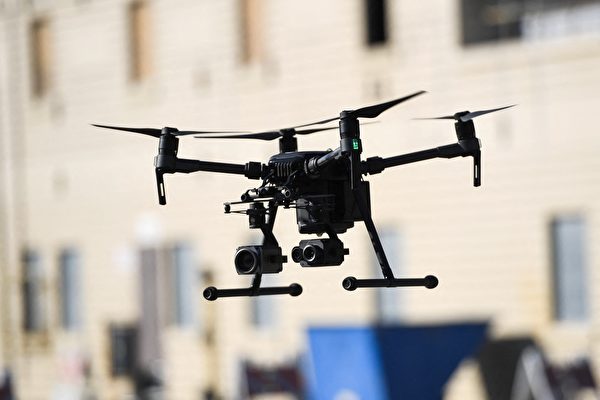
The Chinese authorities announced the adjustment of export control measures for drones starting from September 1st, including adding high-precision inertial measurement equipment to the control list and lifting the temporary control on certain consumer-grade drones for two years. Experts suggest this move might be a response to pressure from the West. The Chinese government has consistently denied providing dual-use military and civilian equipment to Russia for the invasion of Ukraine, but such actions have been continuously exposed by the media and intelligence agencies.
According to a joint announcement issued on July 31st by the Chinese Ministry of Commerce, General Administration of Customs, and the Equipment Development Department of the Central Military Commission, high-precision inertial measurement equipment has been added to the control list, and the two-year temporary control on specific consumer-grade drones has been lifted. In addition to drones and related equipment listed in the control list not being allowed for export without permission, all civilian drones not included in the control list are prohibited from being used for mass destruction weapon proliferation, terrorist activities, or military purposes.
The Chinese Ministry of Commerce also stated that it will adjust the control standards for some key components of drones, such as infrared imaging devices and lasers used for target designation.
Last July, amid escalating tensions between the US and China over drone technology channels, China announced the implementation of export controls on certain drones and related equipment, including a two-year temporary export control on some consumer-grade drones, prohibiting the export of any civilian drones for military purposes.
Shu Xiaohuang, Deputy Researcher at the Institute of Chinese Politics and Military Affairs at the Taiwan Institute for National Defense and Security Studies, told Epoch Times that China’s control adjustment may be in response to increasing pressure from the West. The West is concerned about China’s drone exports supporting Russia’s military actions in Ukraine. China may also be worried about further US restrictions on Chinese drone exports, squeezing its drone export market, hence the decision to cooperate with Western intensified control measures.
DJI Technology Co., Ltd., a Chinese drone manufacturer, has come under scrutiny by the US government for alleged connections with the Chinese military. DJI has repeatedly stated its opposition to its products being used for military purposes and its inability to restrict or track who purchases its products in the market. DJI announced the suspension of all business activities in Russia and Ukraine in April 2022.
Su Ziyun, Director of the Institute for Strategy and Resources at the Taiwan Institute for National Defense and Security Studies, told Epoch Times that the US may temporarily delay sanctions on Chinese drones in order to gain time to make adjustments once other supply chains are in place. The Chinese Ministry of Commerce has also adjusted its export control policies in response, lifting the control on consumer drones. Consumer drones are mainly used for photography and have limited remote control distance and payload capacity.
However, regarding China’s announcement of lifting the two-year temporary control on specific consumer-grade drones, Shu Xiaohuang pointed out that from the perspective of the Russia-Ukraine war, most consumer-grade drones that are capable of transmitting image data can be used for military operations.
“The so-called specific consumer-grade drones mentioned here may not be simple drones used for photography but might be slightly higher-end ones with the ability to provide positioning capabilities for images, enabling more precise guidance of rear weapon systems with drones.”
Several Western countries have repeatedly condemned China for providing dual-use equipment to Russia for the invasion of Ukraine. Multiple media outlets and US intelligence agencies have also exposed several related cases. China claims these reports are “false information.”
China has consistently stated that it does not directly supply weapons to the sides in the Russia-Ukraine conflict and strictly controls the export of dual-use products. However, the semi-official Guangdong-Russia Trade Promotion Association posted a notice on its WeChat public account last year titled “Notice of Foreign Companies Purchasing Drone Equipment.” The organization stated that buyers were looking for “detectors, jamming devices, drone detectors (product names BoriTone, AsselLabs, Bulat) or similar technical products, drone suppressors, communication band jammers, jammers.”
The Bulat drone detector was developed by a St. Petersburg-based company, 3mx. 3mx claimed that the product had been “long used by Russian frontline soldiers in Ukraine” and could “promptly detect and identify enemy drones.”
When contacted by the UK’s Financial Times, a staff member of the association stated that the announcement had errors, so they retracted it and clarified that Russian buyers were actually seeking “children’s toys.”
As reported by Japan’s Nikkei Asia, an investigation found that between December 2022 and April 2023, Russian companies imported at least 37 Chinese drones worth about $103,000. Moreover, the customs declaration for these drones clearly stated them as “specially for military operations.”
Bloomberg reported on July 2nd this year, citing sources, that China is manufacturing and testing lethal attack drones for Russia. These drones, based on Iran’s Shahed drone prototype, could be considered as lethal weapon assistance.
Shu Xiaohuang told Epoch Times that apart from drone exports, the West is also concerned that China’s drone technology could be provided to Russia or Iran. Since Iran is a major drone supplier to Russia, and Iranian-made drones launched attacks against Israel in April this year.
“Even if you are not directly providing drones, you might still install these Chinese-made components on Iranian-made or Russian domestically produced drones.”
Shu Xiaohuang stated that the West has many high-tech controls in place on Russia and Iran, but China remains a big loophole in the system. “So, I think China may still have many ways to bypass these controls, but at least in terms of the system, it needs to cooperate somewhat with the pressure from the West on these controls.”
Critics have long questioned: does China control drone exports targeting Ukraine while benefiting Russia?
According to a report released by the Kyiv School of Economics, based on research conducted on captured Russian weaponry on the battlefield, China’s share in critical component imports to Russia has significantly increased in recent years. In the fourth quarter of 2022, China accounted for 53% of deliveries as the supplying country, compared to 39% in 2021. As the country of origin, China accounted for 63%, up from 48% in 2021.
As the conflict in Ukraine continued to intensify last year, there were numerous reports suggesting that China’s strengthened export controls on drones made it increasingly challenging for Ukraine to purchase small drones crucial to the war, while Russia continued to import Chinese products and technology in large quantities. Politico.eu reported last year that by July 2023, Russia had imported drones worth over $100 million from China, which was 30 times more than Ukraine.
During the Shangri-La Dialogue in Singapore on June 2nd, Ukrainian President Zelensky made a rare statement, mentioning evidence found by Ukrainian intelligence agencies that Russian weapons contained Chinese components. Zelensky described Beijing’s support for Russia as “unfortunate.”