
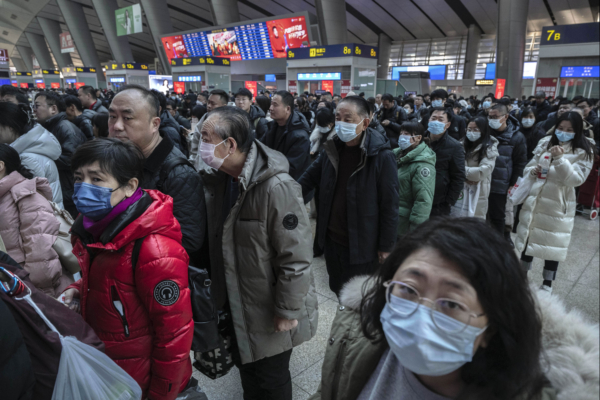
In recent years, “reverse Spring Festival migration” has been on the rise in China, and it has become even more prominent this year. Since January, the number of bookings for reverse flights has increased by approximately 84%, with a trend of passengers flowing from central and western cities to first-tier cities.
“Reverse Spring Festival migration” refers to young people no longer returning to their hometowns for the Lunar New Year but instead, having their parents travel to the cities where they reside, and then returning to the hometown after the New Year.
Mr. Ke, who works at a research institute in Beijing, told China National Radio, “My parents happen to be retired, so they are free and want to visit me. It’s quite easy to buy tickets for the reverse Spring Festival migration, unlike before when it was necessary to compete for tickets to go back home from Beijing.”
A netizen from Shanghai also shared with 21st Century Economic News that in the past, when going back to her hometown for the Spring Festival, she had to take a 4.5-hour high-speed train to Changsha and then a 2.5-hour car ride. With a young child and the cold winter weather, the journey was very exhausting. This year during the Spring Festival travel rush, the child’s grandparents took a high-speed train to Shanghai in reverse ahead of time; the tickets were easy to buy, there were fewer people, and they could experience the atmosphere of celebrating the New Year in Shanghai.
According to data from Meituan Travel, the booking volume of tickets for “reverse Spring Festival migration” has significantly increased this year. From early February to mid and late February, the number of bookings for reverse flights increased by 84% compared to the same period last year. The top 10 destinations include Beijing, Shanghai, Chengdu, Chongqing, Guangzhou, Shenzhen, Kunming, Xi’an, Hangzhou, and Tianjin. The passenger flow shows a trend of concentrated movement from central and western cities to first- and new-first-tier cities.
It is reported that the main reason for this phenomenon is that “reverse Spring Festival migration” not only offers sufficient ticket sources but also significantly reduces travel costs. For example, the round-trip ticket price for a flight from Lanzhou to Beijing from February 13 to February 22 is around 860 yuan, while the round-trip price from Beijing to Lanzhou during the same period is over 2400 yuan, nearly three times the price difference. A report on the “2025 Spring Festival Travel Trend” by Tongcheng Travel indicates that many consumers who travel in reverse during the Spring Festival can save up to 50% to 70% on airfare.
Additionally, during the Spring Festival rush, many train tickets to cities will be available at “bargain prices.” For example, the usual high-speed train ticket price from Shenyang North to Beijing Chaoyang is generally above 300 yuan, but during the Spring Festival rush, the ticket price for the G4404 train is as low as 76 yuan, equivalent to a 60% discount. The G4470 train from Puyang East to Beijing South offers a 60% discount in second class, costing only 68 yuan for the entire journey; the train from Shiyan to Beijing Fengtai in hard seat class is discounted by 60%, costing only 31.5 yuan.