
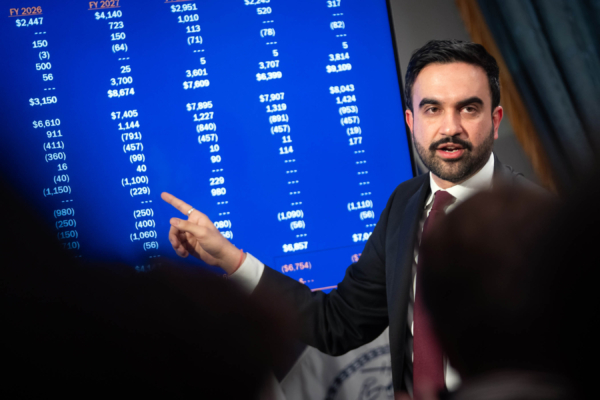
On Tuesday, February 17th, New York City Mayor Mamdani met with City Council Speaker Manning to announce a $127 billion new fiscal year budget plan. The mayor emphasized that faced with a significant financial deficit, he hopes to raise taxes on the wealthy through the O’Bannon plan. Otherwise, he will have no choice but to increase property taxes on New York City residents. Both the governor and the City Council expressed opposition to raising property taxes on that day.
“To bridge the budget gap left by New York City, there are two paths to take. The first path, which is the most sustainable and fair, is to increase taxes on the wealthy and corporations, and to end fiscal spending by correcting the imbalance between tax payments to the state government and those made by the state government,” Mamdani said. “If we do not take the first path, the city government will be forced to take the second path, which poses even greater risks, namely raising property taxes and tapping into reserves – this will weaken our long-term financial base and shift the burden of solving this crisis onto the working and middle class of New York City. We do not want to take such drastic measures to balance the budget. But if there is no other choice, we will have to do so.”
The Mayor’s Office stated in a release that Mamdani discovered upon taking office that the city government’s basic service budgets, such as rental assistance, shelter operations, and special education, were severely underfunded, leading to a $12 billion funding gap identified in the November update of the “Financial Plan.” After deducting savings, adjusting $7.3 billion in revenue, and a $1.5 billion grant from the state government, New York City still faces a $5.4 billion two-year fiscal deficit.
Therefore, without authorization to increase taxes on the wealthy, the city government will be “forced to activate” its only available means: raising property taxes and tapping into reserves. The initial budget plan of $127 billion assumes a 9.5% increase in property taxes, generating an estimated $3.7 billion in revenue; in addition, it will also require tapping into an “emergency reserve fund” of $980 million for the fiscal year 2026, and a retirement fund of $229 million for 2027.
Governor Hochu, at a press conference on the same day, avoided discussing Mamdani’s request to tax the wealthy and also stated that she does not support raising property taxes.
“(The city government) must, by law, disclose the current budget situation,” the governor said. “I do not support raising property taxes, and I am not sure if it is necessary to do so.”
City Council Speaker Manning subsequently released a statement opposing the use of reserves and raising property taxes on New Yorkers.
“At a time when New Yorkers are already facing a housing affordability crisis, tapping into emergency reserves, and significantly raising property taxes should not be on the agenda,” Manning and City Council Finance Committee Chairman Linda Lee said in a joint statement. “The City Council believes that before increasing the burden on small landlords and community small businesses – which will exacerbate the housing affordability crisis, other areas where expenses can be cut and income increased deserve careful examination.”