
On Sunday, February 15th, at the conclusion of the Munich Security Conference (MSC), top military leaders from both the United Kingdom and Germany made a rare joint statement, urging the European public to accept the “moral necessity” of rearmament to address the increasingly severe military threats in the region.
In their joint declaration, the defense chiefs of both countries emphasized that in the face of the most unstable security situation since the Cold War, increasing defense spending is not aimed at provoking war but rather at ensuring peace.
Sir Richard Knighton, the Chief of the Defence Staff of the United Kingdom, and Carsten Breuer, the Inspector General of the Bundeswehr in Germany, co-authored an article published in the media on Sunday, pointing out that Russia’s military posture has significantly shifted westward and is learning and restructuring from the Russia-Ukraine conflict, greatly increasing the risk of conflict with NATO countries.
The two military leaders wrote, “This effort has a moral dimension. Rearmament is not warmongering; it is a responsible action taken by nations determined to protect their people and uphold peace. Strength deters aggression while weakness invites invasion.”
To implement defense transformation, countries have begun taking concrete actions. NATO leaders have pledged to increase defense and security spending to 5% of GDP by 2035. The UK is currently planning to build at least six ammunition factories to establish “always on” production capacity.
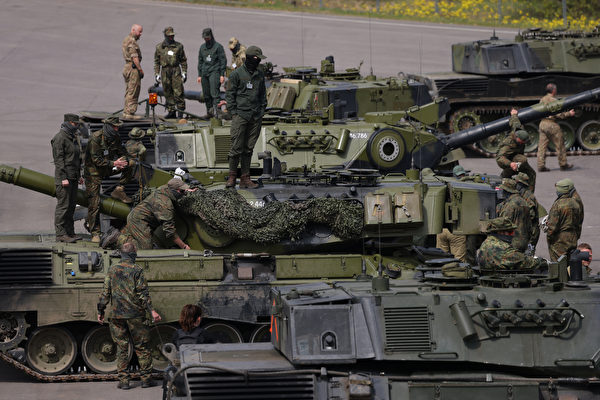
Germany is preparing to permanently deploy a combat brigade on its eastern flank and has amended its constitution to remove restrictions on defense funding. In addition, a procurement plan for thousands of armored vehicles has been launched, along with the expansion of related industrial capacity.
The article also mentioned that the European Union’s Security Action for Europe (SAFE) will inject €150 billion (approximately $178 billion) to strengthen Europe’s defense industrial base.
The two military leaders emphasized, “History tells us that when adversaries perceive disunity and weakness, deterrence fails. If Russia perceives Europe in this way, it may be emboldened to expand aggression beyond Ukraine.”
In response, they stressed that modern defense cannot rely solely on the military but requires “whole-of-society” participation.
“Defense cannot be borne only by those in uniform; it is the responsibility of each one of us,” the two military leaders urged, calling for governments to engage in open dialogue with the public to help them understand that resilience of infrastructure, high-tech research and development in the private sector, and functional national institutions despite numerous threats are all part of safeguarding Europe’s common responsibility.
During the Munich conference, UK Prime Minister Keir Starmer also called for closer defense ties with Europe, covering procurement and manufacturing, to place the UK at the core of a stronger European defense framework.
He stated that Europe is a “sleeping giant” that has been overly fragmented in its industrial and procurement programs in the past, and there is an urgent need to establish tighter defense connections at this stage.