
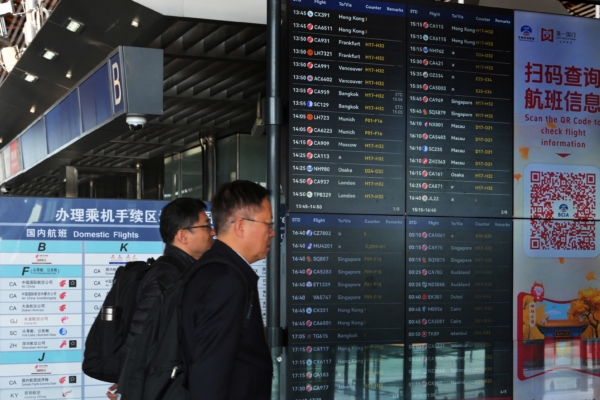
Beijing Capital International Airport, which had long been the busiest airport in China, is now facing massive losses, with a deficit of 11.5 billion yuan (RMB) over the past 6 years. Analysts attribute the huge losses at the Capital Airport to decisions made by the Chinese Communist Party leader Xi Jinping.
Several Chinese media outlets recently reported that Beijing Capital Airport announced its performance forecast for 2025, expecting a net loss of 6.0 to 7.6 billion yuan.
According to “Wings of Civil Aviation,” a Chinese self-media outlet focused on civil aviation industry, the Capital Airport has incurred net losses as follows: 20.35 billion yuan in 2020, 21.17 billion yuan in 2021, 35.27 billion yuan in 2022, 16.97 billion yuan in 2023, 13.90 billion yuan in 2024, and approximately 7 billion yuan in 2025. The airport has been experiencing substantial losses for 6 consecutive years, totaling 115 billion yuan.
Reports from a major brokerage firm indicate that the pre-tax losses at Beijing Capital Airport in the fourth quarter of 2025 ranged from 170 to 250 million yuan, with an increased loss margin compared to the previous year. This suggests that the company’s operational pressure intensified in that quarter, as effective cost control and revenue growth measures were not able to mitigate the losses. The expanded scale of losses throughout the year reflects the severe challenges faced by the industry and the company’s operations.
Beijing Capital Airport used to be one of the busiest international aviation hubs in mainland China, with passenger traffic ranking first. In 2019, it reached 100 million passengers, topping the list in China. However, since 2020, it has been gradually declining.
The core reason for the Capital Airport’s losses lies in the diversion of traffic to the Beijing Daxing Airport. Furthermore, with non-aviation revenue, especially duty-free income, difficult to reach previous levels, along with high fixed costs, the Capital Airport has been in a long-term state of financial imbalance.
The diversion of traffic to the Daxing Airport has been a contentious issue impacting the Capital Airport’s operations. The Daxing Airport serves as Beijing’s second major international airport, coexisting with the Capital Airport as Beijing’s dual international hub airport.
The direct loss of passenger traffic to the Capital Airport due to the opening of the Daxing Airport in 2019 has prompted questions from netizens, holding the decision-makers accountable for the losses incurred.
The Daxing Airport was initiated under Xi Jinping’s leadership, with its construction approved in September 2014 and officially commencing on December 26, 2014. Xi Jinping himself inspected the construction site in February 2017 and attended the airport’s opening ceremony in September 2019, on the occasion of the 70th anniversary of the founding of the People’s Republic of China.
The decline of the Capital Airport is closely tied to Xi Jinping’s “dynamic zero-COVID” policy, which significantly impacted the airport. The enforcement of stringent zero-COVID policies in Beijing, as the political center of the Chinese Communist Party, has led to a drastic decrease in passenger traffic at the Capital Airport.
Furthermore, the Capital Airport Group, directly managed by the Civil Aviation Administration of China, has faced high levels of bureaucracy, with several high-ranking officials implicated in corruption scandals. The managerial inefficiencies, high operational costs, and systemic corruption have contributed to the financial troubles faced by the Capital Airport.
Public records show that several former executives of the Capital Airport Group have been involved in corruption cases, including cases of graft and bribery, leading to severe penalties such as imprisonment and even the death penalty.
In the past, the Capital Airport led in China’s airport industry due to political support and favorable policies, rather than exceptional management capabilities. However, with the aviation industry suffering from the impact of the pandemic, the Capital Airport’s shortcomings have been exposed, complicated by the decline in the northern Chinese economy and the international disengagement from the West. The airport’s inability to reform and recover efficiently has further exacerbated its financial losses.